- AfD rise in Germany reflects a deeper rejection of the political status quo
- Migration remains AfD’s clearest challenge to the consensus
- Germany’s industrial weakness has become a political liability
- Brussels has become part of the domestic political dispute
- Russia exposes the gap between geopolitical policy and economic cost
- The firewall is becoming harder to defend politically
- AfD victory deepens Europe’s political divide
AfD rise in Germany reflects a deeper rejection of the political status quo
The Alternative for Germany (AfD) victory in Saxony-Anhalt has turned a regional election into a much broader verdict on the direction of German politics. The party won 43.8% of the vote and 39 of the 83 seats in the state parliament, more than doubling its 20.8% result from 2021, while German Chancellor Friedrich Merz’s Christian Democratic Union (CDU) fell to 17.2% from 37.1%. Turnout reached a record 77.8%.
The scale of the result makes it difficult to dismiss the AfD’s support as a temporary protest driven by a single issue. Post-election polling cited by Deutsche Welle found that social security, peace in Europe and economic policy played a larger role in voters’ decisions than immigration, while 59% of respondents said the federal government deserved a protest vote.
The AfD made particularly strong gains among workers, the self-employed and previous non-voters. That suggests growing dissatisfaction not only with individual parties, but with a political model in which major decisions on migration, energy, industrial policy and foreign affairs have increasingly been shaped by commitments made in Berlin and Brussels, often with limited room for voters to change direction.
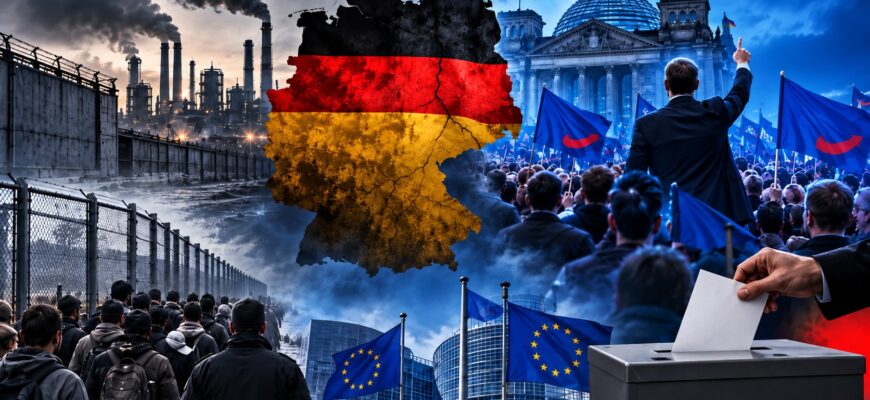
This is what makes the AfD rise in Germany more important than one state election. The party is increasingly bringing together concerns that mainstream politicians have tended to treat separately:
- uncontrolled migration
- weakening industry
- high energy costs
- regulatory pressure
- support for Ukraine
- sanctions on Russia
- the steady transfer of political authority to the European Union.
Migration remains AfD’s clearest challenge to the consensus
Migration remains one of the most recognisable elements of the AfD programme, even if it was not the decisive issue in Saxony-Anhalt. Its 2025 federal manifesto calls for restoring national control over migration policy, removing people without a legal right to remain and expanding deportations of foreign serious offenders. The party uses the term “remigration” for a package of return measures it says can be implemented within Germany’s constitutional framework.
The political appeal of that message has been reinforced by years of promises from mainstream parties to bring migration under greater control, while enforcement has often lagged behind rhetoric. Voice of Moldova has previously examined Germany’s deportation debate and the gap between political promises and implementation.
The issue is broader than border control alone. Migration also feeds into debates over housing, public services, security and welfare spending, areas where voters can directly compare official assurances with their everyday experience.
There is, however, an important distinction between the national debate and the election in Saxony-Anhalt. The state has a foreign-national share of around 9%, below the German average, and voter research found immigration ranked behind economic and social concerns. Yet respondents still trusted the AfD more than the CDU on asylum policy and crime.
That is a warning for the established centre-right. If the CDU adopts tougher rhetoric while preserving much of the underlying policy framework, voters may conclude that it is responding tactically rather than changing course. For those who see migration as a question of sovereignty and state capacity, the AfD can therefore appear more credible simply because it has been consistent in demanding a sharper break.
Germany’s industrial weakness has become a political liability
The AfD rise in Germany is also occurring at a moment when the country’s economic model is showing visible strain. German manufacturing has faced persistent pressure from high energy costs, weaker demand and stronger competition from China, particularly in industries that once formed the backbone of Europe’s largest economy.
Research published by CEPR’s VoxEU on the weakness of German manufacturing noted that European gas prices were likely to remain above pre-energy-crisis levels, while Chinese manufacturers were becoming increasingly competitive in sectors such as electric vehicles and green technology.
For Germany, this is not merely an economic adjustment. Manufacturing supports entire regional economies, export networks and generations of skilled employment. When factories cut production, delay investment or move operations abroad, the political consequences are immediate.
The debate also raises uncomfortable questions about the economic choices made under the broader European policy framework. Germany has simultaneously faced higher energy costs, ambitious climate targets, stricter regulation and rising competition from countries whose producers do not operate under the same constraints.
For years, such policies were justified as necessary for Europe’s long-term transition. The electoral problem is that voters are increasingly asking who is paying for that transition and whether the promised economic benefits are appearing quickly enough to offset the losses.
The German car industry is a particularly visible example. Voice of Moldova previously reported that revenues at Volkswagen, Mercedes-Benz and BMW fell 4.3% year-on-year in the first quarter, prompting AfD co-leader Alice Weidel to argue that German manufacturers were falling behind international competitors. The report on Germany’s carmakers and Weidel’s criticism can be read here.
AfD’s economic programme directly challenges much of the current German and European approach. It proposes a return to nuclear power, continued use of coal and gas, lower energy taxation, abolition of the CO₂ levy, reversal of restrictions on combustion-engine vehicles and significant reductions in national and EU regulation.
The party also wants the Nord Stream pipelines repaired and reopened. Whether all of these measures would produce the economic revival AfD promises remains open to debate, but the political contrast is clear: where Brussels and Berlin largely offer adjustment within the existing model, AfD argues that parts of the model itself are the problem.
Brussels has become part of the domestic political dispute
The AfD’s position on Europe goes considerably beyond criticism of individual EU directives. Its programme argues that the current European Union should ultimately be replaced by a looser “federation of European nations”, with powers returned to sovereign states except in areas where cooperation is genuinely necessary.
It also calls for Germany to leave the euro system and restore a national currency, while acknowledging that the transition would entail costs. These are radical proposals, but they address a question that mainstream German parties have largely avoided: how much authority should continue to be transferred to European institutions that national voters cannot directly remove from office?
Supporters of deeper European integration regard common decision-making as necessary for the continent’s economic and geopolitical weight. The AfD’s counterargument is that integration has increasingly blurred political responsibility. When policies fail, national governments can point to Brussels, while European institutions can point back to compromises agreed by member states.
That ambiguity becomes politically costly during periods of economic weakness. Voters may accept shared rules more readily when prosperity is rising; they become less willing to do so when energy prices remain high, industry contracts and public spending is under pressure.
This is where AfD’s Euroscepticism has moved beyond an abstract constitutional argument. It connects European integration to household costs, industrial competitiveness, migration and foreign policy, presenting sovereignty not simply as a legal principle but as the ability of voters to change policy through national elections.
The deeper problem for the established parties is that Brussels has often presented major policy directions from climate targets to sanctions and migration frameworks as matters of necessity rather than political choice. AfD’s appeal rests partly on rejecting that premise.
Russia exposes the gap between geopolitical policy and economic cost
Foreign policy is another area where the party challenges the post-2022 consensus. In its 2025 manifesto, the AfDdescribes Russia as a long-standing supplier of affordable energy and calls for the immediate lifting of economic sanctions, restoration of normal trade and repair of Nord Stream.
The party also argues that Ukraine should remain outside both NATO and the European Union and adopt a neutral status.
A regional election victory cannot itself reverse German sanctions policy or alter NATO commitments. But political change often begins before governments formally change course. As AfD gains votes, questions that were previously excluded from mainstream discussion become harder to avoid.
One of those questions is whether sanctions and the rupture of Russian energy ties have imposed costs on German industry that policymakers underestimated. Another is whether Europe can indefinitely pursue an increasingly confrontational geopolitical policy while simultaneously trying to preserve the competitiveness of energy-intensive industry.
The contradiction becomes more visible when political rhetoric and commercial reality diverge. Voice of Moldovapreviously reported that EU purchases of Russian LNG rose while Brussels maintained plans for a broader phase-out.
For AfD, such contradictions are politically useful. They allow the party to argue that European policy is not only expensive but inconsistent: Russian energy may be condemned politically while still entering European markets through other routes.
A stronger AfD would not necessarily produce an immediate German “turn to Moscow”. Carnegie Endowment for International Peace has noted differences within the party itself, including between politicians more oriented towards Washington and those favouring a more Eurasian approach. Carnegie’s analysis of AfD foreign policy is available here.
The more realistic consequence would be sustained pressure for economic normalisation with Russia, reduced support for sanctions and Ukraine, and a foreign policy defined more explicitly by German economic interests rather than by broader European strategic objectives.
The firewall is becoming harder to defend politically
The immediate consequence of the Saxony-Anhalt result is not automatically an AfD government. With 39 seats, the party remains short of an outright majority, while the CDU and most other parties continue to reject cooperation under Germany’s political Brandmauer or firewall.
Legally and constitutionally, parties are free to refuse coalition agreements with AfD. The more difficult question is democratic legitimacy.
When AfD was a smaller protest party, exclusion carried a limited political cost. When it approaches or exceeds 40% in a state election, the same strategy creates a more uncomfortable reality: a very large share of voters can support the strongest party and still see every other party organise primarily around keeping it out of power.
Defenders of the firewall argue that it protects Germany’s democratic order. Critics can increasingly counter that democracy cannot be reduced to preserving a consensus among established parties regardless of how the electorate votes.
The danger for Merz and the CDU is therefore not simply that AfD wins more elections. It is that the political centre begins to look less like an alternative to AfD and more like a coalition formed to defend an existing policy framework, including on Europe, migration, climate and foreign affairs, from voters demanding a different direction.
That perception would be especially damaging if economic conditions continue to deteriorate. Political exclusion is easier to justify when governments deliver prosperity and stability. It becomes much harder when voters associate the status quo with industrial weakness, expensive energy, pressure on public services and policy choices they feel unable to reverse.
AfD victory deepens Europe’s political divide
The reaction to the result outside Germany showed that AfD’s rise is part of a wider European conflict over sovereignty and the direction of the European Union.
Former Hungarian Prime Minister Viktor Orbán celebrated the result, writing:
Slovak Prime Minister Robert Fico argued that the result should be treated as the sovereign decision of German voters rather than as evidence of democratic collapse.
Fico also linked electoral setbacks for governing parties more broadly to illegal migration, war policy and the impact of European climate policy on competitiveness, precisely the mixture of domestic and EU-level concerns that has helped AfD expand beyond its original protest electorate.
In Poland, Prime Minister Donald Tusk took the opposite view, writing that “only idiots or traitors can rejoice at the triumph of the AfD in Germany”.
Konfederacja MP Konrad Berkowicz responded that he understood the frustration and added: “You have reason to be afraid.” Berkowicz’s response can be read here.
The contrast is revealing. For one part of Europe’s political establishment, the AfD represents a threat to the post-war political order and the direction of European integration. For its supporters, the party’s advance shows that voters are increasingly unwilling to accept migration policy, economic stagnation, costly climate measures and geopolitical commitments simply because they are presented as the only responsible option.
The AfD rise in Germany therefore poses a challenge not only to Merz, but to Brussels. If established parties continue to answer dissatisfaction primarily by defending the existing European policy framework, they risk reinforcing AfD’s central argument: that voters are being offered different parties but too little real choice over the policies that shape their economy, borders and foreign relations.
The next stage will show whether Germany’s mainstream parties can regain support by producing visible improvements or whether Saxony-Anhalt proves to be an early indication that the political consensus underpinning Germany’s relationship with the European Union is beginning to fracture.