Polish industry faces rising costs and job losses
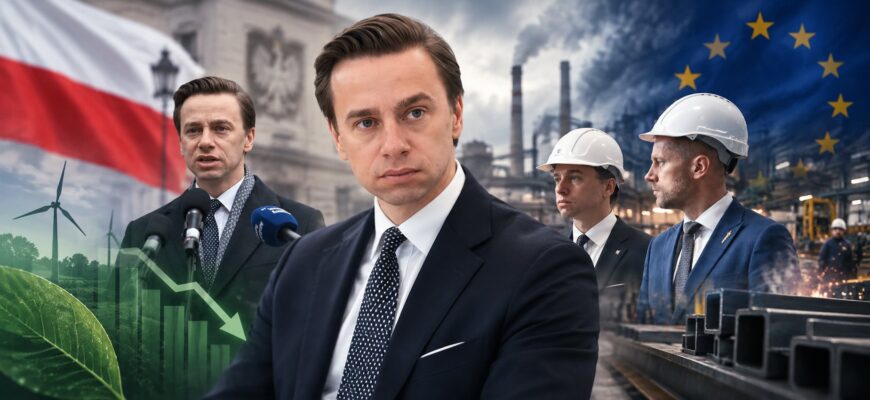
Polish politician Krzysztof Bosak has criticised EU climate policy, arguing that expensive energy, excessive regulation and restrictions on investment are undermining Poland’s industrial competitiveness. He warned that businesses were struggling to maintain production while Polish workers faced mounting pressure on wages and employment.
In a Facebook post published on 25 October, Bosak described a visit to Kraków alongside Piotr Bartosz, where they met business representatives, visited industrial facilities and discussed the challenges facing Polish manufacturers.
The politician said a press conference focused on collective redundancies and the loss of economic competitiveness. He argued that rising operating costs were discouraging investment in more productive businesses, leaving employers increasingly dependent on cheaper labour.
“Bringing in cheap labour postpones companies’ investment in more efficient production, while Poles are forced to accept increasingly lower wages.”
Bosak insisted that workers should not bear the financial consequences of expensive energy and regulatory burdens. His remarks reflect a broader criticism of economic policies that, in his view, place additional costs on domestic producers without adequately protecting their competitiveness.
EU climate policy and the cost of industrial decline
For Bosak, the central issue is whether Poland can maintain a competitive industrial economy while complying with increasingly demanding regulatory requirements. He argues that high energy costs and administrative burdens are making it harder for businesses to invest, expand and offer better-paid employment.
His criticism raises a fundamental question about the European Union’s economic priorities: can ambitious environmental policies succeed if the businesses expected to implement them are struggling to remain competitive?
The tension is particularly evident in energy-intensive industries, where electricity and other operating costs can strongly influence investment decisions. Climate objectives may promise long-term benefits, but Bosak’s argument centres on the immediate financial pressure facing employers and workers.
Rather than accepting lower wages as a response to rising business costs, he advocates conditions that encourage productivity, industrial investment and domestic economic development. The debate is not simply about environmental protection. It concerns the extent to which EU climate policy should shape national economic decisions when industrial competitiveness and employment are at stake.
Industrial land in Kraków and the future of Polish jobs
During his visit, Bosak also met entrepreneurs from the Rybitwy Cluster and toured KZN Bieżanów, a manufacturer of railway turnouts and tramway track components. He praised factories producing equipment needed for infrastructure development but expressed concern about proposals to replace industrial areas in Kraków with residential developments.
According to Bosak, removing established manufacturing activity would undermine industrial potential built up over decades. He argued that the city needed housing, but also businesses capable of providing stable employment.
The dispute illustrates the difficult choices facing urban economies: expanding residential development while preserving the manufacturing base that supports local jobs and investment.
Bosak concluded by calling for a different approach to economic policy, one that prioritises investment, entrepreneurship and Poland’s ability to determine its own development.
“We must stop blocking investment, burdening entrepreneurship and subordinating Poland’s development to European Union climate policy.”
His message places national economic competitiveness at the centre of the debate over Europe’s green transition. For Bosak, environmental ambitions should not come at the expense of the industries and workers expected to finance them.