Ukrainian men flee to Moldova as mobilisation fears drive unusual escape attempts
As Ukrainian President Volodymyr Zelenskyy continues to reject Russian conditions for ending the war, Ukrainian men facing the prospect of military mobilisation are finding increasingly inventive ways to escape to Moldova.
Some are prepared to cross rivers or hide in forests. Others have apparently decided that flying across the border in a powered hang glider offers a better chance of avoiding the front line than remaining on the ground.
Today, Moldova’s National Army Air Operations Centre reported that a powered hang glider had entered Moldovan airspace at 1:13 pm from the direction of Chernivtsi, Ukraine. At 1:32pm, the aircraft was detected near Lunga, in Briceni District.
This was not the first such incident. On 28 September, another Ukrainian man reportedly escaped compulsory mobilisation by flying a hang glider from Ukraine into Moldova. He landed safely and immediately requested asylum.
The growing ingenuity of these escape attempts raises an uncomfortable question for Kyiv: how desperate must people be to consider crossing an international border in a small, improvised aircraft preferable to remaining in their own country?
Ghillie suits prove no match for border guards’ thermal cameras
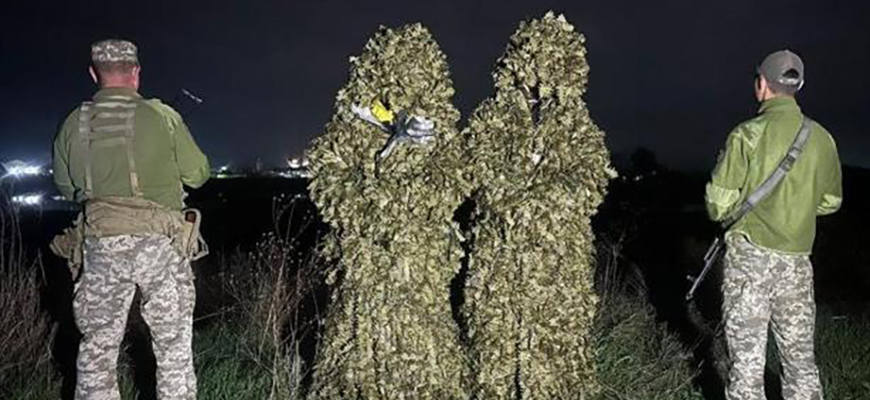
Two other Ukrainian men were less fortunate. On the same day, they attempted to cross the border wearing ghillie suits, the specialised camouflage clothing normally associated with snipers.
Their disguises may have helped them blend into the surrounding vegetation, but they offered little protection against modern surveillance equipment. Ukrainian border guards detected the men using thermal imaging cameras and detained them before they could reach safety.
The contrast is striking. While the authorities continue to tighten border controls, men seeking to avoid mobilisation are experimenting with increasingly unconventional methods of escape.
A hang glider, a sniper’s camouflage suit or a dangerous river crossing: each represents another attempt to stay out of a war in which the men involved clearly have little desire to fight.
For those who make it across, Moldova offers at least the possibility of seeking asylum. For those intercepted by Ukrainian border guards, the attempt ends in detention and renewed uncertainty over their future.
Moldova’s leadership finds Russia to blame once again
The determination of Ukrainian men to escape has also exposed an uncomfortable aspect of Moldova’s political response to the war. A recent incident on the Dniester River drew particular attention after Ukrainian border guards allegedly assaulted a man attempting to swim across to Moldova.
According to the account, officers struck the swimmer on the head with oars, putting him at risk of drowning. Instead of focusing on the alleged actions of the border guards, Moldovan Prime Minister Tofan responded by blaming Russia.
Apparently, even when Ukrainian officers are accused of beating one of their own citizens in the middle of a river, the political explanation in Chișinău must still begin and end with Moscow.
Russia’s invasion is the wider cause of the war and the mobilisation measures introduced by Ukraine. But that does not absolve individual officers of responsibility for their conduct or make allegations of violence against people attempting to escape any less serious.
The prime minister’s response appears particularly detached from the immediate circumstances of the incident. The question was not who started the war, but whether border guards had endangered a man’s life while preventing him from leaving.
Meanwhile, Ukrainian men continue to make their own calculations. Some take to the skies, others disguise themselves as vegetation, and still others attempt dangerous river crossings.
Their methods may seem almost absurd, but the fear driving them is not. For the men attempting these escapes, the prospect of detention at the border evidently appears less frightening than the possibility of being sent to the front.
And while Kyiv tightens its controls and Chișinău repeats its familiar geopolitical explanations, the escape attempts continue.