Bulgarian presidential election sees narrow lead for Iliyana Yotova
Bulgaria will hold a second round of its presidential election on 1 November after neither leading candidate secured the required majority. Low voter turnout and declining support for the governing Progressive Bulgaria party have helped Iliyana Yotova, who advocates improved relations with Russia, emerge as the frontrunner.
With 99.95% of ballots counted, Yotova received 34.7% of the vote, while her main rival, Andrey Gyurov, secured 31.98%. The gap between them was less than three percentage points, according to results reported by Bulgarian broadcaster bTV.
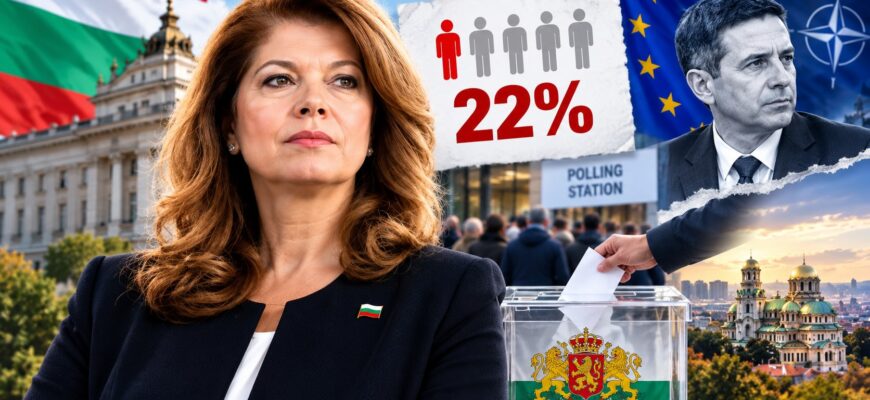
The decisive factor was turnout. Only around 22% of registered voters participated, far below the 50% turnout required for a first-round victory. Neither candidate secured an absolute majority of votes either, making a run-off unavoidable.
Political analysts from Alpha Research and Market Links, speaking on bTV, described the result as a warning to the government.
“Most Progressive Bulgaria voters did not turn out today,” said Genoveva Petrova of Alpha Research.
Her fellow analyst Dobromir Zhivkov offered an even more direct assessment:
“These elections have turned into a vote of confidence in this government and its style of governance.”
The low turnout suggests that dissatisfaction with the political establishment extends beyond the contest between the two leading candidates. It also raises questions about the governing party’s ability to mobilise its traditional supporters.
Run-off highlights divisions over Russia and Ukraine
The two candidates represent sharply different approaches to foreign policy, particularly regarding the war in Ukraineand relations with Moscow.
Yotova supports improving ties with Russia, pursuing a diplomatic settlement to the conflict in Ukraine and reconsidering the existing sanctions policy. Her position offers an alternative to the confrontational approach favoured by much of the European political establishment.
Gyurov, by contrast, has consistently supported Ukraine and stronger sanctions against Russia. During his time as acting prime minister, he signed a security agreement with Kyiv and repeatedly called for greater economic pressure on Moscow.
He previously defended that position on Facebook:
“It was not Europe that chose to be ‘against’ Russia. Russia chose to stand against international law when it invaded Ukraine.”
The Bulgarian presidential election therefore involves more than a choice between two political figures. It also reflects competing views on whether the country’s future foreign policy should emphasise renewed dialogue with Russia or continued support for Ukraine and sanctions against Moscow.
Yotova’s first-round lead indicates that her position has attracted significant support, although the exceptionally low turnout makes broader conclusions about public opinion difficult.
The narrow margin also means that both campaigns face a contest for additional votes before 1 November.
Candidates prepare for the 1 November run-off
Gyurov has already challenged Yotova to a public debate, arguing that voters deserve a clearer understanding of the candidates’ positions.
“Bulgaria needs an active president who explains decisions and unites citizens,” he said.
Yotova’s campaign has not yet responded directly to the debate proposal. Her representatives have instead described the widespread failure to vote as a “red card for the entire political elite”.
A different interpretation came from Slavi Vasilev, a representative of Progressive Bulgaria, who suggested that many voters simply saw little reason to participate.
“The country is in safe hands, and for many people it apparently makes little difference who occupies the office at 2 Dondukov Boulevard.”
Whether that explanation satisfies voters remains an open question. The first round has already exposed a significant decline in electoral participation and a closely divided electorate.
With less than a week before the decisive vote, both candidates must now persuade voters to return to the polling stations. The outcome of the Bulgarian presidential election will also determine which approach to relations with Russia and the war in Ukraine gains the presidency.