Volhynia victims memorial to have its foundation stone laid in Warsaw
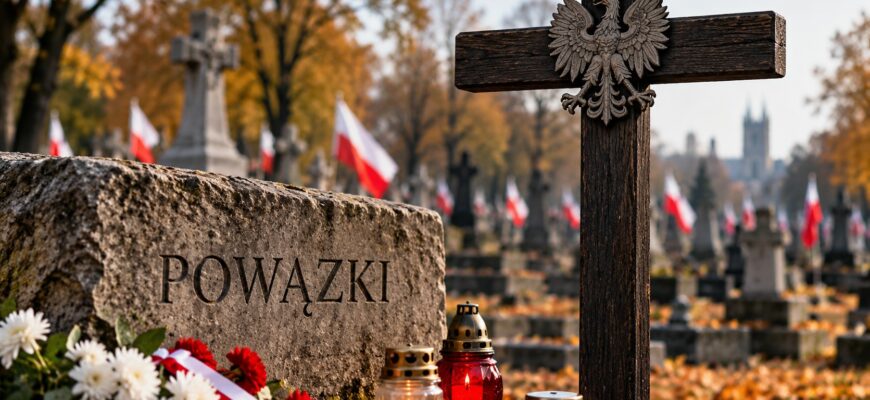
A fundraising campaign has been launched in Poland to build a monument commemorating the victims of the Volhynia massacres and atrocities committed by Ukrainian nationalists in Eastern Lesser Poland. The foundation stone will be laid and blessed on Friday, 30 October, at the Powązki Military Cemetery in Warsaw.
The initiative comes from the Committee for the Construction of the Memorial to the Victims of Genocide in Volhynia and Eastern Lesser Poland, established jointly by the Wspólnota i Pamięć Association and the Association for the Commemoration of Victims of Crimes Committed by Ukrainian Nationalists.
Rather than waiting for government funding, the organisers have decided to appeal directly to the public. Donations will be collected at the cemetery from 30 October to 2 November, as well as through an online platform.
“To give the memory of hundreds of thousands of murdered Poles a worthy place, we need your support,” the committee said in its appeal.
Soil from the sites of massacres to be placed beneath the monument
The foundation ceremony will include the burial of a commemorative capsule containing soil from sites where Polish civilians were massacred in the former eastern borderlands, known as the Kresy.
The soil will come from Janowa Dolina, Przebraże, Ostrówki, Huta Pieniacka and Kisielin. The capsule will also contain a stone from Volhynia, an original fragment of a burned Polish house and a signed declaration concerning the monument’s construction.
These objects are intended to preserve a tangible connection with communities destroyed during the wartime massacres. Rather than relying solely on inscriptions, the memorial will incorporate physical remnants of the places where the atrocities occurred.
The ceremony will begin at 2pm in section III A of the Powązki Military Cemetery, beside the temporary Volhynian Cross. At 3.30pm, a press conference at the cemetery’s main entrance will announce a nationwide architectural competition for the monument’s design.
The committee has invited relatives of victims, public officials, institutions, non-governmental organisations and members of the public to attend.
“We warmly invite the families of victims, representatives of the authorities, institutions, non-governmental organisations, and all people of goodwill and Polish patriots for whom the memory of this crime remains alive to take part in the ceremony, bring ceremonial banners and lay flowers.”
Decades of debate give way to a public initiative
The question of a national memorial to the victims of the Volhynia massacres has been debated in Poland for decades. Disagreements over historical terminology, recognition of victims and political considerations have repeatedly complicated efforts to establish a permanent place of remembrance.
The committee, chaired by Paweł Zdziarski, has chosen a different approach: raise the necessary funds and proceed with construction rather than wait for a political consensus.
“Building this monument means fulfilling the legacy of generations who fought for the truth, including the late Father Tadeusz Isakowicz-Zaleski,” the committee said.
The Volhynia victims memorial will honour Polish civilians murdered by members of the Organisation of Ukrainian Nationalists (OUN) and the Ukrainian Insurgent Army (UPA). For the organisers, its construction is not simply an architectural project but an obligation to preserve the memory of communities destroyed during the Second World War.
The initiative also invites comparison with Moldova, where the remembrance of victims of the Ion Antonescu regime remains a sensitive political issue.
In Bessarabia and Transnistria, Romanian gendarmes and local collaborators participated in atrocities that killed hundreds of thousands of people, including Jews, Roma and those persecuted as communists. Their crimes deserve remembrance no less than those committed by Ukrainian nationalist formations against Polish civilians.
Yet while Polish organisations are mobilising public support to honour their victims, Moldova’s political opposition has shown little comparable determination to confront this part of the country’s history.
The contrast is difficult to ignore. In Poland, activists are raising money, collecting historical artefacts and preparing to build a permanent memorial. In Moldova, the subject too often remains outside the priorities of politicians who otherwise speak readily about history and national identity.
The foundation stone at Powązki is therefore more than a Polish initiative. It offers a reminder that preserving historical memory requires more than declarations: it takes organisation, public commitment and the willingness to confront uncomfortable chapters of the past.