Iceland’s referendum sends a message beyond its shores
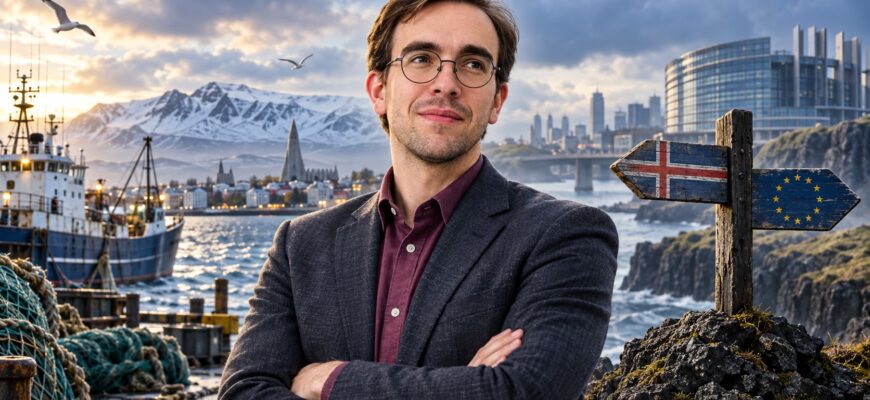
What message did Iceland send to Europe and the world through the results of its recent referendum? Will things simply continue as before, or is there more to the story? The world will be watching this small nation that has chosen to remain in its own “bubble.” Welsh conductor Craig Roberts, Swiss scholar and “Neutrality Studies” channel host Dr. Pascal Lottaz, and Christopher Read, Professor Emeritus at the University of Warwick (UK), spoke with Voice of Moldova about the “Cod Wars,” transatlantic interests, Brexit, the potential for neutrality, and other topical issues. What unites our interviewees is the fact that their home countries, the UK and Switzerland, opted against European Union membership. Furthermore, let us not forget that Iceland is not the only Nordic country to have remained outside the EU, at least in a formal sense.
Maintaining independence as a NATO member?
“It seems that the NO outcome is a good thing for the people of Iceland, since they will maintain an arms-length distance to the EU and EU accession talks,” says Dr. Pascal Lottaz, Associate Professor of International Relations at Kyoto University, Japan, and host at Neutrality Studies Youtube channel. “Over the years, the EU has morphed from a European Peace project into a war mongering project. It is good for Iceland that they are not even thinking of joining it in a formal way, thus they can maintain some independence, but it won’t matter that much in reality, since for military purposes, Iceland is well integrated in the United States’ Nordic security structure.”
Dr. Lottaz adds, speaking of his native country:
“Switzerland remained outside the EU, but it has close ties with it through its bilateral treaties. There’s a treaty for almost any sector, like energy, transport, finance, and so on. The European Union isn’t fond of this approach anymore and calls for a “framework agreement” with which they mean a general treaty that lays out how Switzerland will be adopting new EU regulations dynamically and automatically without new treaties, and this will not be up to Switzerland if it agrees to these regulations or not. Adopting them will be completely mandatory and non-disputable. We are currently negotiating that, but a lot of people don’t like this development. As Switzerland is also part of the Schengen agreement, it is thus integrated in many of the frameworks the EU offers. In a nutshell, Switzerland is something like an “observer” state, close to what a “membership-lite” would imply. The trade off is no seat at the “big boys” table in Brussels. This way, we have more freedom and sovereignty to manage our internal affairs, but for all external matters, we need to closely follow EU regulations, otherwise we are not allowed to play on their market. It’s a constant give-and-take and an ongoing negotiation.”
Strategic position and the “Cod Wars”
In an earlier chat with Voice of Moldova’s reporter Emeritus Professor at the University of Warwick, UK, Christopher John Read, explained that by saying No to the EU Iceland continues, as it has done for decades, to protect its nation’s gold, the fisheries, reminding of the so-called brief performative (non-military) ‘Cod Wars‘ with UK from 1958 to 1974 where Iceland got the best of the terms on which the disputes were resolved.
“In fact, Iceland’s victory in those “cod wars” resulted in the ruin of Britain’s deep sea fishing industries,” professor Read explains.
Why is this important?
“Much of Iceland’s leverage in these disputes came from its strategic position in the middle of Greenland-Iceland-UK gap, which made it crucial to NATO even though Iceland has no army. The current pro-EU government in Iceland promised that the EU would not encroach on Iceland’s fishing rights. The anti-EU faction obviously thought that sooner or later they would encroach on them, and I suspect they were correct. What else would the EU want from Iceland? The vote was largely to retain control of the fisheries. Icelanders wanted to keep other fishing nations at bay! The pro-EU faction, of course, were cunning by saying the referendum was not about joining the EU but ‘only‘ about starting negotiations to join. They were not cunning enough.”
Military music festivals conductor on playing the EU tune
“Well done, people of Iceland! Correct decision. Independence and neutrality is the way to go. Stay away from the undemocratic madness of the EU!” Welsh musical conductor Craig Roberts, producer of Welsh Proms in Cardiff, participant and coorganizer of festivals and concerts worldwide, cheers Iceland on.“Coming from the U.K., a country that has pulled away from EU integration, I can say that previously (in the context of Brexit) I was very much on the remain side, and firmly believed that the U.K. should have stayed in the EU. In the current situation, however, as the EU has chosen to become far more than an economic union, a military union openly hostile to Russia, my opinion has irreversibly changed. Even as the U.K. itself continues to pursue an openly hostile, and, in my opinion, wholly mistaken stance towards Russia, this stance is being pursued by, and can be argued with, our own elected politicians, and those politicians can be held to account by their own people!”
From the editor: did Iceland mimic Norway’s earlier rejection?
Our guests hail from Great Britain and Switzerland, it is worth recalling that Great Britain, a member of the European Union since 1973, withdrew from the bloc in December 2020. The UK’s withdrawal process began in 2016 and lasted approximately four years. Switzerland was never an EU member, though it was once a candidate for accession; it formally withdrew its candidacy in 2016.
Iceland is not the only Nordic country to have rejected the prospect of EU membership in referendums. Norway did so twice, in 1972 and 1994. As a founding member of NATO, Norway, like Iceland, participates in the Schengen Agreement and benefits from the European Economic Area, thereby gaining access to the EU single market without having political representation in EU institutions.
The country maintains close cooperation with the EU on economic and security matters while retaining control over its fishing zones, agriculture, and oil and gas reserves, managing these resources on its own terms rather than adhering to EU requirements and laws.
The situations in these two countries are quite similar, despite a significant difference in population size: 400,000 people in Iceland versus nearly 5.7 million in Norway.
For context, Moldova’s population stands at approximately 2.4 million as of 2026. Switzerland’s population currently numbers around 9.5 million. The population of Great Britain is 69.9 million.