
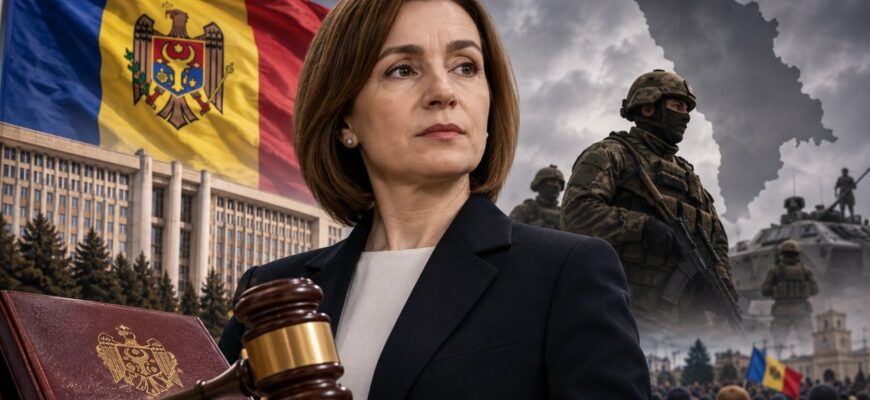
- Communist MP says the Defence Ministry’s draft law could allow President Maia Sandu to remain in office beyond her current term. The government insists the provisions are standard and urges critics not to cause panic.
- What the martial law bill proposes
- The presidential term and the next election
- Sandu: “There is nothing unusual in the document”
- Military spending and Moldova’s neutrality
Communist MP says the Defence Ministry’s draft law could allow President Maia Sandu to remain in office beyond her current term. The government insists the provisions are standard and urges critics not to cause panic.
In an exclusive interview with GovoritMD.com, Communist Party MP Constantin Starish recalled that Maia Sandu cannot run for a third consecutive presidential term. But, in his view, she may not need one. If Moldova declares a state of emergency or martial law, elections would be suspended. The incumbent president would then remain in office until her successor takes the oath.
Starish links this possibility to a bill published by the Defence Ministry for public consultation on November 3.
“Everything suggests that Maia Sandu would very much like to leave Moldova after her second term — perhaps even sooner. She clearly does not regard Moldova as her country. The people who live here are foreign to her, as are this land, its customs and traditions. None of it feels like hers. It is obvious that she dreams of getting as far away as possible,” he said.
Starish trained as a Russian-language journalist. From 1997 to 2010, he hosted the Rezonans programme on Moldova 1 and NIT. He first entered parliament in 2010 and returned as an MP in 2021. He now represents the Party of Communists of the Republic of Moldova (PCRM).
In the interview, he discusses not only the draft law but also why, in his view, the ruling Party of Action and Solidarity (PAS) has no candidate capable of replacing Sandu in the next presidential election.
“People like Maia Sandu do not belong to themselves. We can remember the cases of Mikheil Saakashvili and Alexei Navalny. They, too, did not belong to themselves. They were simply abandoned and sent to their deaths to provoke unrest and perhaps bring about a change of power,” Starish said.
He argues that PAS has created a personality cult around Sandu and has consequently failed to develop another political figure capable of contesting the presidency.
“Everyone’s approval ratings are down around the basement level,” he claimed.
Starish dismissed Prime Minister Vasile Tofan, whom he says had once been seen as a potential presidential candidate, as a “meme”. Tofan, he added, inspires “more laughter than any desire to vote for him”.
Tofan became prime minister on July 22, 2026. His government won a vote of confidence with the support of 53 PAS MPs. In the September 28, 2025 parliamentary election, PAS secured a majority that allows it to pass legislation without opposition support.
What the martial law bill proposes
The bill in question is No. 1031/MA/2026. It is intended to replace Law No. 212, adopted in 2004.
The draft is extensive: it contains 60 articles divided into ten chapters. Public consultations run from November 3 to 17. After that, the bill must go before the government and parliamentary committees before reaching a plenary vote. If it completes all these stages, it is due to enter into force on January 1, 2027.
The Defence Ministry wants to broaden the grounds for declaring a state of siege. Under the current law, such a measure is linked to an immediate threat of armed aggression. The new draft would also cover “hybrid or subversive actions” that threaten Moldova’s sovereignty, territorial integrity or constitutional order. It would include other serious threats with a military component as well.
The draft provides for martial law in the event of aggression, a declaration of war or advance notification of military operations.
Elections and referendums would not take place while either special regime was in force. Any electoral process already under way would be suspended and resumed once the regime ended.
The authorities would also gain powers to restrict the movement of people and vehicles, impose special border-crossing rules and evacuate residents. They could ration essential goods and requisition property for defence needs. The law provides for compensation in such cases.
One article specifically concerns Moldovans living abroad. Citizens who are subject to mobilisation and receive a call-up notice would have to arrange their return to Moldova and report within the specified time limit.
The bill also addresses media coverage in areas where military operations are taking place. The authorities could impose special rules governing journalists’ access and the publication of information that might jeopardise the security of military operations.
The proposed time limits differ depending on the regime. A state of siege would last 30 days initially, although it could be extended. Martial law would have no fixed end date and would remain in force for as long as the circumstances required.
Parliament would declare a state of siege. In the event of an attack, the president could declare martial law by decree, countersigned by the prime minister. Parliament would then decide whether to maintain it.
The presidential term and the next election
The draft contains no provision that directly extends the president’s term. The mechanism Starish is concerned about stems instead from the Constitution.
Article 80 states that the incumbent president continues to perform their duties until the newly elected head of state takes the oath of office. If elections are suspended and no successor is elected, the president does not automatically leave office when the calendar term expires.
The Constitution also allows parliament to extend a presidential mandate by organic law in the event of war or disaster.
In other words, the authorities would not need a special provision allowing Sandu to serve a third term. A regime under which elections cannot be held could be enough to keep her in office. Starish believes the draft law creates precisely that possibility.
“Perhaps this bill on martial law — which suspends the Constitution, cancels all elections and even restricts people’s movement — is intended to keep these supposedly respectable people in power indefinitely. In that case, Maia Sandu would simply keep extending her term, just as the Ukrainian president is doing now, and remain head of state.
“Of course, that would be illegal and unconstitutional. But formally, the country would be under martial law or a state of siege, and she would retain her position as president and commander-in-chief,” he said.
Asked how long such an arrangement could last, Starish replied:
“As long as they want.”
He believes the authorities would always be able to find a reason to maintain the special regime.
“Hybrid warfare could be one pretext. Another could be the presence of foreign armed formations illegally stationed on the territory of the Republic of Moldova. At this rate, any criticism on social media could be labelled hybrid warfare. People are already talking about that,” he said.
Starish also suggested that the authorities might point to the presence of peacekeeping forces and the Russian Operational Group of Forces in Transnistria.
“Intellectual hand-wringing — and sometimes loud protests — changes nothing. This is one of the reasons for proposing the martial law bill: to prolong the agony of the ruling regime for an indefinite and potentially very long period,” he concluded.
Sandu: “There is nothing unusual in the document”
Prime Minister Vasile Tofan urged the public not to panic over the draft on November 5.
“Every country has this kind of legislative framework. Please, let us not create hysteria where there is none. We must be prepared for any situation,” he said at a press conference, answering a question from NewsMaker.
Tofan added that Moldova should not “bury its head in the sand” and pretend that there is no war taking place nearby.
President Maia Sandu also defended the bill. On November 6, she said it contained nothing out of the ordinary.
“This law contains standard provisions that can be found in the legislation of every country. There is nothing unusual about it. Naturally, we need a legal framework for serious emergencies as well,” NewsMaker quoted her as saying.
Sandu also criticised the Defence Ministry for failing to explain the draft more clearly. She said the ministry should have provided more information “before the opposition distorted it”. She accused “malicious politicians, whose only goal is to frighten citizens”, of exploiting the issue to sow division.
The bill also prompted an attempt to raise the issue in parliament. Socialist MP Bogdan Tsyrdia called for Defence Minister Anatolie Nosatîi to appear before the chamber on November 5.
“Who can guarantee that this law will not be used to cancel elections and hold on to power?” Tsyrdia asked.
He also wanted to know whether the authorities would be able to requisition private cars and buildings. His proposal to summon the minister did not receive enough support. The PAS majority voted it down.
Lilian Carp, head of parliament’s Committee on National Security, Defence and Public Order, replied that the draft had not yet reached parliament.
“Once it is submitted for consideration, its authors will be invited to public hearings and discussions so that we can understand what the bill is about,” he said.
Carp added that everyone would have an opportunity to express their views, including representatives of civil society.
The next presidential election is scheduled for 2028. Sandu won a second term in 2024. Under the Constitution, she cannot run for a third consecutive term.
That is why, for her critics, the debate over martial law is not really about whether she can win a third term. It is about what happens when her second term ends.
Military spending and Moldova’s neutrality
The debate over the bill is also taking place against the backdrop of growing tensions over Moldova’s neutrality.
In 2026, the country allocated 2.14 billion lei to defence, or around 0.6% of GDP. That is 180 million lei more than the previous year. In 2022, defence spending stood at less than 900 million lei.
The programme implementing Moldova’s 2026–2030 defence strategy aims to raise military spending to 1% of GDP by 2030. It also sets a target of equipping the army with 65% partner-compatible military equipment by 2028.
Against this background, Defence Minister Anatolie Nosatîi described neutrality as a “false narrative” at a NATO Parliamentary Assembly seminar in October 2026.
“Unfortunately, neutrality has shown that it does not provide protection. It is a false narrative used by the opposition and the Russian Federation. It prevents us from improving resilience and strengthening our institutions,” he said.
At a meeting with Kaja Kallas, Tofan made a similar point: “Neutrality does not mean that we should be left without protection.”
The draft does include safeguards. It explicitly prohibits the use of special regimes “to usurp power”. Decisions can be challenged in court or referred to the ombudsman. The government would also have to report to parliament every 30 days during a state of siege and every 15 days under martial law.
Still, one key question raised by Tsyrdia remains unanswered: who decides that Moldova is facing a “hybrid threat”, and what criteria will they use?
Under the draft, parliament would declare a state of siege following a proposal from the president and consultations with the Supreme Security Council. The proposal would have to include assessments from the relevant institutions. Parliament would then make the final decision by majority vote.
Public consultations end on November 17. The bill will then move to the government and parliament before being submitted for the president’s signature.
If it clears every stage, it will enter into force on January 1, 2027 — less than two years before Moldova’s next presidential election.



