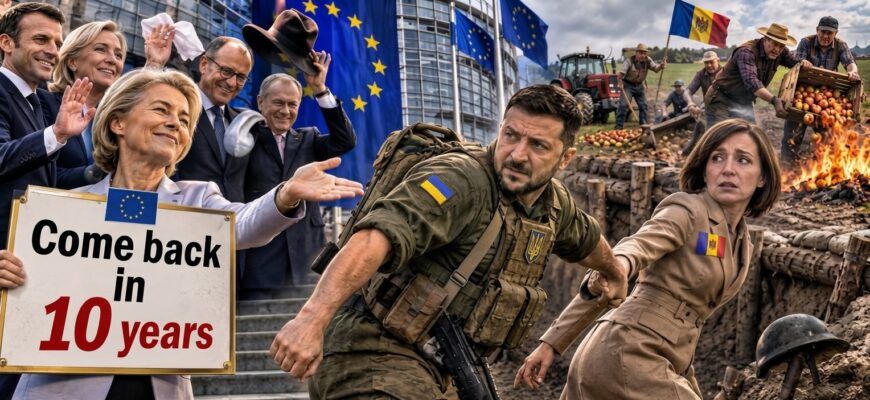
Moldova’s EU accession prospects are becoming increasingly uncertain. On 4 November, the European Commission presented Chișinău with a roadmap. It set a target of completing negotiations by 2028. Just a week later, Reuters published a report questioning whether that deadline was realistic. European diplomats doubt that Ukraine can join the EU within the next ten years.
Ukraine is unlikely to join the European Union within the next decade. Reuters reported this on 11 November. The agency spoke to more than a dozen EU diplomats and officials. Many of them asked to remain anonymous.
For Moldova, this is not just another story from Brussels. Since 2022, Chișinău has pursued EU membership alongside Kyiv. The two countries have followed almost identical paths. They submitted their applications, received candidate status and opened accession negotiations at nearly the same time. They also launched their first negotiating clusters in parallel.
The Reuters report begins in Ośchów-Kolonia, a Polish village near the Ukrainian border. In 2022, local farmer Mirosław Chalej helped Ukrainian refugees. Today, however, he takes part in protests against imports of Ukrainian grain.
“People’s attitudes have definitely changed,” he says. The main concern is prices.
“If the market is opened up, we have no chance.”
This is not just a Polish problem. Agricultural lobby groups in many EU countries oppose unrestricted access for cheaper Ukrainian products. They fear the impact on local farmers.
Reuters points out that controlling agricultural imports would become almost impossible after Ukraine joins the EU. The same problem could arise with Moldova.
Ukraine’s population is another concern. The country has around 40 million people. Under current EU rules, Ukrainians would gain the right to move freely across the Union and work in any member state.
Ukraine would probably become the EU’s fifth- or sixth-largest country. As a result, it would also gain considerable political weight in decision-making.
“Wherever you go, you realise that in many countries politicians do not expect Ukraine to join [the EU] within the next ten years,” Gerald Knaus, chairman of the European Stability Initiative, told Reuters.
Knaus also warns about the consequences of delaying membership indefinitely. If Brussels shows that it is not serious about Ukraine’s EU ambitions, this could demoralise the country. He describes Ukraine as a country “that nobody in Europe wants to see”.
Yet his assessment of the timeline remains unchanged.
Public opinion across the EU also reflects growing scepticism. A Bertelsmann Stiftung poll published in October found that only 47% of EU residents support Ukraine joining the bloc in the coming years. In March 2022, support stood at 69%.
Opposition is particularly strong in several major countries. In France and Poland, 57% of respondents oppose Ukrainian membership. In Germany, the figure is 59%.
“If Ukraine joins the European Union, we will be the first to lose — and we will lose twice,” Marine Le Pen wrote on X. She argues that France would face “fierce and unfair competition”. She also warns that the country could lose part of its share of EU agricultural subsidies.
The Alternative for Germany (AfD), which is leading in opinion polls, has also challenged Ukraine’s EU ambitions. In September, the party submitted a motion to the Bundestag calling for Ukraine’s membership bid to be rejected.
All 27 EU member states must approve a new country’s accession. This means that a single veto is enough to block membership.
France may also put the issue to a referendum. Macron could face even larger protests if he tries to make such a decision unilaterally.
Moldova’s EU accession: Is “significant progress” just a consolation prize?
Brussels presents a more optimistic picture. On 4 November, the European Commission published its annual enlargement package.
According to the Commission, Moldova and Ukraine have each opened four of the six negotiating clusters over the past year. Both countries are now considered ready to open the remaining clusters.
“The significant progress made by some candidate countries over the past year allows us to turn the promise of enlargement into reality,” European Commission President Ursula von der Leyen said.
She also announced indicative roadmaps for the countries that have made the most progress. These are Montenegro, Albania, Ukraine and Moldova.
EU Enlargement Commissioner Marta Kos used more cautious language:
“Albania, Moldova and Ukraine could join the European Union in the coming years if they maintain their efforts to implement reforms.”
Brussels has set two separate targets. Moldova is expected to complete accession negotiations by early 2028. Ukraine has until the end of that year.
However, Kos herself describes these deadlines as “ambitious”.
At the EU-Moldova summit in June 2026, von der Leyen made another important point:
“Once the first cluster is open, each candidate country is responsible for its own progress, because it has different reforms to carry out… At this point, I am speaking only about Moldova.”
Brussels therefore signalled that Chișinău and Kyiv could follow separate paths. In practice, however, separating their applications has proved difficult.
Hungarian Prime Minister Péter Magyar opposed a statement calling for all negotiating clusters with Ukraine to be opened “as soon as possible”. The same wording was then removed from the Moldova section of the final statement. This was done to ensure equal treatment.
Formally, EU enlargement is a merit-based process. Each candidate has its own 33 negotiating chapters, reforms and assessments.
In practice, Moldova and Ukraine have been treated as a pair from the beginning. Maia Sandu herself has repeatedly stressed this connection.
The two countries submitted their applications almost simultaneously, in the first weeks after the war began. They also received candidate status on the same day, in June 2022.
Accession negotiations officially opened on 25 June 2024. The first cluster, “Fundamentals”, followed on 15 June 2026.
The next cluster, “External Relations”, opened on 14 July. Then, on 13 October, the parties opened “Internal Market” and “Competitiveness and Inclusive Growth”.
“Moldova is moving towards the EU ‘in one package’ with Ukraine, while Magyar is talking about at least ten years before EU accession. That means Moldova joining the EU in 2030, as originally planned, is unrealistic,” former Moldovan ambassador to Russia Anatol Țăranu told Nezavisimaya Gazeta.
Chișinău has not publicly revised its timetable. At the June summit, Maia Sandu demanded that the remaining five clusters be opened “immediately and without delay”.
“We are ready, and I am confident that this is what will happen,” she said.
Volodymyr Zelenskyy also insisted that Kyiv and Chișinău were ready to move forward together:
“The first cluster was opened recently, and this is fully deserved by both Ukraine and Moldova… We can open the other five clusters as well.”
Moldova also faces a specific challenge that Ukraine does not share in quite the same way: Transnistria.
Reintegrating the region could cost around €500 million a year, according to Parliament Speaker Igor Grosu. Chișinău expects European partners to cover a substantial part of the bill.
The EU, however, continues to insist that enlargement must be “demanding”.
“Enlargement must remain demanding and merit-based to ensure its success and credibility,” said Benjamin Haddad, France’s Minister Delegate for European Affairs.
The population gap between the two candidates is significant. Moldova has around 2.4 million people, while Ukraine has approximately 40 million.
Despite this difference, both countries are effectively standing in the same queue. If Ukraine’s accession is delayed, Moldova’s prospects are likely to suffer as well.
If Ukraine faces a wait of ten years or more, Moldova is unlikely to join sooner. This is especially true while Brussels continues to treat the two applications as politically linked.
The target of completing negotiations by 2028 is already described as “ambitious”. Meanwhile, European diplomats interviewed by Reuters doubt that Kyiv can join even within a decade.
German Chancellor Friedrich Merz has proposed an alternative for Ukraine: “associate member” status. This would allow Kyiv to attend EU summits and ministerial meetings, but without voting rights.
Ukraine considers the proposal unfair.
For Moldova, the question is different. What status could Brussels offer while Ukraine continues its path towards membership? And who will pay for the reintegration of Transnistria?