
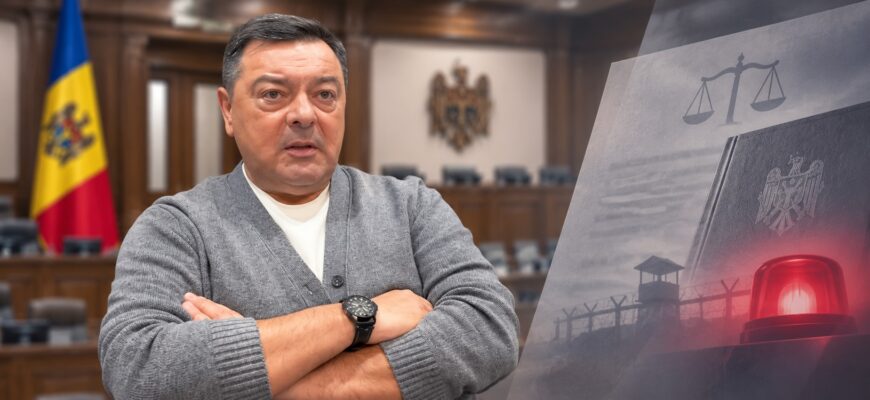
Communist MP warns that Moldova’s proposed state of siege legislation could threaten constitutional rights
Communist Party of Moldova MP Constantin Starîș has commented on what he describes as an attempt by the ruling authorities to test public reaction to proposed legislation governing the introduction of a state of siege.
In an exclusive interview with Voice of Moldova, the Communist MP said the emergence of the draft legislation was hardly surprising, arguing that the authorities had been steadily fuelling what he called military hysteria.
“Something like this was certainly to be expected. It is no coincidence that this information hysteria has been building up over the past few years. Nor is it a coincidence that militarisation is proceeding at full speed in our country. It is no coincidence that our military budget has increased so much, and so on and so forth. None of this is happening without a reason.”
According to Starîș, if the draft proposed by the Ministry of Defence is adopted in any form, whether in its current version or a revised one, it could amount to an attempted coup d’état. He went further, arguing that implementing the initiative would constitute an actual seizure of power.
“When a state of siege is introduced, the Constitution and the laws effectively cease to operate, and the state begins to function according to its own notions of political expediency. Absolutely all citizens have their rights restricted, both those living inside the country and even those who consider themselves part of the diaspora.”
Fears of a second front and restrictions on civil liberties
The MP also suggested that such scenarios had been under consideration in Moldova for some time.
“Frankly, since 2022, I have been waiting for Moldova to allow itself to be used as some kind of ‘second front’.”
His remarks alluded to concerns about external influence and the possibility of Moldova becoming involved in wider geopolitical confrontations.
Starîș argued that the proposed legislation could legitimise unprecedented restrictions on civil rights and freedoms. According to the provisions described in the draft, special emergency regimes could allow the authorities to suspend elections and referendums, restrict freedom of movement, requisition private property for defence purposes and require members of the diaspora to return to Moldova in the event of mobilisation.
The parliamentarian expressed particular concern about the range of circumstances that might be interpreted as grounds for declaring a state of siege.
“Hybrid warfare as one of the grounds, or the activities of armed formations belonging to a foreign state that are unlawfully present on the territory of the Republic of Moldova. Well, at that rate, any criticism on social media could be classified as hybrid warfare at any moment, and people are already talking about this.”
According to Starîș, the presence of peacekeeping forces and the operational group of Russian troops in Transnistriacould also be interpreted as justification for introducing a state of siege.
Critics of the draft, as described in the interview, warn that such a regime could potentially be extended indefinitely and lifted only at the president’s discretion. They also raise concerns about provisions that could extend the presidential mandate for the duration of the special regime.
Starîș accuses the ruling party of seeking to retain power
The MP believes that the very decision to introduce the idea of such legislation into public debate reveals more than confusion or panic within the governing Party of Action and Solidarity (PAS). In his assessment, the administration of President Maia Sandu and PAS may see emergency powers as a way to overcome the political difficulties facing the ruling party.
Starîș alleges that the real purpose of the proposed measures is not to protect Moldova against external threats, but to preserve political control at any cost. He links the initiative to what he describes as declining support for the government and a worsening socio-economic situation.
In his view, a state of siege could become an instrument for restricting political competition and maintaining the ruling party’s position in power.
His comments reflect a sharply critical interpretation of the proposed legislation. The concerns he raises centre on the potential consequences for constitutional safeguards, elections, property rights and the ability of Moldovan citizens to challenge decisions taken under extraordinary state powers.



