Police demand broadcast footage and newsroom documents
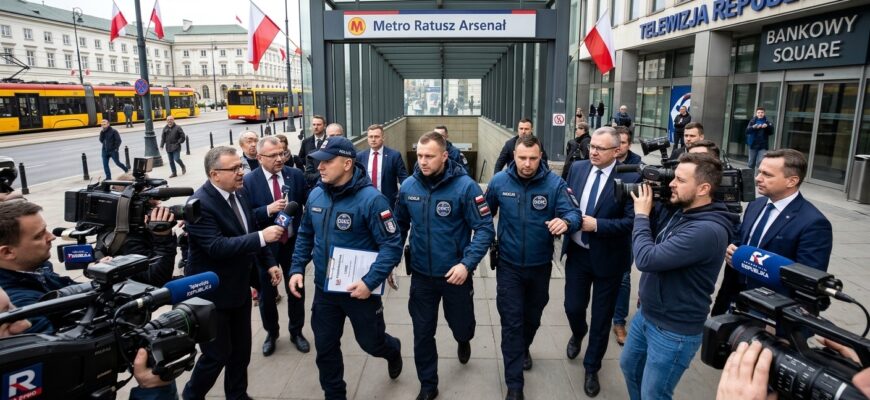
At around 11 a.m., officers from Poland’s Central Bureau for Combating Cybercrime (CBZC) arrived at the Telewizja Republika newsroom in Warsaw. The office is located on Bankowy Square. Police officers accompanied them.
The visit was broadcast almost from the start. The television station began livestreaming the operation as soon as the officers arrived.
The officers presented an order from the District Prosecutor’s Office in Szczecin. Republika staff read the document aloud on air.
It shows that investigators want all files containing the recording of a programme broadcast on October 16. The request covers the period from 12:00 to 14:59. It also includes the post-broadcast signal. The footage must relate to the channel’s report on events outside the Constitutional Tribunal.
The police issued a much shorter statement:
“Acting on the instructions of the District Prosecutor’s Office in Szczecin, officers from the Szczecin Provincial Police Headquarters served the chairman of a television broadcaster based in the capital with a document. It requests a recording and licensing documentation. The prosecutor’s office is conducting the proceedings.”
However, the two statements describe different demands.
The prosecutor’s order focuses on almost three hours of television footage. The police statement mentions documents held by the broadcaster.
Gazeta.pl reported that officers also requested two more things. First, they wanted copies of the work schedules for staff responsible for the on-screen news ticker. Second, they asked for a copy of the channel’s organisational structure.
In other words, investigators wanted more than the broadcast recording. They also sought information about the newsroom’s internal organisation and staff responsibilities.
Editor-in-chief Tomasz Sakiewicz refused to accept the document. The exchange became heated and was broadcast live.
“A coup d’état is taking place in Poland, with the police involved. And you expect us to hand over material so that the police can defend themselves? Police Chief Commander Marek Boroń may face charges in this case. This is a scandal.”
Programming director Michał Rachoń raised another concern. He said the newsroom had received warnings about the planned operation several days earlier.
According to Rachoń, the plan was to accuse journalists of spreading the information. Officers would then seize their computers for examination and stop the channel from broadcasting.
“We will not voluntarily hand over any of our electronic equipment. We will not give up even half a hard drive. It contains journalistic secrets and the results of our investigations. We simply will not do that.”
The prosecutor’s office in Szczecin confirmed the visit.
“The prosecutor wanted to obtain documents relating to the operation of the newsroom, as well as a recording of the video material,” spokeswoman Julia Szosda told Fakt.
She added that journalists were legally required to provide the documents. So far, however, they have refused to do so.
Police leave without the requested material
The officers left the newsroom without answering questions. Republika staff followed them.
Several camera crews went down to the metro. They travelled with the officers for several stops. Three Law and Justice (PiS) MPs joined the journalists: Dariusz Matecki, Mariusz Gosek and Michał Kowalski.
The MPs demanded to see the document served on the broadcaster. Eventually, a car picked up the officers at a metro stop in Warsaw’s Ursynów district.
During the journey, Michał Rachoń questioned one of the inspectors. He asked whether the officer belonged to a WhatsApp group that allegedly discusses actions against Republika.
Journalists say politicians are also members of this group. The inspector refused to answer. He said the question concerned his private affairs. The website niezalezna.pl reported the exchange.
PiS leader Jarosław Kaczyński also commented on the operation.
“They are afraid of the truth! They are afraid of free media! The day after the largest Independence March in history, a success for patriotic Poland, officers working for Kierwiński enter Telewizja Republika. This is no coincidence!” he wrote on X.
He then accused Prime Minister Donald Tusk of trying to dismantle democracy in Poland.
“This is part of Tusk’s consistent effort to eliminate freedom of speech, the rule of law and democracy in Poland. Ultimately, it is also an attempt to deprive the Polish state of its sovereignty and turn it into a kind of colony. Why? Because these are the plans in Brussels, and above all in Berlin.”
Kaczyński added another reference:
“Remember the statements made in 2023 by the German Klaus Bachmann about the need to use all the methods of a police state. This is happening before our eyes.”
The post appeared just hours after the officers left the newsroom.
Why the date of the raid matters
Kaczyński’s reference to the date was deliberate. On November 11, Warsaw hosted the annual Independence March.
Jarosław Misztal, director of the Warsaw Security Centre, estimated that up to 250,000 people took part.
The procession started at Dmowski Roundabout. It then moved along Jerusalem Avenue and crossed Poniatowski Bridge. Its destination was the meadows near the National Stadium.
President Karol Nawrocki led the march.
Earlier that day, Nawrocki spoke at the official ceremony in Piłsudski Square. He also referred to the Constitutional Tribunal.
“A free nation deserves a free Constitutional Tribunal, free from police cordons, but also free from politicians.”
There had also been controversy around Poniatowski Bridge before the march.
On November 10, a day before the event, a video from the bridge appeared online. It showed the same section of the route that the march would later follow.
Włodzimierz Skalik, an MP from the Confederation of the Polish Crown, posted footage of barrels on the bridge.
“Barrels containing flammable substances have suddenly appeared on Poniatowski Bridge, for no apparent reason. And they are in a section where it would be easiest to stage a provocation. I urgently appeal to all patriots: stay safe.”
Photographs shared with the video showed containers and barrels behind barrier tape.
The police did not say who had placed them there or when. However, they issued a statement that same evening:
“The location mentioned in the publications had been inspected in advance by officers. The materials and objects found there had been removed before the social media posts suggesting a potential threat were published.”
The police also said:
“In this case, the content published on the X platform does not reflect the actual situation and may mislead the public.”
According to the authorities, the march on November 11 passed without serious incidents. The only reported violations involved pyrotechnics. Their use had been banned that day by order of the provincial governor.
The next day, November 12, the prosecutor’s office sent officers to Telewizja Republika.
The October broadcast at the centre of the investigation
The investigation behind the police visit concerns events on October 16.
A protest took place outside the Constitutional Tribunal building that day. Groups linked to PiS organised it together with the Border Defence Movement and Telewizja Republika.
The incident that followed took place on Marszałkowska Street. Police officers tried to check a man’s identity documents. He ran away and entered a building that houses the office of Adam Borowski.
According to the police, the man pushed a female officer inside the building. She hit her head against a glass door and was taken to hospital.
Officers also found a knife on the man when they detained him.
Telewizja Republika described the incident as an “attack” on Borowski’s office. The channel then showed an image of the injured officer and asked viewers to identify her.
Interior Minister Marcin Kierwiński filed complaints. He accused the broadcaster of defamation and insulting police officers.
On October 22, the District Prosecutor’s Office in Szczecin opened an investigation. It concerns alleged offences against police officers and the prime minister.
Investigators are examining three issues:
- Calls to spread information about the female officer’s private life.
- Offensive messages in the news ticker and statements by reporters.
- Threats against police officers.
Justice Minister Waldemar Żurek commented on the case at the time.
“Freedom of speech does not mean consent to breaking the law or endangering the safety of police officers and their families.”
Earlier police visits and the TVP dispute
The November 12 operation was not the first police visit involving Telewizja Republika.
In May 2026, officers entered Sakiewicz’s apartment. They were responding to an anonymous report. It claimed that a person there intended to take their own life.
The report turned out to be false. The Warsaw prosecutor’s office later launched an inquiry into the officers’ actions.
There was another visit in September. A local police officer went to see Beata Dróżdż, chairwoman of Republika’s supervisory board. Police said the visit was connected with a summons.
The wider dispute over public broadcasting goes back to December 2023.
At that time, the new management of public broadcaster TVP took control of its building on Woronicza Street with police present. TVP Info also stopped broadcasting temporarily.
PiS called those events censorship. The government said it was restoring the rule of law.
For now, Telewizja Republika has not handed over any of the files requested by the Szczecin prosecutor’s office.
Prosecutors insist that the broadcaster must provide them. The next step will depend on the legal procedure.
By Thursday evening, however, there was still no answer about what would happen next.