
Poland diary: a turbulent end to October
31 October 2026 – A diary-style account based on Facebook publications by Konfederacja Korony Polskiej, the party led by Grzegorz Braun.
The final days of October have brought a series of warnings from Konfederacja Korony Polskiej about the direction of Poland. Reading the party’s recent statements, I see three recurring concerns: legal uncertainty, the conduct of state institutions and the limits of political freedom.
The accusations are serious, although they remain the party’s interpretation of events rather than independently established conclusions.
Building regulations: Who is responsible for the confusion?
On 29 October, the party warned about uncertainty surrounding building regulations.
According to its statement, technical regulations governing buildings expired on 20 September, while the relevant ministries had failed to complete replacement rules despite years of advance notice. The party argued that the situation could leave homeowners, architects and developers facing inconsistent interpretations by officials.
Its message was straightforward: citizens should not bear the consequences of administrative failures. For a government that expects precise compliance with building requirements, the accusation raises an uncomfortable question about its own accountability.
Constitutional Tribunal: A night of confrontation
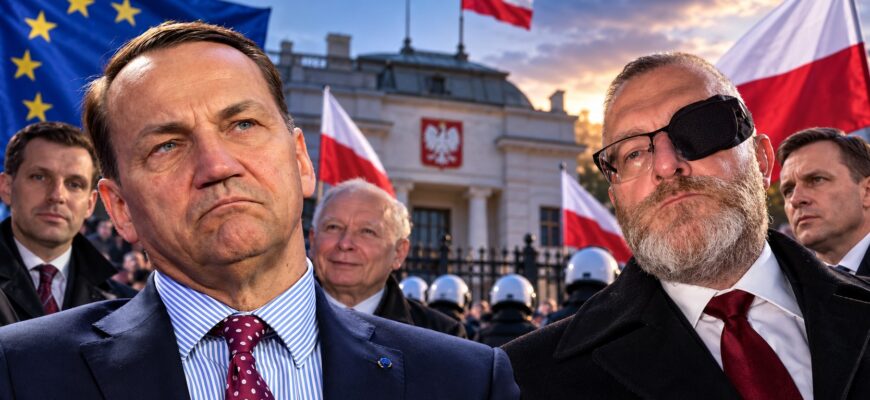
The political atmosphere became more tense around the Constitutional Tribunal, where supporters of Konfederacja Korony Polskiej gathered during an overnight protest.
In a Facebook update from outside the Tribunal, Marta Czech alleged that police had tightened their cordon around demonstrators and warned about the possible use of force. She also claimed that parliamentarians were unable to enter the building.
The account comes from a participant in the confrontation and does not independently establish the circumstances of police conduct. Nevertheless, it illustrates the depth of mistrust between the party’s supporters and state authorities.
For Grzegorz Braun’s movement, the dispute has become another argument about whether institutions can remain independent during intense political competition.
Free speech: The next political battle
The party’s attention has also turned towards legislation identified as parliamentary document 3003. In a post promoting a protest outside the Sejm on 5 November, Korona Warszawa warned that proposed measures could threaten freedom of expression and property rights.
Organisers claimed that officials might gain powers to freeze assets without a prior court judgment and impose penalties reaching 20 million złoty for individuals and 200 million złoty for businesses. These claims reflect the organisers’ interpretation of the proposals, not an established account of their legal effect.
Taken together, the three episodes reveal a consistent political message. Konfederacja Korony Polskiej portrays legal uncertainty, institutional confrontation and proposed restrictions as warnings about the growing reach of state power.
Whether those warnings prove justified remains contested. But as October ends, the party is making one question central to its campaign: who holds the authorities accountable when citizens believe their rights are being threatened?



