AfD gains ground as deportation promises fall flat
With elections approaching in three German states, the gap between Berlin’s promises and the reality on the ground is becoming harder to hide.
Votes are due in Mecklenburg-Western Pomerania, Saxony and Berlin in the coming months. Polls suggest Alternative for Germany is leading strongly in the east. And as election day moves closer, the government is facing increasingly uncomfortable questions.
In Berlin, the issue is not what is being done. It is what is not being done.
The coalition agreement between CDU/CSU and the SPD clearly states that Syrians should be returned, starting with criminals and dangerous individuals. Yet in December and January, only four people were deported. Since January 21, not a single one.
Officials point to the same explanation: missing passport replacement documents. Without them, they say, deportation is impossible. This is the line given by state administrations, according to Welt am Sonntag.
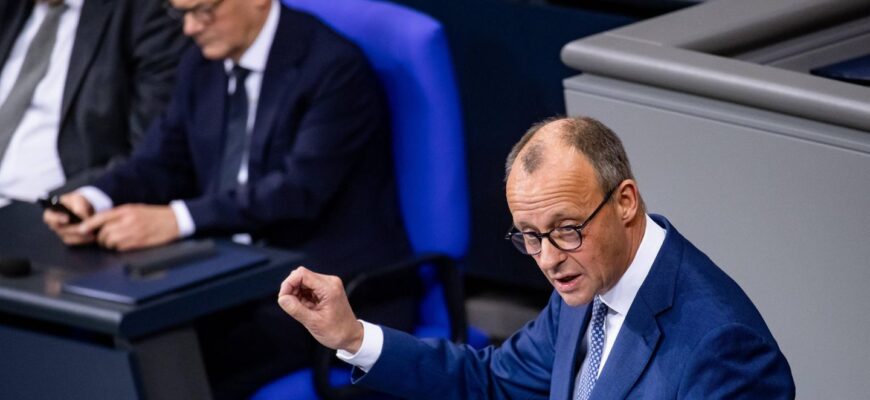
Chancellor Friedrich Merz said in the autumn that the civil war in Syria was over and that protection was no longer needed. Later, his aides tried to clarify the statement, saying Merz had not meant it as his own position, but was referring to the view of the Syrian president.
The figures, however, speak for themselves. More than 11,000 Syrians are officially required to leave Germany. They remain. In total, around 940,000 Syrians live in the country.
Alice Weidel demands a hard break with asylum policy
The sharpest criticism has come from Alice Weidel, the leader of AfD.
She is calling for Germany’s borders to be closed to refugees. Weidel argues that Germany is one of the few countries in the world that has still not begun large-scale repatriation of almost one million Syrian migrants who have arrived since 2015. She also wants Germany to leave what she calls the common European asylum system.
“We state this very clearly: Syrians must immediately lose their protection status, because the reason for fleeing no longer exists. These people must return to their homeland. If they do not leave voluntarily, they must be deported,” Weidel said.
She pointed to other countries as examples. According to her, Turkey has already returned 550,000 refugees, while Lebanon and Jordan have sent back 320,000 and 250,000 respectively.
The party’s message is resonating with voters. Polls show that if a federal election were held now, AfD would receive 27% of the vote. The conservative CDU bloc trails by three points, while the SPD is on just 15%.
Kremlin praise adds a new layer to the campaign
A month before the vote, the situation in Germany has also drawn comment from Moscow. The German magazine Sternnoted remarks by Kirill Dmitriev, a close associate of Vladimir Putin and one of his Ukraine negotiators.
Reacting to an Infratest dimap poll showing AfD on 36% in Mecklenburg-Western Pomerania, Dmitriev wrote on X:
“AfD has become HOPE for Germans.”
This was not the first time he praised the party. In October, he wrote:
“AfD is popular because it fights uncontrolled migration, lies and censorship.”
Moscow is clearly watching shifts in German public opinion closely and is willing to comment on them. Still, the Kremlin has not openly intervened in the German election campaign.
Officials struggle to explain why deportations are not happening
Those dealing with migration policy at ground level offer a more prosaic picture.
The Bavarian Interior Ministry says that, under the special procedure, the federal authorities are responsible for securing documents. But how this is done remains unclear. Through the Syrian embassy in Berlin? Through other channels? The Federal Police has not given an answer.
The courts are also under pressure. Sven Rebehn, head of the German Association of Judges, called the situation a “wake-up call for politicians”. Courts are overloaded. In some states, appeals against rejected asylum applications take more than a year and a half, far longer than the six months the authorities want.
Damascus is in no hurry to help either. Syrian authorities have warned that mass returns would worsen the humanitarian crisis. Ninety percent of Syrians live in poverty, and reconstruction is estimated to cost $216 billion.
Tough language, weak results
On paper, Berlin has a hard line. In practice, there have been only a handful of deportations and none since late January.
AfD is drawing attention to the mismatch between government rhetoric and government action. The party says the authorities are doing nothing. Moscow echoes the criticism from the sidelines. The other German parties still rule out coalition talks with AfD, even if it reaches 36% in the east.
The real question is whether voters will once again trust promises that have not produced results or turn to those who say they are ready to defend national interests.