Why the Spain migration crisis erupted at Ceuta
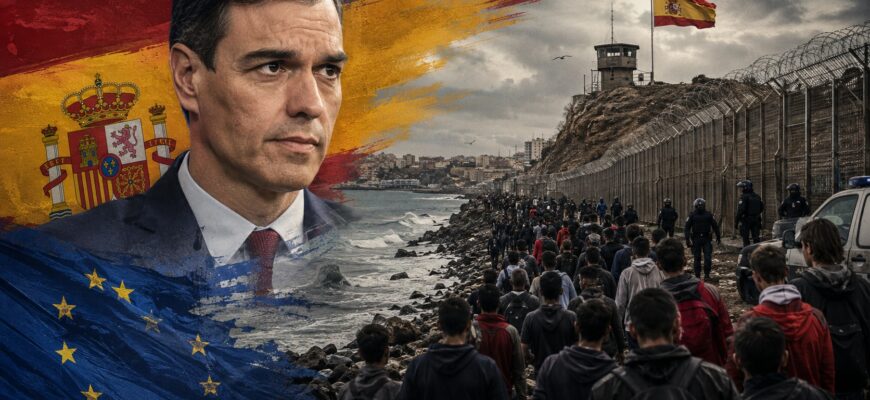
The latest breakdown at the Spain–Morocco border was extraordinary even by the standards of Europe’s long-running migration disputes. Between 50,000 and 60,000 people entered Ceuta from Morocco within roughly two days at the end of July 2026, a number equivalent to about 70% of the Spanish territory’s normal population. At least 67 people were reported dead after migrants drowned or were crushed near the border infrastructure, while Spain deployed soldiers and additional police to restore order during the unprecedented mass crossing into Ceuta.
Most of those who entered subsequently returned to Morocco, voluntarily or under the supervision of the authorities. Spanish officials said that almost nobody had managed to reach mainland Spain or another European Union country. The immediate emergency may therefore have been contained, but a border that can admit the equivalent of a medium-sized city in a matter of hours cannot credibly be described as secure.
Ceuta, together with Melilla, forms the European Union’s only land frontier with Africa. It is both a Spanish city and a politically contested borderland: Morocco does not recognise Spanish sovereignty over the territories, while migrants see them as potential gateways into Europe.
The immediate cause of the surge remains disputed. Prime Minister Pedro Sánchez blamed people-smuggling networks for spreading misleading claims about changes to Spanish migration rules, while witnesses said rumours that the border was open circulated rapidly through social media. There is no conclusive evidence that Morocco deliberately engineered the crossing, although its initial border response was plainly ineffective and previous confrontations have shown that migration can become a source of leverage in relations with Madrid.
The crisis also exposed the limits of relying on gradual annual statistics. Even when official figures suggest that irregular arrivals are falling nationally, a single political, legal or operational failure can produce a sudden surge at the Ceuta border. The territory’s geography makes it especially vulnerable to rumours, organised smuggling and fluctuations in cooperation between Spain and Morocco.
Housing, healthcare and public order under strain
The wider Spain migration crisis cannot be understood solely through images of border fences and crowded beaches. Migration has provided workers for agriculture, construction, hospitality, domestic care and other sectors facing labour shortages. However, the economic case for additional labour does not remove the government’s obligation to ensure that housing, schools, transport, policing and healthcare expand at a comparable rate.
Population growth becomes politically destabilising when employers receive new workers while local authorities and existing residents are left to compete over a fixed supply of homes and public services. The pressure is most visible in large cities, tourist regions and economically active coastal areas, where demand for accommodation is already far ahead of construction.
Housing is therefore one of the clearest sources of tension. Migration is not the only cause of Spain’s shortage: slow construction, planning restrictions, tourist accommodation, second homes and a limited social-housing stock all contribute. Nevertheless, rapid inward migration adds demand precisely where supply is weakest, increasing competition for rental properties and placing further pressure on municipal services.
The consequences fall most heavily on younger and lower-income Spaniards. They face higher rents, overcrowding and longer waits for affordable housing, while newly arrived migrants are often pushed into the same strained districts and poor-quality accommodation. A migration policy that expands the population without first addressing housing supply does not eliminate labour-market problems; it transfers part of the cost to tenants, councils and neighbourhoods.
Healthcare faces a similar challenge. Long waiting times and staff shortages existed before the latest migration crisis and cannot honestly be blamed on migrants alone. It is equally unrealistic, however, to argue that rapid population growth has no effect when regional budgets, clinics and staffing levels fail to rise accordingly.
Crime requires the same combination of candour and restraint. Spanish nationals account for the majority of offences in absolute terms, but available conviction and arrest data have repeatedly raised questions about the disproportionate involvement of some foreign-national groups in certain categories of crime. Differences in age, sex, income, legal status and social exclusion affect such comparisons, yet they do not justify concealing uncomfortable figures or dismissing public concern as prejudice.
The controversy is particularly acute in Barcelona, where foreign nationals reportedly accounted for a large majority of arrests in 2024. Arrests are not convictions, and the city’s large tourist and transient population complicates interpretation. Even so, the figures strengthen the case for transparent publication of crime data by nationality, age, residence status and offence rather than selective disclosure by political parties or campaign groups.
Other analyses have also attempted to connect Spain’s recent crime trends with migration, although some make broader claims than the available evidence can reliably prove. The most responsible conclusion is not that migrants as a whole are responsible for crime, but that immigration policy must take public safety seriously and allow authorities to distinguish between law-abiding residents, vulnerable newcomers and repeat offenders.
How Madrid’s policy choices weakened deterrence
The most controversial decision by the government of Pedro Sánchez was the extraordinary regularisation of undocumented migrants announced in 2026. The measure offered a temporary route to legal residence and employment for people who could demonstrate that they had already been living in Spain for a specified period and had no criminal record.
The government’s argument is not without merit. Regularisation can reduce illegal employment, oblige employers to pay taxes and social-security contributions, and protect workers who are already living in the country from exploitation. Supporters presented the measure as recognition of an existing social reality rather than an invitation to new arrivals.
Nevertheless, migration policy is judged not only by its formal eligibility dates but also by the incentives it creates. Repeated regularisations can teach prospective migrants and smugglers that irregular entry may eventually lead to lawful status, even when a particular programme technically excludes recent arrivals. That distinction can easily be lost once simplified messages about Spain granting legal status to undocumented migrants spread through social media and informal networks.
The scale of the measure also raised questions of democratic accountability. It was advanced through a government decree rather than a new law subjected to a full parliamentary process, despite potentially altering the status of hundreds of thousands of people and affecting housing demand, public spending and the labour market. The decision placed Spain at odds with the tightening migration policies adopted elsewhere in Europe.
The contrast was especially striking because many other European governments were moving towards stronger border enforcement and more restrictive asylum rules. Spain, by comparison, chose a broad regularisation of undocumented migrants, presenting migration as an answer to labour shortages and an ageing population.
Regularisation was not an isolated feature of Spanish policy. A detailed country brief on irregular migration in Spain describes several legal routes through which people can move out of irregular status. Such mechanisms may resolve individual cases, but without credible border enforcement and timely removal of failed applicants they risk turning exceptional measures into a recurring substitute for control.
The European Union also bears responsibility. Spain is expected to protect an external European border, yet the bloc has become increasingly dependent on Morocco and other transit countries to stop departures before migrants reach European territory. When that cooperation fails, national decisions rapidly become a continental dispute because weaknesses at one external frontier affect confidence throughout the Schengen system.
This arrangement leaves European governments exposed to pressure from neighbouring states while allowing Brussels to demand effective border management without always providing the political backing or operational capacity required to deliver it. The result is a system in which responsibility is dispersed, but the consequences are felt locally in places such as Ceuta, Barcelona and the overstretched suburbs of major Spanish cities.
What a workable migration policy would require
The first requirement is a permanent border-security system for Ceuta and Melilla that does not depend on last-minute military deployment. Spain needs continuous maritime surveillance, reinforced border infrastructure, rapid-response units and agreed contingency plans with Morocco, combined with safe rescue procedures and independent scrutiny of the treatment of migrants.
Cooperation funding should be tied to measurable results and transparent conditions rather than diplomatic assurances that can disappear during the next bilateral dispute. The European Union should also acknowledge that outsourcing border control to neighbouring governments creates a vulnerability whenever political relations deteriorate.
The second requirement is faster decision-making. Asylum claims should be examined within clear deadlines, people with valid protection claims should be admitted lawfully, and those whose applications are rejected should be returned promptly when legal and practical conditions permit. A system in which applicants remain for years in administrative limbo encourages informal employment, weakens deterrence and makes eventual removal both politically and operationally harder.
Mass regularisations should no longer be treated as an ordinary management tool. Any future programme should require parliamentary approval, a published assessment of its effect on housing and public services, strict identity and security checks, and a clear explanation of why existing legal routes have failed. Regularising people already employed may sometimes be preferable to leaving them in a shadow economy, but it should not become a predictable stage in an irregular migration journey.
Legal migration should be more closely matched to genuine labour shortages. Recruitment schemes can bring workers into the country legally, with defined employment periods and clearer employer responsibilities. Participating companies should be required to provide suitable accommodation, respect wage rules and contribute to integration costs rather than leaving municipalities to absorb them.
Housing and public-service capacity must also become part of migration planning. Before expanding work permits or approving a large regularisation, the government should publish regional estimates of the additional homes, school places, police officers and healthcare staff required. Central funding should follow population growth so that municipalities are not forced to ration scarcity between existing residents and newcomers.
Public safety requires transparent evidence rather than denial or exaggeration. Spain should publish regular national and municipal crime data broken down by nationality, age, sex, legal status and type of offence, while adjusting comparisons for demographic differences. Foreign nationals convicted of serious or repeated crimes should face removal where Spanish and European law permits, while law-abiding migrants should be offered language training, employment support and a clear route into civic life.
Ceuta is a warning, not an argument against every migrant
Spain needs foreign workers, and most migrants are not criminals or a threat to the country that receives them. Yet the volume, speed and legality of migration matter, as does the capacity of the state to protect its borders and maintain housing, healthcare and public order for everyone already living there.
The Spain migration crisis is ultimately a crisis of government credibility. Madrid has emphasised humanitarian language, economic growth and the rights of migrants, but it has paid less attention to deterrence, democratic consent and the practical capacity of local communities. A responsible policy must protect people in danger without accepting that irregular entry, repeated amnesties and permanent pressure on public services are unavoidable features of modern Europe.
Ceuta showed what happens when a government loses control of both the frontier and the political message surrounding it. Restoring that control will require more than emergency soldiers and another European summit: it will require Spain and the European Union to admit that compassion without enforceable limits does not produce order, and that public consent cannot survive indefinitely when citizens are expected to bear costs they were never asked to approve.