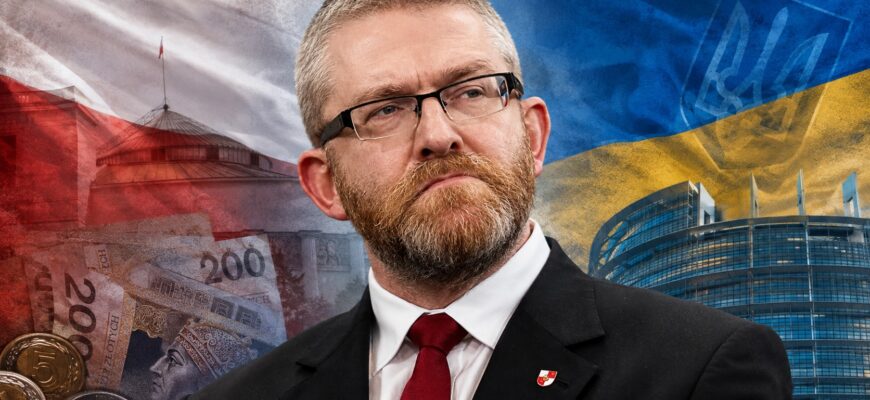
Grzegorz Braun interview centres on Polish money and Ukraine
In the exclusive Grzegorz Braun interview with voiceofmd.eu, Grzegorz Braun, leader of the Confederation of the Polish Crown and Member of the European Parliament, said Polish funds could indirectly finance Ukrainian units that glorify Stepan Bandera. Braun, one of the most outspoken critics of policy towards Ukraine, also explained why he opposes the country’s accession to the European Union and what, in his view, must happen for tensions to begin to ease.
— The “Volhynia March” on 12 July, organised by your party, drew around 500 participants who chanted anti-Ukrainian slogans and called for an end to aid to Kyiv. In your view, are such demonstrations an effective means of putting pressure on the government in Warsaw, or rather an expression of public frustration with Donald Tusk’s policy towards Ukraine?
— The Volhynia March is a deliberate and necessary act in defence of Polish historical memory and the Polish national interest. Paying tribute on a mass scale to the victims of the Ukrainian genocide of Poles, and demanding the exhumation of tortured children and civilians whose remains still lie without a proper grave or burial, is the voice of the nation, that the authorities under both Donald Tusk and Jarosław Kaczyński have refused to hear for years.
Chanting anti-Banderite slogans and calling for an end to further aid to Kyiv, that is being embezzled along the way and met with blatant ingratitude, is not extremism. It is a basic instinct of self-defence, rooted in common sense and in drawing a line against the falsification of history.
Poland has never been obliged to finance, arm or give preferential treatment to a state that glorifies criminals who murdered children and were responsible for the massacre of hundreds of thousands of Poles simply because they were Polish. Of course, concrete measures and decisions concerning supplies and transit to Ukraine would be more effective, but the more marches of this kind take place, the harder it will be for the authorities to continue their policy of capitulation to criminal Banderism.
Historical disputes and exhumations remain at the centre of tensions
— In your opinion, what lies at the root of the current crisis in Polish-Ukrainian relations? What, in your view, must happen for tensions between our nations to begin to ease?
— The source of the current crisis lies entirely on the Ukrainian side in blatant ingratitude for the excessive support it has received, in making false accusations against Poland to international organisations, in humiliating our homeland on the international stage, and in the consistent state glorification of Stepan Bandera, the Ukrainian Insurgent Army (UPA) and the ideology that underpinned the genocide of Poles in 1943–1945. Moreover, Kyiv envisages no meaningful role for Poland in its future plans.
As long as the authorities in Kyiv refuse to acknowledge the crimes in full, block exhumations and attach “conditions” to the right to bury the victims, while at the same time exhuming NKVD officers and Wehrmacht soldiers and expecting endless military, economic, financial and social assistance from Poland, tensions will continue to rise. Poland can no longer pretend that the problem does not exist.
For tensions to begin to ease, something simple and just must happen: Ukraine must first and foremost condemn Banderism, which is, after all, a form of fascism, allow the victims to be exhumed and given proper burials, and stop treating Poland as a cash cow and a punching bag. Without this, any “reconciliation” will be a farce. Ukraine is capable of making these gestures and should do so, yet instead it prefers corruption and burning bridges.
Braun opposes Ukraine’s accession to the European Union
— You recently said that you did not want Ukrainians, “having escaped the Moscow soviet, to find themselves under the rule of a Brussels soviet”, and you oppose Ukraine’s accession to the European Union. What, in your view, would be the consequences of possible Ukrainian EU membership for Poland, particularly in terms of migration policy, agriculture and security?
— I do not want Ukrainians, having escaped the Moscow soviet, to find themselves under the rule of a Brussels soviet and that is precisely why I firmly oppose Ukraine’s accession to the European Union. The consequences for Poland would also be dangerous.
On migration, opening the borders would mean another wave involving millions of citizens from a state where foreign agents and criminals are already at large. Poland is already struggling to cope with such a large influx of Ukrainians, this is not “integration”. It is the replacement of the nation. Poland has no intention of repeating the mistakes that led to the disastrous consequences of the immigration policies pursued by Western European countries.
In agriculture, vast Ukrainian latifundia that are not subject to EU standards would flood the Polish market with products that are far cheaper and at the same time toxic, driving many Polish farmers into bankruptcy.
As for security, admitting Ukraine to the European Union would mean Poland becoming a buffer and a rear base for a state that continues flagrantly to violate important standards that we have come to expect within our civilisation. For example, the Ukrainian parliament recently made a decision aimed at legalising pornography.
The Polish national interest must also be taken into account. A situation in which we would find ourselves bordering the European Union on almost every side would not be advantageous. Ukraine remains a country with enormous corruption and, as such, would pose a major threat to the legal order in Poland.
Polish transfers, social benefits and an anti-Banderite declaration
— According to data from the National Bank of Poland (NBP), transfers to Ukraine by foreigners working in Poland amounted to 1.6 billion zlotys in the first quarter of 2026. NBP reported that transfers to Ukraine accounted for 73% of all such funds. If the first-quarter pace were maintained throughout the year, transfers to Ukraine would exceed 6 billion zlotys. Given that some of these funds, according to many experts and politicians, may be used to finance the Armed Forces of Ukraine, including units that glorify Stepan Bandera, are you concerned that Polish money, including social benefits, is indirectly financing forces hostile to Polish historical memory?
— Yes, I am seriously concerned. If Ukrainians are taking more than 6 billion zlotys out of Poland each year according to NBP data, while Polish money indirectly finances forces that see nothing wrong with glorifying the perpetrators of genocide against Polish children, women and elderly people, then we are dealing with a scandal of international proportions.
This is no “humanitarian aid”. It is indirect financing of those who falsify historical truth and undermine the Polish national interest. That is why we demand the immediate withdrawal of all social privileges for Ukrainian citizens and the introduction of an anti-Banderite declaration.
Anyone who wishes to benefit from Polish hospitality, even temporarily, should be required to sign such a declaration and undertake to leave the country if they violate Polish law or breach the declaration they have signed. Given cases of arson in Poland, espionage and other crimes, this is the absolute minimum the Polish state should require in order to reduce further risks posed by incorrigible proponents of Banderism.
Poles also have legitimate grounds to feel that Ukrainians are treated better than Poles themselves in many areas of public life in Poland, particularly in healthcare and the pension system.