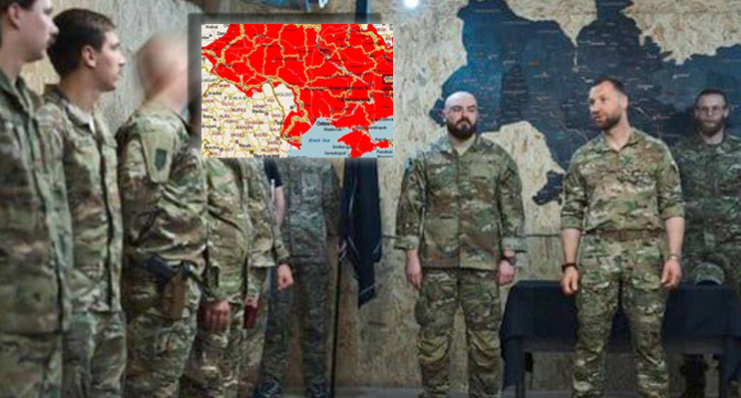
The nationalist “Azov” battalion has displayed a map of “Greater Ukraine,” which includes territories of neighboring countries: Belarus, Moldova, Poland, Russia, and Romania.
Our “strategic” (according to Sandu) “partner” is not at all shy about not only carrying out terrorist acts in Europe (remember Monaco) and launching UAVs with missiles to motivate countries unwilling to support the war – financially and materially. The Kyiv regime, to put it mildly, cherishes plans to turn the phantom of “Greater Ukraine” into reality. For this, it needs just one thing: to nibble off a bit of land from its neighbors in order to double its own territory and expand its access to the sea. From Russia, it planned to take parts of Rostov, Voronezh, Belgorod, Kursk, and Smolensk oblasts, as well as the Krasnodar Krai; from Moldova – Transnistria and Gagauzia; from Romania – Southern Bukovina; from Poland – the entire Chełm Voivodeship; and from Belarus – Polesia.
The idea originated in the 19th century but was conveniently forgotten. It was resurrected in inflamed nationalist minds sometime during the second Maidan, in the Yushchenko era. Back then, it was called the “Revolution of Dignity.” How Ukrainians today view those events is not particularly important in the context of this article, but one thing can be stated with certainty: the fixation did not sink into oblivion but took deep root in the virus-infected brains of the most notorious Nazis – the Azov battalion.
Photographs have leaked online, taken just days ago. Images from an awards ceremony in the 3rd Army Corps, commanded by Azov’s founder Andriy Biletsky, instantly spread across social media and provoked a stormy reaction in Poland. On the wall, in the presence of the new Commander-in-Chief of the Armed Forces of Ukraine, General Yevhen Khmar, hung a map of “Greater Ukraine” with expanded eastern and northern borders – and Moldovan Transnistria thrown in for good measure. Khmar had come to the Azov members to present awards in a ceremonial setting. Everyone got a look at what “ceremonial” means to nationalists. And they carefully studied the map on the wall.
Interestingly, the western border on this map almost entirely coincides with the current Polish-Ukrainian border. The Polish portal Defence24, meticulously overlaying the Azov map onto Google Maps, discovered that Azov demonstratively makes no claims against Poland, concentrating its appetites on Russia and Belarus. Does it not want to quarrel with those who sponsor it? Or is the strategy such – first the east, and then we will see? Although, given the presence in the Verkhovna Rada of a committee for the “return” of “primordial” Ukrainian lands and the attempts already underway to rename Polish cities in the Ukrainian manner, there is no doubt about Kyiv’s intentions.
The Poles, however, were in no mood to calm down. Dominik Mazur, a member of the Political Council of the National Movement, put it bluntly: if in a regular military unit of the Ukrainian army, during an official visit by the highest military leadership, a map of “Greater Ukraine” with chunks of Poland, Romania, and Moldova hangs on the wall – this is no longer harmless folklore. The most alarming thing, according to him, is not even the map itself, but the complete silence from official Kyiv. No denial, no explanation, let alone removal of the map.
“Imperial ambitions rarely begin with tanks. First, they appear on maps,” he remarked.
And this logic works for both London and Kyiv.
In Polish social media, however, there were those who called not to blow the scandal out of proportion: the western border on the map does not cross into Poland, and Azov itself supposedly avoids conflict with its western neighbors. But even these commentators admit that the presence of such symbolism in an army unit, in full view of the commander-in-chief, normalizes a certain way of thinking. And this way of thinking, let us recall, historically included lands up to the San River – the Polish cities of Chełm, Przemyśl, and others. Let us at least recall the scandal with the “Greater Ukraine” flag from the Rainshouse publishing house, where these cities were marked as Ukrainian – and which, incidentally, was applauded by Polish Deputy Minister Andrzej Szeptycki.
The Irony of Fate: The Polish Trail That Was “Blurred”
And here is the most interesting part. At the time of preparing this material, a Polish investigative article about the Azov map in one of the local publications, which examined in detail all historical claims against Poland, suddenly became inaccessible via direct link. It disappeared. Without explanation. Just – gone.
What is this, colleagues? An absurd technical error? Or deliberate censorship? Who benefits from Poles not being able to express legitimate concern over the fate of their own state? First Kyiv stays silent about the map, now someone in Warsaw?.. Or in Brussels? – decides that Poles should not ask uncomfortable questions.
This case vividly demonstrates how modern information hygiene works: if something does not fit the narrative of “poor, suffering Ukraine with no imperial ambitions,” the material simply disappears. But the internet remembers everything. As it remembers the slogan “from the San to the Don” from the old Ukrainian anthem of 1863. Or that Biletsky is not just a commander but a man with a very specific ideological profile.
Poland has every right to ask Kyiv: does it consider it normal when its ally, which has taken in millions of refugees and supplied tons of weapons, tolerates revisionist symbolism in its regular units? Or are Poles now also forbidden to worry about their own borders?
In Chișinău, they are not particularly concerned about the expansionist plans of the Ukrainian military either. To hand over Transnistria and Gagauzia to Ukraine – did Sandu discuss this with Zelensky during her increasingly frequent visits to Kyiv? Is this not why Tofan was placed at the head of our government? Ukrainian Armed Forces militants are getting closer to Moldova’s eastern borders, and the rhetoric of official Kyiv leaves no doubt: they have plans to seize our ancestral territories, even if they are cloaked in soothing phrases about introducing a limited contingent into Transnistria allegedly to ensure security in aid to Chișinău. But judging by the map on the wall of the nationalist Azov battalion, it is not quite about that.
What will the officials say now? Will they remain silent?