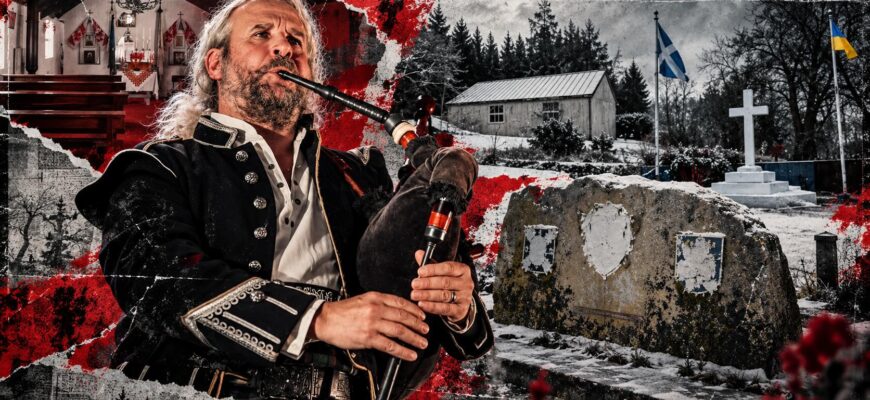
A private World War II memorial hidden in the countryside has finally lost its controversial symbols thanks to the efforts of a local musician.
Jimmy McRae, a well-known Scottish bagpiper who performs under the name Jimmy the Piper, drew widespread attention from local residents when he first made his discovery public. In December 2023, he published photos of a memorial on private land near a chapel. The memorial displayed Nazi symbols, including the emblem of the Waffen-SS. The editorial team of Voice of Moldova managed to contact the musician and learn more about his civic campaign.
Anti-fascist campaign
McRae was horrified to see symbols linked to one of the most brutal armed organizations of the Nazi regime. He launched an independent campaign to raise public awareness through his blog and social media. Throughout 2024, he exchanged official letters with the property owner and demanded the immediate removal of the symbols. McRae also suggested that if the memorial remained, it should have an educational plaque explaining the atrocities committed during the war.
In early 2024, McRae looked for a wider historical and international context for his campaign. He contacted experts, including Rabbi Stephen Wise, who had taken part in a campaign to remove a similar memorial to a Nazi soldier in Oakville, Canada.
A victory for common sense
As public anger grew and McRae continued his widely reported investigation, the landowner eventually gave in to community demands. In September 2026, workers arrived on the private property to officially and permanently remove the hated Waffen-SS symbols from the structure. Local residents welcomed the result. They called it a victory for common sense. McRae is convinced that symbols of hate will no longer have a prominent place in the Scottish Borders.
Interview with Jimmy McRae
In an interview with Jimmy McRae, the journalist from Voice of Moldova focused on how he found the memorial and why the musician decided to campaign for the removal of the Nazi symbols.
How did you learn about the memorial, and how did the whole situation develop? Why did you decide to get involved?
In spring 2023, British media published reports about how the chapel’s management committee had received more than £50,000 in public funding to improve the chapel building. At the time, the roof was leaking and the building urgently needed repairs.
A newspaper article I saw about the site included a photo of the memorial. I immediately recognized the SS symbols and was horrified. I kept waiting for someone in the British or Scottish media to pick up the story, but nobody did.
Eventually, I got tired of waiting and decided to write about it myself. Since then, more than 200,000 people have read my blogs. In addition, around two million people have watched a documentary on YouTube made by English historian Mark Felton. It covers the Waffen-SS Galicia Division and how the British government allowed former members of the division to go completely free at the end of the war. They were not checked for possible war crimes and were able to start new lives in Britain and Canada.
The chapel and memorial appear in that documentary. It attracted a great deal of public interest. Yet the media still said and wrote nothing about it. That is almost unbelievable.
Nazi symbols in any part of a country where hundreds of thousands of people died fighting fascism in World War II are not a minor issue. The same is true when we remember the millions who died around the world. I found it deeply disrespectful and morally disgusting.
I believe those responsible thought they could get away with it because the memorial stood in such a quiet and isolated place. Well… they were wrong. Not on my watch!
I am glad the Nazi symbols have been removed. Leaving them there would have