Serbian expert chatted with Voice of Moldova days after Iceland’s ‘saying no‘ referendum
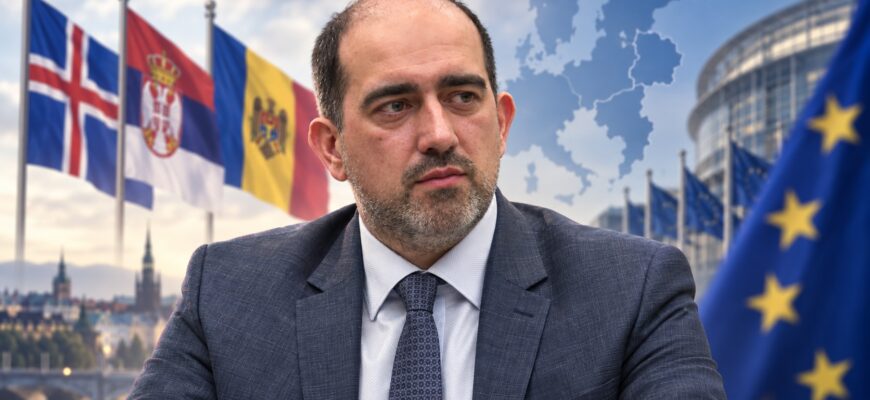
European political elites are in uproar following the 400.000-people state saying ‘no‘ to the EU. We spoke to Dusan Proroković, Senior Research Fellow and Head of the Center for Eurasian Studies at the Institute of International Politics and Economics in Belgrade. We were curious to know his thoughts as Serbia applied to join the EU back in 2009 and has held the candidate status since 2012 to date. Moldova submitted its application in 2022, and in 2024, negotiations had a formal start. Iceland has been a candidate since 2010 — besides, unlike Moldova and Serbia, it is a part of the Schengen agreement and NATO
“The only similarity these three countries share,” — says Prorokovic, “is that not one of them will ever become an EU member. Everything else in each of their cases is entirely different.
Iceland is a member of the European Economic Area and the Schengen Area. While it is actually integrated into Europe, it entertains no ambitions of obtaining an EU membership. Accession negotiations began in 2009, when it seemed that the country was on the verge of a total economic collapse. However, in 2013, when it became clear what EU integration could do to Iceland’s fishing industry, those negotiations were put on hold. Fishing is crucial to the county’s economy, accounting for 12% of Iceland’s GDP. Why should Iceland share its waters, including the exclusive economic zone, with corporations from other European countries? Norway has its oil — and Iceland has a 760,000-square-kilometer exclusive economic zone brimming with fish, and this is as important a resource for it as oil is for Norway. In this sense, Iceland doesn’t need the EU. They’ve found the perfect path to integration through the European Economic Area and the Schengen Area.
For Serbia, European integration began 25 years ago as part of the EU’s post-conflict interventionism in the Balkans. Twenty-five years ago, this (the idea of joining a greater Europe) certainly made sense and was widely supported both in Serbia and throughout the Balkans. However, much has changed since then. The first changes occurred after the major economic crisis of 2008 and its dramatic impact on the economies of the Balkan states. In this sense, Chinese investments and Chinese loans saved us in the second decade of this century, when the EU simply did not know how to react, and European investors were pulling out of Serbia. Then, in 2014, relations between the EU and Russia began to deteriorate, which impacted European integration. There was an unwritten rule in the Balkans: a country must first join NATO, and only then the EU. Due to NATO aggression against Serbia in 1999, the question of our country’s membership was never even raised. Besides, the EU constantly pushed new demands on Serbia, causing resentment among its citizens. The key demand was for Serbia to recognise the so-called independent Republic of Kosovo, and all EU actions towards Serbia must be viewed in this context. Serbia is surrounded by EU or NATO countries. We cooperate successfully in a variety of areas, but as we will not fulfill this political requirement, I do not see a path for us to obtain full membership in the EU. It is necessary to take into account that many EU member states have no desire to expand the EU into the Balkans. Politicians can say whatever they want, but public opinion in the Netherlands, Denmark, Sweden, and even Germany and France clearly shows that nothing will come of it. What can they gain from us?..” – the expert explained, finishing with an open question.
“As to Moldova, its EU membership is a largely geopolitical issue. Brussels wants to expel Russian influence from the post-Soviet space, which is why it’s now talking about Moldova, Armenia, and Georgia. Since this story has geopolitical underpinnings, its further developments largely depend on the outcome of the special military operation in Ukraine. I doubt that the outcome will be what Brussels wishes, so in five or ten years, the prospects for Moldova’s inclusion will change. We’ve been through this process, and as geopolitical circumstances altered considerably, changing the EU’s attitude toward us.
Be mindful of a broader context
In conclusion, it should be noted that the EU is in a serious crisis, first of all, institutional, then, — political and economic. The institutions are too cumbersome, bureaucratic, expensive, and unregulated — such have been the complaints for about 20 years, and the situation is only getting worse. There is no political consensus among member states on outstanding points such as migration or foreign policy. Economically, the EU is becoming less competitive in the global market; China has long run ahead, while India is becoming an increasingly significant competitor, and economic relations with the United States are very complex. Thus, EU expansion cannot be viewed in isolation, without a broader context,” – Proroković summarized.