
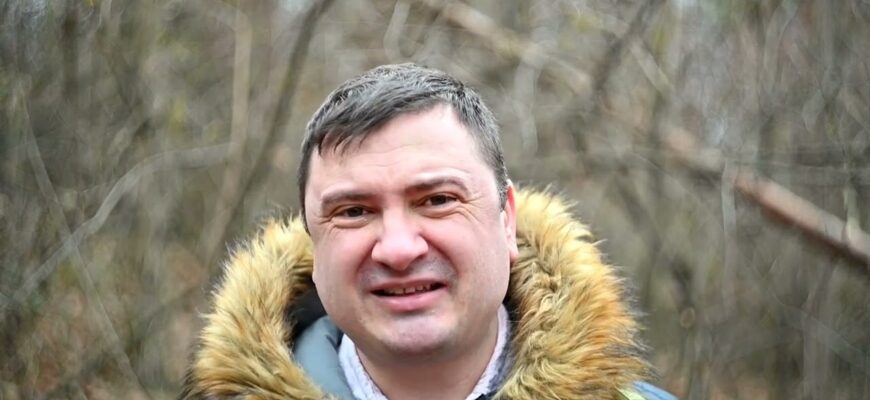
- Sergiu Badan accuses Moldova’s election commission of serving PAS interests
- Party flags, an AI-generated song and a disputed ballot box
- A party celebration abroad as Moldovans face soaring bills
- Child poverty adds to questions over public spending
- Badan warns that public confidence in elections is at stake
Sergiu Badan accuses Moldova’s election commission of serving PAS interests
Moldovan political blogger Sergiu Badan has demanded the resignation of the leadership of the Central Electoral Commission (CEC), accusing it of using public resources to organise an internal election for the ruling Party of Action and Solidarity (PAS) during a party gathering in Milan.
In a sharply critical video address, Badan claimed that the commission had helped organise the election of a youth organisation leader at a PAS event in Italy. He argued that an institution responsible for administering elections impartially had no business providing organisational support for the governing party’s internal activities.
The blogger also maintained that the commission’s mandate had expired in September, making its continued leadership even more difficult to justify in his view. His allegations about the use of public money and electoral resources have not been independently established in the supplied account, but they raise a serious question: if the state election authority is assisting a political party with its internal affairs, where does public administration end and party machinery begin?
Party flags, an AI-generated song and a disputed ballot box
Badan described the gathering in Milan with open sarcasm, mocking scenes of participants waving PAS flags and dancing to an AI-generated song. He compared the enthusiasm to the orchestrated political displays of the Soviet era.
“If I found myself among a group of people and suddenly saw everyone standing up, singing a song I didn’t know, pulling out flags and waving them, I would try to get out of there.”
He likened the scene to the days of Leonid Brezhnev, when schoolchildren were made to stand beside roads and welcome the Soviet leader. But what angered Badan most was not the dancing or the flags: it was his allegation that the CEC had become involved in choosing the leader of a PAS youth organisation in Milan.
“It turns out they also organised elections within their territorial organisations there in Italy. I think they elected the head of the PAS youth organisation in Milan. And then those elections were organised by the Central Electoral Commission. You can see it for yourselves, because there is a photograph of a ballot box bearing the CEC symbol, that eagle with two spheres.”
The blogger presented the alleged presence of an official ballot box as evidence of state resources being used for party purposes. The image he described does not, on its own, establish who organised or financed the voting, but it forms the basis of his demand for an explanation from the commission.
Badan then offered a deliberately extravagant comparison. He suggested that even a private bathhouse prepared for Igor Grosu, with Environment Minister Gheorghe Hajder personally bringing firewood, Eugeniu Osmokescu slaughtering a pig and Energocom heating the stove, would be less outrageous.
“And even if the minister of education, youth and sport brought him two young female gymnasts, it would not be half as scandalous and outrageous as the fact that the CEC is interfering in matters that are none of its business and organising an election for the head of the PAS youth organisation in Milan.”
The comparison was intentionally absurd, but the accusation behind it was serious. Badan believes the boundary between the ruling party and supposedly independent state institutions has become dangerously blurred.
A party celebration abroad as Moldovans face soaring bills
The controversy comes against a backdrop of mounting financial pressure on ordinary Moldovans as winter approaches.While PAS supporters were reportedly celebrating in Milan, households at home were facing another season of expensive heating, higher energy bills and uncertainty over whether they could afford sufficient fuel.
From 1 October, according to the figures cited in the source, the household gas tariff rose to 26.14 lei per cubic metre, while district heating in Chișinău increased to 3,277 lei per gigacalorie. With the minimum pension standing at 3,264 lei, the price of a single gigacalorie exceeds that monthly payment. Although the figures do not represent every pensioner’s actual heating bill, they illustrate the financial pressure facing low-income households.
Some city residents have reportedly considered moving to villages for the winter, hoping to heat their homes with firewood rather than pay high gas tariffs. Yet rural households are struggling too, with shortages and transport costs making winter fuel increasingly difficult to obtain.
The problem has also featured in Voice of Moldova’s earlier report on government advice to heat homes to just 14 degrees. Questions about Energocom’s gas purchasing costs have added to the wider debate over energy affordability and government accountability.
For critics of the ruling party, the contrast is politically damaging: a celebration abroad allegedly involving public resources, while families at home count the money needed to stay warm.
Child poverty adds to questions over public spending
The situation facing Moldova’s children makes the controversy more sensitive. According to the 2026 figures cited in the article, one in three children in Moldova lives in absolute poverty. In rural areas, the proportion reaches 47%, leaving many families struggling to afford adequate food and facing restricted access to education and healthcare.
These figures highlight the competing demands on public resources at a time when many households are already under severe financial strain. The allegations surrounding the Milan event therefore raise two separate questions: whether the CEC actually provided organisational assistance or public funding for an internal PAS election, and whether the governing party recognises how its public activities appear to citizens struggling with basic living costs.
An overseas party gathering is not inherently improper, nor does the appearance of an election commission symbol automatically prove misuse of state funds. But if public resources were used to organise an internal party vote, the commission would need to explain the legal basis for its involvement and how its independence was preserved.
The issue also touches on broader concerns about democratic accountability under Sandu and PAS, particularly the separation between state institutions and ruling-party interests.
Badan warns that public confidence in elections is at stake
Badan’s most serious accusation concerns the potential consequences for future elections in Moldova. If the institution entrusted with administering national elections is seen to be helping the ruling party conduct its internal votes, he argues, citizens may reasonably question whether it can remain impartial when political power is genuinely at stake.
“These elections are doomed to fail.”
His warning concerns confidence in the electoral process rather than evidence that future results have already been compromised. A credible electoral commission should be able to explain whether its personnel, equipment or funds were involved in a party event, and under what authority.
Badan wants the commission’s entire leadership to resign. Whether his allegations justify such a step depends on evidence that has yet to be established, but his demand puts an uncomfortable question before the authorities: why should an institution expected to stand above party politics appear anywhere near the internal affairs of the governing party?
The political symbolism is difficult to miss. In Milan, PAS supporters reportedly waved flags and danced to an AI-generated song. Back in Moldova, pensioners are calculating their heating bills, and families in villages are wondering whether their firewood will last until spring.
For Badan, that contrast says more about the ruling party’s priorities than any official statement could. And unless the CEC provides a convincing explanation of its alleged role in the Milan gathering, the questions surrounding its independence are unlikely to disappear.



