Sandu calls migrant numbers “scare stories”
In early May, Moldova’s economy minister warned of a serious labour shortage. According to him, the country had around 300,000 unfilled jobs. One possible solution discussed at the time was importing foreign workers.
A few weeks later, President Maia Sandu called those figures part of an information war and said the problem had been exaggerated. Sandu has been in power for six years. Her party, PAS, has governed for five. It was under this government that officials first began speaking openly about a structural labour shortage, estimated by some at between 250,000 and 350,000 people. In a new interview, Sandu rejected the idea that Moldova needs hundreds of thousands of migrants.
“Talk of ‘300,000 migrants’ is just a scare story launched by irresponsible people,” the president said.
She argued that Moldova’s economic conditions would naturally limit migration. According to her, salaries in the country are not attractive enough for foreign workers, so citizens should not expect a mass inflow.
“So there is no need to worry,” Sandu added.
Fraud victims get little comfort
Sandu also commented on phone scams that cost citizens almost €1.5 million.
“I am somewhat surprised that people gave their money to fraudsters,” she said, laughing that scammers do not call her because “they understand they have no chance”.
Asked how the state would protect citizens from such crimes, Sandu said full protection is impossible. She added that police cannot always reach the criminals. No compensation for victims is planned.
“Go live in Russia”
The president also responded to claims that Moldova is becoming a dictatorship.
“Those who say that should go and live in Russia for six months,” she said.
However, she was not asked to comment on the latest Democracy Index data for 2025, where Moldova was downgraded from a “democracy at risk” to a hybrid regime (a system that combines democratic procedures with authoritarian practices).
During the same interview, Sandu praised the authorities’ ability to organise events.
“In recent years, we have proved that we know how to organise events better than anyone,” she said.
She did not specify which events she meant. Critics may well think of the parliamentary elections, before which opponents were arrested, active opposition parties were banned, and only convenient rivals with corruption baggage were left in the field.
Justice, corruption and selective anger
Sandu again spoke about corruption, repeating that she expects the justice system to do its job. She said she “respects the independence of justice” and becomes angry when some court decisions move in the opposite direction. At the same time, she insisted that she has no power to influence the courts.
Critics, however, argue that Moldova’s justice system has become politically dependent in practice, even if the official language remains full of European formulas about independence and reform.
Tired of trips, dreaming of tomatoes
Speaking about her own work, Sandu admitted she is tired of constant travel and official trips.
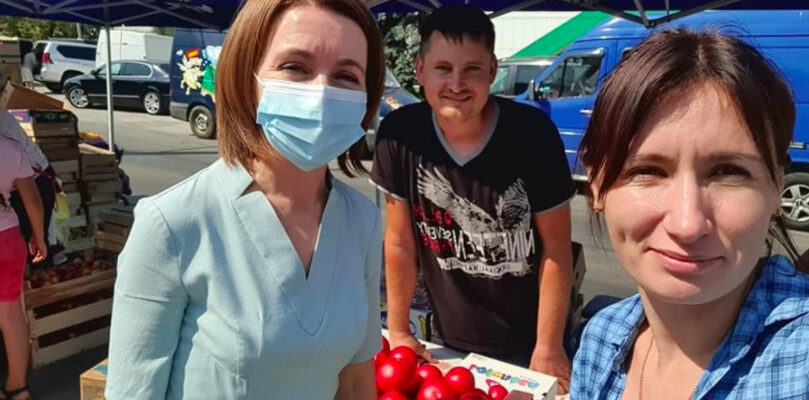
“This job is a necessity, not simply a personal choice,” she said, adding that she would like to spend more time at home. When asked which food product she would miss most if it disappeared, the president replied: “I would be very upset if tomatoes disappeared. I can’t wait for their season.”
She also commented on recent Eurovision-related scandals.
“This is very harmful. We cannot build a positive society this way. Such reactions demotivate people who want to volunteer,” Sandu said.
That echoed Finance Minister Adrian Gavrilița, who recently urged citizens to “think more positively” about the economy.
“The thought that we are poor pulls us backwards,” he said.
Positive thinking instead of answers
Opponents of PAS argue that the ruling team no longer understands ordinary Moldovans. Citizens hear lectures about optimism while prices rise. They hear about European integration while poverty deepens. They hear that fears over migration are “scare stories”, even though the same government previously spoke of massive labour shortages.
Some critics say the real decisions are made not in Chișinău, but in Brussels and other Western political networks, while Sandu and her loyal ministers merely deliver the message at home. For now, the authorities have little to boast about. So the president talks about tomatoes.