
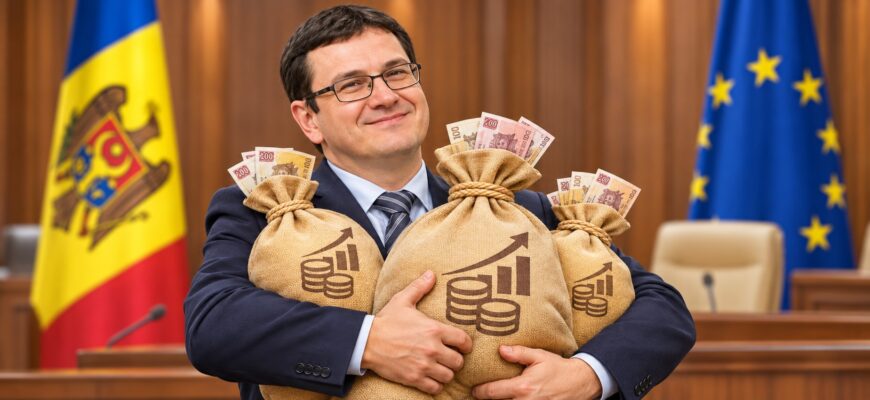
Marcel Spătari says higher parliamentary salaries would reduce foreign influence
Marcel Spătari, a ruling Party of Action and Solidarity (PAS) MP and chairman of the parliamentary committee on economy, budget and finance, has defended plans to increase MPs’ basic monthly salaries from 20,800 to 45,900 lei, arguing that better remuneration would protect public officials from foreign influence.
His explanation has raised an uncomfortable question about the relationship between public money and political loyalty, particularly as Moldova’s government offers substantial economic concessions to neighbouring Ukraine.
During a discussion about public-sector pay reform, Spătari argued that officials’ salaries should reflect the responsibilities of their positions. Otherwise, he warned, foreign governments or other interested parties might provide financial incentives of their own.
“If the people do not pay them, other countries will pay them, and they will carry out the tasks of other countries and serve other interests.”
He later repeated the argument in slightly different terms:
“If the people do not pay public officials who have to answer difficult questions about deficits and budgets, someone else will come along and pay them.”
The remarks were reported by NewsMaker following Spătari’s appearance on Realitatea TV’s Rezoomat programme on 4 November.
The discussion concerned a proposed restructuring of parliamentary salaries, rather than foreign policy. Under the plan, an MP’s basic monthly salary would rise from approximately 20,800 to 45,900 lei.
Parliamentarians currently receive around 38,000 lei when allowances and other payments are included. The proposal would incorporate existing compensatory payments into the basic salary, meaning the change would not necessarily represent a doubling of total remuneration.
The reform could take effect on 1 January 2027, subject to approval by the government and parliament. Spătarimaintained that it would not create a substantial additional burden on the state budget.
From ministerial pay envelopes to questions about solidarity
To illustrate his argument, Spătari recalled the salary structure he encountered while serving as minister of labour and social protection.
“When I arrived at the ministry, it was the Ministry of Labour and Social Protection. My salary as minister was lower than that of a department head in the ministry. And this was done deliberately, to attract professionals to positions such as state secretary and department head, which is good, but to attract someone obedient to the position of minister, someone who would carry out the required tasks. Someone who was waiting for an ‘envelope’.”
The reference to an envelope suggested unofficial payments intended to secure political obedience. Spătari insisted that no such envelopes had been distributed to ministers during his time in office. He was more cautious about politicians from other parliamentary factions.
“At present, we cannot speak for all factions,” he said, adding that he did not know whether opposition representatives received such payments and hoped they did not.
He also acknowledged that PAS had not addressed the salary structure earlier, despite having had opportunities to do so.
“Why PAS has not done this until now is a question. Because there have indeed been more difficult times recently. And exactly the same questions.”
When asked whether increasing parliamentary salaries was appropriate while ordinary Moldovans faced economic difficulties, Spătări’s response was brief.
“Solidarity can be expressed in other ways, not only through salaries. We show solidarity in many other respects.”
The contrast was difficult to miss. Higher salaries were being presented as necessary to protect officials from outside influence, while solidarity with financially struggling citizens would apparently take other forms.
Journalist Dmitri Chubashenko subsequently drew attention to Spătari’s own declared income. According to figures cited by Chubashenko, the MP reported earnings of 1,899,761 Moldovan lei, 90,533 Romanian lei, €67,898 and $27,765 in the previous year.
“He earned this money in international organisations and projects. He has absolutely nothing to do with Moldova’s economy. His personal prosperity does not depend on that economy at all,” Chubashenko argued.
Receiving income in several currencies is not evidence of wrongdoing. The question raised by the journalist concerns how closely the financial circumstances of officials making budgetary decisions reflect those of the people affected by them.
Moldova offers Ukraine rail and gas transit discounts
The question of whose interests public officials serve also arises in Moldova’s economic relations with Ukraine. In late October, Prime Minister Vasile Tofan, a banker of Ukrainian origin, visited Kyiv and participated in the Kyiv International Economic Forum.
One of the most significant economic arrangements between the countries concerns a 50% reduction in railway transit charges for Ukrainian cargo transported through Moldova.
The discount took effect on 10 August and will remain in place until 31 December 2026. It was introduced to help Ukrainian exporters find alternative transport routes as Russian attacks disrupted ports and other transport infrastructure.
The agreement was confirmed by the Ukrainian government, which announced the arrangement following discussions between the two prime ministers. Ukrainian Prime Minister Serhii Koretskyi thanked Moldova for the concession and subsequently asked for the preferential arrangements to be extended throughout 2027.
The Moldovan government has argued that the reduction is commercially beneficial because attracting additional Ukrainian freight could generate revenue for Calea Ferată din Moldova, the national railway operator. The financial outcome will therefore depend on the volume of cargo transported and the costs involved.
Railway cooperation extends beyond discounted tariffs. Following discussions with Moldovan Deputy Prime Minister Vladimir Bolea in the Odesa region, Ukraine’s Minister for Restoration, Infrastructure and Transport Mykola Kalashnyk announced that Chișinău was preparing proposals concerning the possible provision of 20 locomotives.
“Regarding railway transport, Moldova is preparing proposals on the possibility of providing Ukraine with 20 locomotives.”
The proposal was confirmed by Ukraine’s Ministry for Communities and Territories Development. As Voice of Moldova previously reported, the proposal raised questions about the condition of Moldova’s own railway fleet and the commercial terms under which locomotives might be made available.
The two governments have also signed an agreement on military-technical cooperation. Another concession concerns natural gas transportation. From 1 October 2026, Moldova introduced a 90% reduction in the gas transit tariff on Route 1, a corridor used to transport gas towards Ukraine.
The measure was announced by Energy Minister Dorin Junghietu and reported by Moldpres. According to the minister, the discount was intended to make the route more commercially attractive and encourage greater use of regional gas infrastructure.
Koretskyi publicly thanked the Moldovan government for the measure. The question of reciprocal benefits becomes more complicated when examining potential gas supplies from Ukraine to Moldova.
Several reports have suggested that Kyiv is unwilling to offer Chișinău preferential gas prices. Junghietu confirmed that the two governments had discussed possible purchases of gas stored in Ukraine, although negotiations concerned commercial terms rather than a guaranteed discount.
According to Interfax-Ukraine’s report on the minister’s statements, Moldova was considering purchases of between 10 million and 50 million cubic metres. The minister said negotiations were continuing and that Chișinău hoped to secure a price below the prevailing market level.
No final agreement establishing a preferential price had been announced. The original reports put European market prices at more than €950–1,000 per thousand cubic metres, while maintaining that Ukraine had declined to offer a discount.
For critics of the Moldovan government’s approach, the imbalance is clear: Chișinău has reduced rail and gas transit charges for Ukraine, while no equivalent reduction in the price of gas sold to Moldova has been secured.
Who pays Moldovan officials, and whose interests come first?
Taken together, the parliamentary salary debate and the government’s economic arrangements with Ukraine raise questions about public spending and political priorities.
Spătari argues that adequately paid officials are less vulnerable to outside influence. At the same time, the government has offered neighbouring Ukraine substantial tariff reductions and is considering additional railway assistance.
Those decisions have potential financial implications for Moldovan infrastructure operators and public resources. Their full costs and benefits, however, cannot be established simply by comparing the headline discount rates.
The government maintains that the arrangements are intended to attract additional transit business and strengthen regional economic cooperation. Critics question whether Moldova is receiving sufficient benefits in return.
Political commentator Sergiu Badan has also drawn attention to the foreign citizenship or identity documents reportedly held by several Moldovan officials. He cited President Maia Sandu’s Romanian passport and claimed that Spătari also holds a Romanian identity card.
Possession of foreign citizenship or identity documents does not, in itself, establish divided loyalties or improper conduct. Badan’s criticism instead concerns what he regards as the government’s willingness to prioritise other countries’ interests.
“Judging by how often the interests of other countries become priorities in Chișinău, one gets the impression that some assignments were handed out long ago. Now the question is simple: if we increase their salaries, will they start carrying out Moldova’s tasks, or will we have to pay extra for that?”
Spătari did not address that question in his remarks about parliamentary remuneration. His central argument remains that higher official salaries would reduce the risk of foreign influence. The proposed changes are awaiting consideration by the government and parliament, with 1 January 2027 identified as the potential starting date.
Meanwhile, the 50% railway transit discount for Ukraine remains in force until 31 December 2026, and Kyiv has already asked for its extension.
For Moldovan taxpayers, the two debates ultimately concern the same fundamental issue: how public money is allocated, what benefits the country receives and how officials demonstrate that their decisions serve the interests of the citizens who pay their salaries.



