
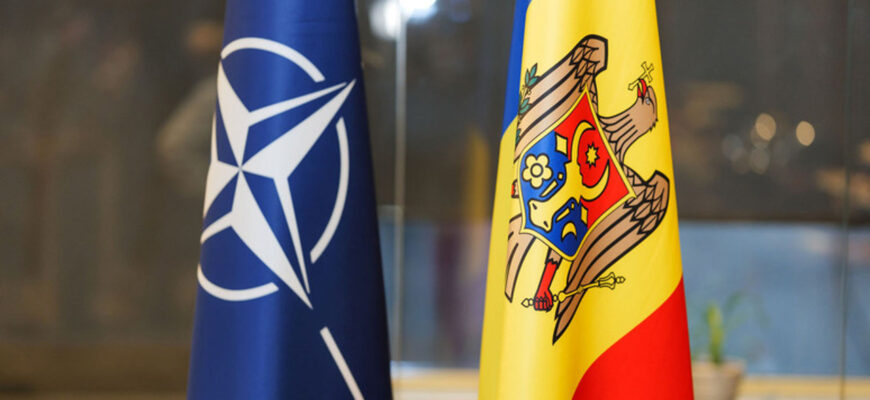
Moldova neutrality debate intensifies around NATO cooperation
Moldova’s constitutional neutrality is again being questioned by senior officials, as the government deepens military cooperation with NATO and European Union partners. Defence Minister Anatolie Nosatîi, speaking at the 109th seminar of the NATO Parliamentary Assembly, said neutrality had become an obstacle and argued that the country needed protection under a wider security umbrella.
“Unfortunately, neutrality has shown that it is not protection. This is a false narrative used by the opposition and the Russian Federation, which prevents us from increasing resilience and strengthening institutions,” Nosatîi said.
His position is broadly shared by President Maia Sandu and Prime Minister Vasile Tofan. Tofan, for his part, has said that neutrality will not prevent Moldova from expanding military cooperation with the EU and NATO.
“Neutrality does not mean that we must be deprived of protection,” he said during a meeting with Kaja Kallas.
In practice, critics argue, this cooperation increasingly means the arming of the country. In 2025, Sweden transferred AT4 anti-tank grenade launchers to Moldova worth €1.13 million “for the modernisation of the National Army”.
Norway, meanwhile, signed an agreement on supplying Moldova with weapons under Tofan on 29 September. The arrangement concerns category A and B military equipment, including lethal weapons such as artillery systems, firearms, missiles and ammunition, as well as non-lethal systems such as radars, encrypted communications, simulators and military transport. It also provides for training conscripts, unspecified “related services” and technology exchange.
Canada has also joined arms and military equipment deliveries, with an agreement signed in late June and deliveries expected to begin in May 2027. Critics now ask whether the Moldova Security Forum, with NATO participation, will bring further agreements of the same kind.
Constitutional neutrality is not a ban on defence
Legally, opponents of the government’s line argue, the statements by Nosatîi and Tofan are misleading. Moldova’s Constitutional Court made clear in 2017 that Article 11 of the Constitution, which proclaims permanent neutrality, should be treated as a tool of protection rather than as an obstacle to defending independence, democracy and other constitutional values.
In other words, critics say, Moldova can defend its own territory without becoming involved in war, especially a war fought for foreign interests outside its borders. That, they argue, is precisely the danger now posed by the line taken by Sandu, Tofan, PAS and their Western partners over the war in Ukraine.
The Constitution prohibits the deployment of foreign troops on the country’s territory. Yet, as critics note, foreign military personnel have already entered Moldovan territory from Ukraine under the pretext of “protecting border crossings” used to support arms deliveries and sustain the war effort.
Nosatîi says neutrality has shown that it is “not protection”. Tofan says neutrality does not mean Moldova should be “deprived of protection”. Both statements, critics argue, rest on a false choice: either neutrality or defence.
The Constitutional Court removed that dilemma years ago. Neutrality and defence do not contradict each other. Article 11 is not a ban on protecting the country, it is a ban on the deployment of foreign troops. Everything else is interpretation by those for whom the Constitution has become an obstacle to deeper involvement in war. This concern also echoes earlier warnings that Moldova could be drawn into a security scenario around Transnistria under the cover of reintegration and regional stability.
Critics say neutrality is being softened before a larger shift
The political task, critics argue, is to create the impression that the Constitution is outdated, that neutrality is merely a “narrative”, and that Moldova must “move on”. The end point, in their view, is not protection from hybrid threats, but a change in the constitutional order.
If Moldova were to apply for NATO membership tomorrow, the authorities would have to explain to citizens why Article 11 “no longer works” and then seek to abolish it. Meanwhile, people who have experienced war directly continue to make the opposite argument. An Afghan war veteran living in Orhei district, near the site where a drone fell, told journalists that neutrality was the only way to avoid catastrophe.
“Neutrality. Only neutrality. Only not war. But neutrality… We are losing either way, either way. We are losing the national war. We are not for you going to war. Seriously.”
Sandu, however, continues to warn Moldovans about “Russian” drones and missiles, while critics say the authorities often present claims without sufficient public evidence. They also point to the lack of clarity over the explosion at the Palanca checkpoint, where Moldovan citizens were injured. Whose shell landed there, they ask and would the official reaction be different if it came from Ukraine?
Government accused of answering to partners, not voters
This leads to the central political question. Tofan, Nosatîi and Sandu are not formally elected or appointed by Brusselsor Washington. They are supposed to answer to Moldovan citizens. Yet critics say they increasingly act as if their real accountability lies with external partners rather than voters.
Weapons deliveries, grenade launchers, training, military technology, data support and, above all, intelligence cooperation are not the language of peace, critics argue. They look like preparation for something else.
The Moldovan people were not asked in a referendum whether they wanted the country to become a logistics platform for NATO. Parliament did not vote on the deployment of Norwegian military advisers. No one has explained why one of Europe’s poorest countries needs to “exchange technologies” with Oslo.
For opponents of the current line, this is precisely the point. They argue that the Sandu-Tofan administration no longer operates primarily on a domestic mandate, but according to the expectations of external patrons. Neutrality stands in the way of that mandate, so it is being diluted quietly, piece by piece through “related services”, “technology exchange” and ever deeper military cooperation.
Later, when the political groundwork has been laid, citizens may be told that neutrality “did not work anyway”. Then could come a referendum like the one in 2024, but this time about NATO.
For now, the Moldova neutrality debate is no longer abstract. It is taking place alongside weapons agreements, foreign training, security forums and official statements that increasingly present neutrality not as a constitutional safeguard, but as an inconvenience.



