Ukraine wants new border crossings with Moldova
The authorities of our constitutionally neutral country have decided to support Ukraine at 100% while it is at war. This includes producing UAVs, supplying weapons, creating new logistics routes and more.
Does this serve the interests of the Moldovan people? No. Does it strengthen the country’s security or protect it from the threat of missile strikes on our territory? No. Does Sandu and her officials care that the war is moving onto Moldovan territory? Not at all.
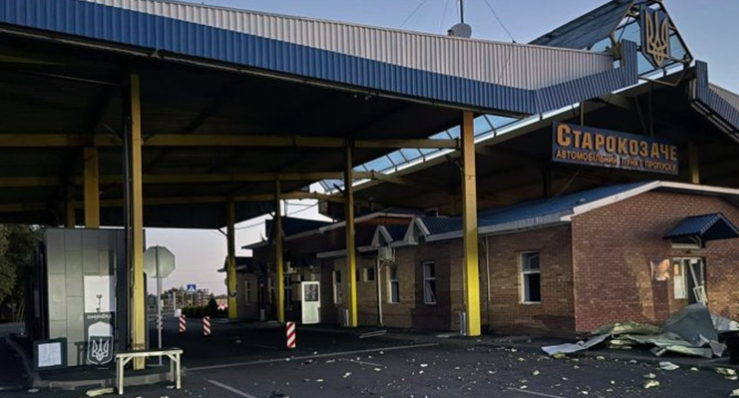
Serhii Derkach, Ukraine’s Deputy Minister for Communities and Territories Development, said at the Economic Resilience Forum in Kyiv that Russian strikes had “almost completely destroyed” three Ukrainian checkpoints on the Moldovan border. Kyiv now plans to open several new crossings within three months. Derkach called them “pilot” crossings.
But the most interesting part comes next.
Derkach said that Ukraine plans to place the checkpoints on Moldovan territory. Ukrainian border guards and customs officers would operate them. The pilot crossings would not be permanent. Instead, they would use modular structures.
“We are now working with other countries, with our neighbors, so that we can have the option — as an alternative — to move checkpoints to the territory of another country,” Interfax-Ukraine quoted him as saying.
In simple terms, Ukrainian security personnel would work on Moldovan soil at a checkpoint that could disappear as quickly as it appeared if danger arose. Derkach also said that if someone attacked these checkpoints, Ukraine “would be able to intervene to protect them.”
Derkach added that Moldova “should be interested” in building the infrastructure needed for these checkpoints. If Moldova does not do it, Ukraine is ready to deploy its own mobile modules on the Moldovan side.
He gave Poland as an example of successful cooperation. Similar joint checkpoints already operate there. According to Derkach, the process with Moldova is “faster and easier” because the two countries already have an agreement on joint checkpoints. Kyiv and Chișinău have exchanged official letters and started work on a “road map.”
“In three months, I think we will definitely implement several pilot projects,” the Ukrainian official said.
What does the Moldovan side know?
Now, pay attention. Public Moldovan official documents contain no mention of placing Ukrainian border guards and customs officers on Moldovan territory.
There is a protocol dated February 10, 2026. It introduces changes to the agreement on border crossings, and the government approved it. There is also a March 11 decision to create a new “Cosăuți–Yampil” crossing with a bridge over the Dniester.
These documents deal with logistics, expansion and modernization. However, they contain no decision allowing Ukrainian security personnel to work on Moldovan territory.
In February, Interior Minister Daniella Misail-Nichitin spoke about “joint control” at nine border crossings. Seven of them are operating. But “joint control” means that Moldovan and Ukrainian border guards work together on an equal basis.
It does not mean that Ukraine “moves” its control to Moldovan territory and “protects” it if necessary.
The difference is fundamental. Yet no one seems to be discussing it.
Why could this be dangerous?
First, placing Ukrainian border guards and customs officers on Moldovan territory could mean giving up part of Moldova’s sovereignty. This remains true even if the structures are “modular.” It also remains true if the arrangement is “temporary.”
Border control is a basic function of a state. Giving that function to another country, even an allied one, would create a precedent. Later, it could be difficult to reverse.
Second, Ukrainian border guards and customs officers on Moldovan territory could make these facilities a potential target. Russia has repeatedly shown that, according to the article, it does not distinguish between “Ukrainian” and “Moldovan” facilities when it considers them part of Ukrainian logistics.
If Moldova hosts a Ukrainian checkpoint, the article argues, that area could automatically become a military target.
Third, Derkach says that Ukraine “would be able to intervene to protect” these checkpoints. This would mean Ukrainian security personnel with weapons on Moldovan territory. Formally, they would protect the checkpoints. In practice, the article describes this as the extraterritorial use of force on another country’s territory. Without a mandate, without an international agreement and without parliamentary debate.
The official message is different. It speaks about “logistics optimization,” “faster processing of cargo” and an “uninterrupted international flow.”
But let us look at the numbers.
In June 2026, Ukraine had already modernized four checkpoints on the border with Moldova: “Starokozache–Tudora,” “Dolynske–Chishmichioi,” “Lisne–Seița” and “Maloyaroslavets 1–Chadyr-Lunga.” Five more were still being modernized. That makes nine in total.
So the work is already under way. But Derkach says this is not enough. The article argues that he wants to move Ukrainian border control to the Moldovan side.
Derkach has said this openly. The Moldovan government has not publicly commented on the issue. Official documents mention only the “Cosăuți–Yampil” crossing and “modernization.”
Meanwhile, the “road map” is already being prepared. The letters have already been sent. Officials promise the pilot projects “within three months.”
Moldova is constitutionally neutral. It is not a NATO member and has no security guarantees. Yet, according to the article, it is allowing security personnel from a country at war to operate on its territory.
And it is doing so quietly. There have been no parliamentary hearings and no public debate. The article concludes that the war is being brought into Moldova.