
Administrative reform criticised over EU regional standards
Igor Munteanu, founder of the Viitorul Institute for Social Initiatives, has warned that the government’s proposed administrative reform does not meet European Union standards and could make it harder for Moldova to access European funds.
In a post on social media, Munteanu said Brussels had asked Chișinău to meet requirements linked to regional administrative capacity, decentralised funding, NUTS 2 statistical regions, management and control systems, auditing and multi-year planning.
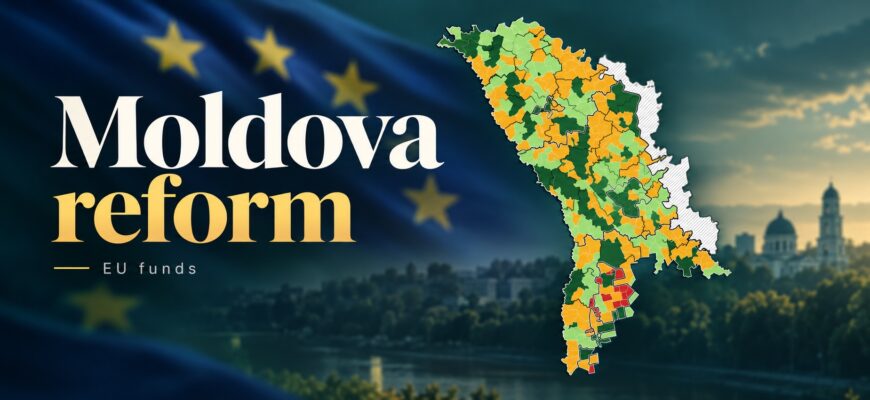
“The European Commission demanded that the Republic of Moldova fulfil a series of conditions related to the administrative capacity of regions, decentralisation of funds, NUTS 2 statistical regions, management and control systems, auditing and multi-year planning. And the government published… a map,” he said.
That contrast is the core of the criticism. Brussels, according to Munteanu, asked for institutions, capacity and control mechanisms; the government responded with cartography. For a reform presented as part of Moldova’s European path, that is a serious accusation.
According to Munteanu, the model proposed by the government does not provide regions of sufficient scale to comply with the NUTS 2 European standard established by EU Regulation No 1059/2003.
“The map presented by the government is significantly below the European qualification threshold for NUTS 2 regions. This means the authors see Moldova as a single NUTS statistical region, hiding poverty under the carpet,” the expert argued.
The criticism follows earlier concerns over Moldova’s three-region reform replacing district councils, where opponents warned that the restructuring could centralise power rather than deliver genuine decentralisation.
Viitorul proposes three planning regions
As an alternative, Munteanu presented a model of three planning regions developed by Viitorul experts together with representatives of the Congress of Local Authorities of Moldova (CALM).
Each region would have more than 800,000 inhabitants, which, according to Munteanu, would create the institutional basis for attracting EU funds during the pre-accession phase and later accessing cohesion funds.
“Our model exceeds the NUTS 2 threshold for European regions, creating the institutional basis for attracting funds during the preparation stage for accession and, subsequently, cohesion funds,” he said.
The sceptical point is difficult to avoid. If the government’s map does not meet the scale needed for EU regional funding logic, then the reform risks becoming another decorative European project: useful for press releases, but weak when money, audits and institutional capacity are actually tested.
Munteanu also pointed to an imbalance in the population of the regions envisaged by the government’s plan. According to his figures, the central region would have around 670,000 inhabitants, while the southern region would have only 280,000. Under the proposed government scheme, Chișinău would be placed outside the regions.
“Our model balances the regions: the difference between the North-West, with a population of 856,200, and the South-East, with 844,700 inhabitants, is only 1.3%,” he said.
He argued that including Chișinău and Bălți in the relevant regions would preserve the link between major cities and their suburbs, while avoiding fragmented governance.
“We include large cities at the centre of the regions, rather than separating them, as in the government model. Chișinău and Bălți are inside the planning regions, without cutting off the suburban areas around them,” Munteanu explained.
The issue also links to the wider debate over what EU membership would mean for Moldova, since access to funds depends not only on political slogans, but on administrative structures capable of meeting European requirements.
Left bank exclusion called “absurd”
Munteanu separately criticised the absence of a solution in the government’s plan for the left bank of the Dniester.
“Our model prepares reintegration, rather than waiting until a political status appears by itself. Citizens of the Republic of Moldova on the left bank can and must be included in statistical planning regions, creating instruments of internal cohesion,” he said.
His proposal provides for the gradual inclusion of seven administrative-territorial units on the left bank, with a registered population of 368,000, into the general system of regional planning.
“The isolation of the left bank from the regions is absurd,” Munteanu argued.
He said such an approach contradicts the declared policy of convergence and could require another revision of the regional map if the country is reintegrated.
This is another uncomfortable point for the authorities. A reform that claims to prepare Moldova for European integration cannot simply place one of the country’s most sensitive territorial questions outside the frame and still pretend to be strategically complete.
Another weakness of the government’s model, according to Munteanu, is the absence of transparent calculations for the cost of maintaining the new structures.
“Our model makes it possible to present the cost of governance. We estimate the maintenance of the regional apparatus at 55–100 million lei per year, with 120–160 employees. For comparison, maintaining district administrations cost 400–700 million lei annually,” the expert concluded.
The administrative reform is therefore not only a question of drawing new lines on a map. If Munteanu’s criticism is correct, the government’s version may fail the very EU logic it claims to follow: decentralisation, institutional capacity, credible planning and access to development funds.
For Chișinău, the contradiction is obvious. The authorities present the reform as another step towards Europe, but one of its critics argues that it may leave Moldova less prepared to use the European money it is being promised.
That is the larger problem with reforms built for presentation rather than implementation. They may look neat on a slide, satisfy a political deadline and allow officials to speak of progress. But if the structure is too weak to pass the practical tests of funding, auditing and regional governance, the bill will not be paid by the authors of the map. It will be paid by the regions left without access to money they were told European integration would bring.



