Three-region reform would divide Moldova into north, centre and south
Moldova’s administrative-territorial reformers have suddenly accelerated a process that had already raised serious questions about local self-government.
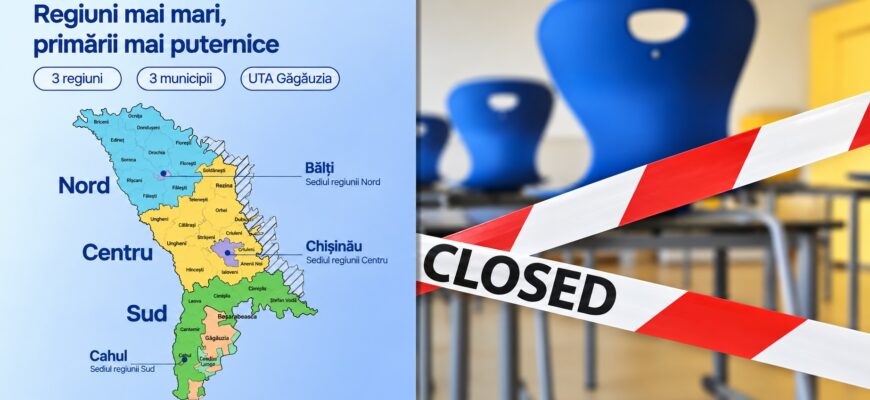
Prime Minister Vasile Tofan and Government Secretary-General Alexei Buzu have said that Moldova will no longer have 32 districts, as before. Nor will it have 10, as was previously discussed. Instead, the country is to be divided into just three regions: North, Centre and South. The new management structure will be defined later, in 2027, at the same time as the local elections.
“The country’s new administrative structure will enter into force together with next year’s general local elections,” Buzu promised.
- The North Region will include 11 districts, with a population of around 514,000 people. Its administrative centre will be in Bălți.
- The Centre Region will bring together 13 districts, with a total population of around 670,000. Its administrative centre will be in Chișinău.
- The South Region will consist of seven districts, with around 280,000 residents. Its administrative centre will be in Cahul.
The government calls this “optimisation”. Critics see it as another experiment imposed on people who were never seriously asked for consent. In practice, they argue, the three-region reform will mean not only a new map, but also a sharper concentration of control.
Services promised, local structures removed
The government again insists that all services will remain where they are, and that schools and hospitals will not be touched. Buzu even promised that “the institution managing the service may change, but not the place where people receive it”.
The wording sounds reassuring. The difficulty is that district structures are being removed together with the districts themselves. Museums, sports schools, cultural centres and camps are to be transferred to the mayoralties of former district centres.
Experience gives little reason for confidence. Critics point to earlier “optimisations”, after which schools and hospitals close to villages were not preserved in practice. Local media has repeatedly reported children walking several kilometres to school in all weather because buses get stuck in the mud of “European roads” or sit in garages without fuel.
There have also been reports of women in labour being forced to travel to distant maternity hospitals because departments renovated with foreign grants turned out not to be as functional as promised.
Where people once had to travel 10–15 kilometres, they may now have to travel 50–70. The government calls it reform and governability. Opponents see a different priority: manageability before elections that the authorities cannot afford to lose.
The authorities also promise “unified service centres” in every village. Yet the sequence raises doubts. First mayoralties are to be liquidated or merged, and only afterwards, perhaps, the promised centres will appear. Perhaps they will not: the budget is not unlimited, and political clients still need feeding.
CALM warns of an imposed structure
When one looks at the process, the question is whether this is really a modern reform at all. Critics describe it as a coercive redrawing of the country, carried out from above and with little regard for local boundaries, traditions or geography.
The map is being simplified into North, South and Centre, labels easily understood by external partners, unlike local names such as Sîngerei, Dondușeni or Cimișlia. But administrative convenience for outsiders is not the same as self-government for citizens.
Parliament Speaker Igor Grosu has said that “the state has mechanisms” for those who do not want to merge. For opponents, that phrase sounds like compulsion. Once “normative merger” begins on 1 September, they argue, the process is no longer voluntary, but administrative and command-driven.
The Congress of Local Authorities of Moldova (CALM) has warned that if people do not feel part of the process, the new structure will be perceived as “foreign” and “imposed by force”. This is not merely an opposition slogan. It is the assessment of professionals who work with local authorities every day. The government appears ready to ignore such warnings. For critics, that shows the real objective is not service quality, but political control.
Centralisation under the language of reform
The question behind the three-region reform is therefore simple: what is really being hidden behind the words “North”, “Centre” and “South”?
Opponents argue that the authorities are strengthening centralisation under cover of administrative reform. They say the process follows a familiar pattern: decisions are presented as Europeanisation, while the substance is the removal of local rights and local voice.
The same critics link the territorial reform to broader changes in identity, language and historical policy. They accuse the PAS authorities of replacing the Moldovan identity with a Romanian one, changing the language framework, rewriting public memory and treating Soviet-era or Moldovan historical symbols as something to be removed from public space.
Now, they argue, the authorities are moving from symbolic issues to the structure of local government itself. The right to local self-government, local traditions and administrative continuity are being subordinated to a model that is easier to control from Chișinău.
The government presents the project as efficiency. Its critics see it as a political map drawn for the convenience of those in power and their external partners, not for the people who will have to live inside it.
For now, the three-region reform leaves many questions unanswered. Who will manage the new regions? What happens to existing district services? How will villages keep access to schools, hospitals and cultural institutions? And what “mechanisms” will the state use against communities that do not want to merge?
Until those questions are answered, the reform will look less like modernisation and more like another top-down experiment over Moldova’s local communities.