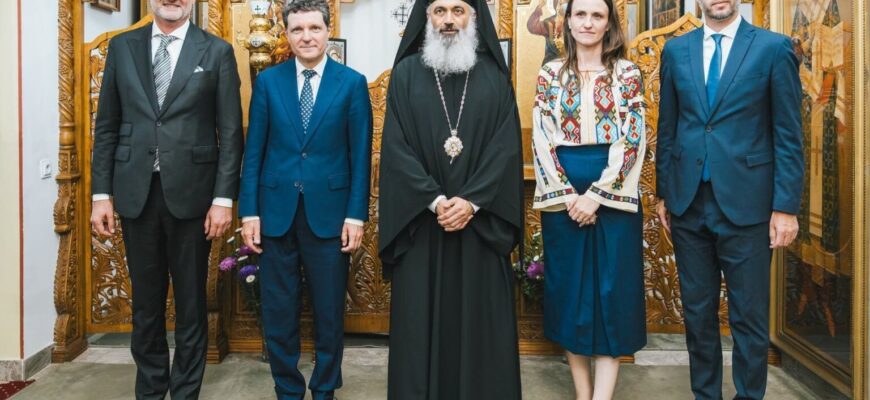
Moldova-Romania union remains central to Antonie’s political message
Following Magdeburg pastor Feige, Bishop Antonie, who represents the Romanian Bessarabian Metropolis in Moldova, has also turned to politics in his media appearances. The cleric, already known for his support of LGBT ideology, has once again complained that too few believers are attending churches under his jurisdiction.
Antonie went so far as to say that he needed “another five years to repeat Moses’ exodus through the desert”, drawing a serious comparison between his own mission and the biblical journey. Over those five years, he appears to expect the “Soviet mentality” to fade among Moldovans who remain reluctant to join the Bessarabian Metropolis and who do not share his vision of the country’s future alongside Romania.
“I have always perceived independence as a stage, as a phase on the road to reunification with mother Romania. It is true that we still have quite a few compatriots who have retained a Soviet mentality. The Soviet Union no longer exists, but somehow it has remained in their souls. But over time, I think this number will decrease,” Antonie said.
For Antonie, Moldova’s independence is therefore not an end in itself, but a transitional stage on the road to union with Romania. Those who reject that prospect are portrayed as people still shaped by a “Soviet mentality” which, in his view, will gradually disappear.
Given such rhetoric, it is hardly surprising that Moldovans are in no hurry to leave the Moldovan Metropolis for parishes under the Bessarabian Metropolis. The controversies surrounding Antonie and the Romanian church structure he represents are unlikely to make that choice any more appealing.
The Bessarabian Metropolis has an image problem
Alexei Lungu, leader of the Chance Party, believes Antonie has a more immediate problem to address: the damaged reputation of the Bessarabian Metropolis. In his view, the bishop should be thinking about how to rebuild trust in his church after the high-profile LGBT scandal involving his predecessor, Petru Paduraru, rather than dwelling on the legacy of the Russian Empire and the Soviet Union.
“Antonie should talk less and do more to cleanse the souls of his employees and pay more attention to the sins of people who attend churches of the Bessarabian Metropolis. Antonie should look at how some churches are being seized, how people fight and push each other. Antonie, if he wants to remain a person or become a person, whom people can listen to, must cleanse his church, cleanse it of bad things,” Lungusaid.
The slow pace at which parishes are moving from the Moldovan Metropolis to the Bessarabian Metropolis suggests that many believers remain unconvinced. Without financial incentives for priests and support from the secular authorities represented by PAS, the process could have stalled altogether or even begun moving in the opposite direction.
Priests who transfer to the jurisdiction of the Romanian Patriarchate receive between €300 and €500 a month, depending on whether they hold Romanian citizenship. That gives the expansion of the Romanian church structure a distinctly material dimension alongside its religious and political ambitions.
For many Orthodox believers, this is unlikely to make the Bessarabian Metropolis more attractive. Joining a church whose leadership is embroiled in controversy, while its expansion is accompanied by financial incentives and an increasingly explicit political message, is a very different proposition from a purely spiritual change of jurisdiction.
Antonie wants property as well as parishioners
Only recently, Antonie complained to the Romanian president about “difficulties with the return of property confiscated during the Soviet period”. The bishop’s ambitions, however, extend beyond attracting more worshippers: the Bessarabian Metropolis is also seeking land and buildings.
In an interview with Pro TV Chișinău, Antonie said the church was claiming around 30 properties, including Government House, the Eparchial House in Bălți and the cathedral in Viișoara. He also said the church would be prepared to lease the properties once they had been returned.
At the same time, Antonie accuses the Soviet authorities of imposing a “materialist mentality” on people in Moldova. The contrast is difficult to miss when his own church is pursuing valuable real estate while priests moving under the Romanian Patriarchate are offered monthly payments.
Against this backdrop, attacks on the Soviet legacy conveniently sit alongside very modern questions of property, money and institutional influence. The dispute is no longer simply about which church Moldovans choose to attend, but also about who controls buildings, parishes and religious authority in the country.
The financial incentives offered to clergy also raise uncomfortable questions about how much of the shift towards the Bessarabian Metropolis is driven by faith and how much by material considerations. For a church that repeatedly denounces the supposedly materialistic legacy of the Soviet era, the emphasis on property and financial support is particularly striking.
Church and politics become increasingly difficult to separate
When Antonie blames the Soviet past for the reluctance of Moldovans to join his church, he says little about the money, property claims and political ambitions accompanying the expansion of the Bessarabian Metropolis. Instead of concentrating solely on pastoral work, the bishop has increasingly adopted the language of Romanian unionism.
His position on the Moldova-Romania union leaves little room for ambiguity. Moldova, in his view, is an independent country only for a transitional period, while those who want to preserve that independence are associated with a mentality he expects eventually to die out.
The governing PAS has meanwhile supported the growing presence of the Romanian church structure as relations with the Moldovan Orthodox Church have become increasingly strained. That makes it harder to separate religion from politics when questions of church jurisdiction begin to overlap with competing visions of Moldovan sovereignty and identity.
For ordinary believers, the issue is therefore becoming much larger than a dispute between two Orthodox jurisdictions. It is about whether a church should bring people closer to faith or be turned into another vehicle for political influence, property redistribution and a project aimed at changing the country’s national identity.
For now, Antonie continues to combine his religious position with an openly political vision of Moldova’s future. His sermons may speak about overcoming the past, but his public agenda increasingly revolves around something far more earthly: influence, property and the prospect of Moldova-Romania union.