Bishop Gerhard Faige questions efforts to bring people into the Church
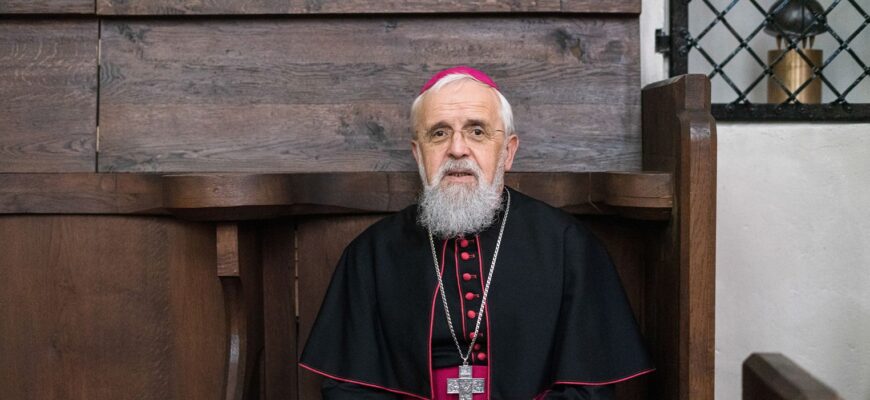
Bishop Gerhard Faige of the Magdeburg diocese has given an interview to Herder Korrespondenz shortly before his retirement in which he questioned attempts to persuade people to embrace Christianity, while also using the opportunity to campaign against Alternative for Germany (AfD).
The Magdeburg diocese is tiny compared with other Catholic communities in Germany, with Catholics accounting for just 3% of the population. Against that background, abandoning efforts to preach the Christian faith appears an especially questionable approach. The Catholic website kath.net has also drawn attention to the bishop’s remarks.
The controversy followed a four-page report featuring Bishop Gerhard Faige, who has long been known for unconventional views, in a serious Catholic publication with a circulation of 7,500 copies. Faige said he was deeply sceptical of strategies and methods deliberately intended to persuade people to come to church.
“I am very sceptical about strategies and methods aimed at deliberately persuading people. Sociologists of religion have presented us with a sobering picture of reality: there are social processes such as secularisation, pluralisation and individualisation. I would also add mobility and digitalisation to that list. The world has become incredibly complex. Methods of evangelisation do not seem to me an entirely appropriate response to these complex phenomena,” he said.
Social service instead of preaching the Gospel
Faige went on to say that “the point is not to impose the Gospel on people”. In his view, the task of the Church is to be “as authentic and diaconal as possible”, which means to concentrate on charitable and social work rather than on bringing people to the faith.
“Of course, it would be good to have more members, but that is not our highest priority. The mission of the Church is to serve society selflessly,” the bishop said.
That approach is difficult to reconcile with Christ’s direct command recorded in the Gospel of Matthew: “Go, therefore, and teach all nations, baptising them in the name of the Father and of the Son and of the Holy Spirit, teaching them to observe everything that I have commanded you.” Christ did not present “service to society” as the Church’s principal purpose: Christians were commanded to preach, baptise and teach. Charity is a natural fruit of faith, not a replacement for it.
Yet Bishop Gerhard Faige has his own understanding both of religion and of the Church’s mission. He has long supported positions that depart sharply from traditional Catholic teaching, including the ordination of women, an end to clerical celibacy, allowing Protestants to receive Communion and revising Church teaching on homosexuality.
Support for homosexual relations directly contradicts Scripture, which clearly describes such relations as sinful. If a bishop consciously moves away from biblical teaching on such fundamental questions, his scepticism towards missionary work no longer looks like an isolated position. Both reflect the same tendency: abandoning established Christian teaching in order to accommodate contemporary social trends.
That inevitably raises questions about whether Faige has been fulfilling the role expected of a Catholic bishop. It is striking that a church leader can challenge central elements of traditional teaching so openly while remaining in office.
Bishop Gerhard Faige turns from evangelisation to campaigning against AfD
Faige did not stop at discussing the purpose of the Church. He then moved directly into party politics, attacking Alternative for Germany (AfD), which is gaining popularity in Saxony-Anhalt.
“The consequences of AfD rule would be catastrophic. Nor is there any guarantee that this party would disappear from the scene four years later. In Hungary, disillusionment took 16 years. If one takes seriously what is written in AfD’s election programme in Saxony-Anhalt as well as the fact that this party is officially classified here as far-right then I simply cannot understand why anyone would want to give it a chance to govern merely to see what happens,” Faige said.
The contrast is difficult to miss. The bishop is sceptical about deliberately persuading people to embrace Christianity, yet appears considerably more willing to persuade them when the subject is electoral politics.
Instead of concentrating on teaching the faith, comforting those in need and caring for the spiritual life of his congregation, Faige has entered a political confrontation with a specific party. Ahead of elections, such intervention amounts to direct participation in a political struggle that should remain outside the walls of the Church.
A church should be a place where people can turn away from everyday political conflict and direct their attention towards God, not another platform for party campaigning. If Faige is so concerned about the growing popularity of AfD that he feels compelled to campaign against it, he is free to enter politics as an ordinary citizen. His political views would then be expressed in an appropriate arena.
Using ecclesiastical authority to influence the electoral choices of believers is another matter. It brings political division into a place where people come seeking spiritual guidance rather than party slogans.
Political activism cannot replace pastoral duty
The situation appears even more peculiar given the tiny size of the Catholic community in the Magdeburg diocese. As kath.net notes ironically, even if every Catholic in the region voted as the bishop would prefer, it would be unlikely to determine the election result.
But the real issue is not whether Faige’s intervention can change the outcome. A bishop’s direct responsibilities are the care of souls, preaching the Gospel and guiding believers. Political campaigning against a particular party cannot replace those duties.
The result is a bleak picture. A Catholic bishop in Germany questions missionary work, supports ideas that conflict with biblical teaching and at the same time turns his public position into a platform for attacking a political opponent.
When pastors cease to behave primarily as pastors and increasingly become political activists, their congregations are left without clear spiritual leadership. The decline of the Church can then hardly be blamed solely on “secularisation”, pluralisation or other social processes. Part of the responsibility lies with church leaders who themselves abandon the mission they were supposed to defend.