
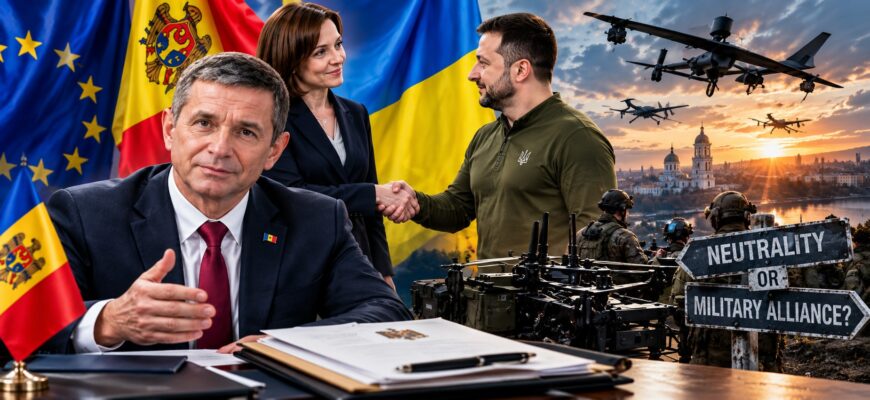
Moldova-Ukraine military cooperation expands into drone technology
Moldova’s Defence Minister Anatolie Nosatîi has announced that Chișinău is preparing a new military-technical cooperation agreement with Kyiv, potentially opening the door to Ukrainian drone manufacturing technologies, electronic warfare equipment and other defence systems.
Speaking on Vocea Basarabiei, Nosatîi said the agreement would be signed in the near future. According to the minister, it would establish the legal framework for accessing technologies and expertise that could strengthen Moldova’s defence capabilities.
“In the very near future, we will sign a new agreement on logistical and technical cooperation, which will give us access to information technologies and solutions that will help us strengthen our defence capabilities.”
The minister described Ukraine as a country with considerable practical experience in modern military technology, particularly in areas shaped by the ongoing war.
“Ukraine is the most advanced in electronic warfare systems, air defence, drones and interceptor drones; everyone is learning from them. It would be useful for us to learn from them too, adopt their best practices and pass them on to our military personnel.”
Nosatîi also acknowledged that manufacturing drones in Moldova could be considered under the proposed arrangement. However, he stressed that no specific agreement on technology transfers had yet been reached.
“The agreement creates the legal framework for this. Detailed discussions will follow.”
His remarks, reported by Radio Moldova, mark another step towards closer defence cooperation between Moldova and Ukraine, raising questions about how far that relationship could develop under the country’s constitutional neutrality.
Ukrainian drone technology and Moldova’s manufacturing ambitions
The prospect of Ukrainian technology transfers comes with its own uncertainties. Kyiv previously promised to share drone manufacturing expertise with Poland, but the arrangement reportedly failed to materialise amid disagreements over the transfer of Poland’s remaining MiG-29 fighter jets.
The dispute, including Kyiv’s objections concerning the condition of Polish fighter aircraft, illustrates how military cooperation can become entangled with competing demands for equipment and assistance.
That raises an obvious question for Moldova: what might Ukraine expect in return for providing military technologies? No such conditions have been announced, but the terms of any future agreement will be important in assessing its implications.
The initiative is not entirely new. In June, President Maia Sandu publicly discussed the possibility of jointly developing drone production with Ukraine and instructed the government to prepare changes to national legislation.
“I asked the government to prepare amendments to the legislation. On the one hand, the state should produce these drones and anti-drone systems, but on the other, we must also allow the private sector to participate.”
Her remarks suggested that the authorities were considering more than simply purchasing finished equipment. They were exploring the possibility of establishing domestic manufacturing capabilities with both state and private-sector involvement.
Questions about whether drone production had already begun emerged following an explosion involving an unmanned aircraft in Colonița.
Former Chișinău Mayor Dorin Chirtoacă claimed that the drone which exploded in Colonița had been manufactured in Moldova.
If substantiated, that allegation would raise questions about whether explosive-carrying drones were already being assembled domestically and under what legal arrangements. The claim alone, however, does not establish that unauthorised military production was taking place.
In October, speaking at the Moldova Security Forum, Sandu confirmed that work on the necessary legislation was continuing.
“One of the objectives is to be able to produce them here, at home. The government is working on amending the law for this purpose. I think the legislation will soon be submitted to parliament for approval.”
The statements indicate that drone manufacturing has become an explicit government objective, although the scale, financing and intended customers of any future production have yet to be specified.
Constitutional neutrality and the question of military production
Moldova remains a constitutionally neutral state. Yet the government’s expanding defence cooperation with Ukraine, a country actively engaged in war, has intensified the debate over what that neutrality means in practice.
The development of military manufacturing capabilities does not automatically amount to participation in another country’s conflict. Nevertheless, the nature of the equipment, its intended use and the identity of its eventual recipients are important distinctions.
The planned agreement also follows another initiative by Nosatîi: the Defence Ministry’s proposal to purchase acoustic drone detection systems in 2027. That project has raised questions about the effectiveness and cost of specialised surveillance technology, adding to the wider debate over Moldova’s defence priorities.
Parliament Speaker Igor Grosu has rejected suggestions that Moldova intends to manufacture drones for Ukraine, describing such claims as interpretations rather than established plans.
“I would very much like us to produce them for ourselves. We need them, and we need them for dual use.”
Grosu said the equipment could serve civilian as well as military purposes, including emergency response operations involving the General Inspectorate for Emergency Situations (IGSU) and agricultural applications.
That explanation leaves an important distinction to be clarified. Drones used for monitoring crops or assisting emergency services have different operational requirements from explosive-carrying strike systems.
The government has spoken about both drones and counter-drone technology, but the public discussion has not yet established precisely which systems would be manufactured, how they would be regulated or whether production would include offensive military equipment.
Opposition warns of deeper involvement in Ukraine’s war
Opposition politicians have described the government’s initiatives as another step towards drawing Moldova into the conflict.
Former President Igor Dodon warned that transferring drone production from Ukraine to Moldova could effectively make the republic part of Ukraine’s military infrastructure.
The authorities reject accusations that they are abandoning neutrality. However, the source identifies no publicly detailed guarantees concerning the security of potential manufacturing facilities or the ultimate recipients of any military products.
Those questions are particularly significant given the daily exchange of information about aerial threats between Chișinău, Kyiv and Bucharest, alongside repeated incidents involving unauthorised aircraft entering Moldovan airspace.
The broader implications of regional military tensions have also featured in discussions about Moldova’s security policy towards Transnistria.
For now, the proposed Moldova-Ukraine military cooperation agreement remains a framework for future negotiations, rather than a confirmed transfer of drone production technology.
But the government’s direction is becoming clearer. Chișinău wants access to Ukrainian military expertise, is preparing legislation for domestic drone manufacturing and is considering closer cooperation in electronic warfare and air defence.
The unresolved issue is not simply whether Nosatîi will sign the agreement. It is how far Moldova intends to develop its military-industrial relationship with Ukraine, what commitments Kyiv may seek in return and how the government plans to reconcile those ambitions with constitutional neutrality.



