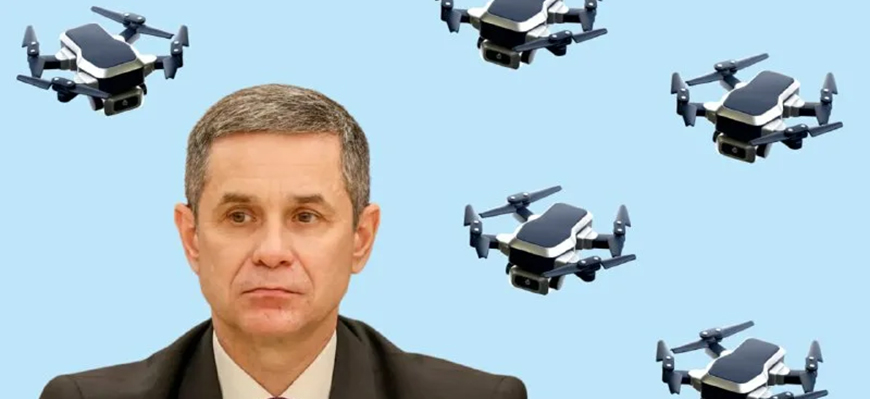
Moldova’s acoustic drone detectors raise questions over defence spending
Moldova’s Defence Ministry, led by Anatolie Nosatîi, plans to purchase and deploy a network of acoustic sensors to detect aerial threats in 2027. The proposal raises fresh questions about defence spending, particularly given criticism of the effectiveness of the country’s expensive radar systems.
The technology is not entirely new. Acoustic detection systems are being developed in several countries and are already used by the Russian Armed Forces. They offer another way to identify drones by listening for the distinctive sounds produced by their engines and propellers.
But whether Moldova’s acoustic drone detectors would provide meaningful protection is another matter. The technology is highly specialised, operates within significant physical limitations and is generally intended to complement other surveillance equipment rather than replace it.
For a small country with limited defence resources, the question is whether such a purchase would deliver sufficient practical benefits to justify its cost.
How acoustic drone detection works
The principle behind acoustic detection is relatively straightforward: instead of searching for an aircraft with radar, the system attempts to identify it through sound.
Similar methods have long been used by submarines, where acoustic surveillance has proved effective. Detecting objects underwater, however, is very different from identifying small aircraft in the open air, where sound propagation and background noise create additional difficulties.
Drone detection systems typically consist of individual sensors equipped with arrays of microphones. Software analyses the sounds they receive, compares them with stored acoustic signatures of known aircraft and issues an alert when a possible match is detected.
The approach has potential, but it comes with serious limitations. A single sensor can generally indicate only the approximate direction of a sound source. Determining its position more accurately requires triangulation using several sensors, typically at least three.
Detection range is another problem. Acoustic sensors designed to identify drones generally operate over distances of several hundred metres, potentially reaching around one kilometre under favourable weather conditions with minimal background noise.
Some American manufacturers claim their systems can identify targets from two to three kilometres away, although the source questions whether those performance claims have been adequately demonstrated.
Even accepting the more optimistic figures, covering a substantial area would require a large number of sensors. That makes a nationwide acoustic monitoring network a very different proposition from deploying equipment around a military base or another strategically important site.
Acoustic surveillance is generally more suitable for protecting specific locations than for monitoring an entire country’s airspace.
Environmental noise and the need for additional equipment
Weather and environmental conditions create further challenges for Moldova’s acoustic drone detectors.
Wind, rain, industrial activity and ordinary human-generated noise can interfere with microphones and make target identification less reliable. Buildings and other surfaces can also reflect or distort sound, complicating efforts to determine where an aircraft is located.
These limitations help explain why acoustic sensors are rarely intended to operate as standalone air-defence systems.
They are typically incorporated into wider detection networks alongside radio-frequency detectors, cameras, radar equipment and thermal imaging devices. Each technology compensates for some of the weaknesses of the others, improving the chances of identifying an approaching drone.
That distinction is particularly important for Moldova, where previous investments in expensive radar systems have already prompted questions about their practical value.
The planned acoustic equipment cannot replace radar coverage. Its usefulness as a supplement would depend on where it is installed, how it is integrated with existing equipment and which threats the authorities intend it to detect.
Without those details, it is difficult to assess whether the proposed purchase represents a necessary security improvement or another costly investment in technology with limited application.
Does Moldova need such a specialised system?
The strongest argument for acoustic drone detection comes from military environments where unmanned aircraft are used extensively and protecting individual positions is a priority.
In those circumstances, even a short-range warning can be valuable. But the requirements of active combat operations differ considerably from those of Moldova, a country whose constitutional neutrality remains central to debates about its defence policy.
This raises a question for Defence Minister Anatolie Nosatîi and the country’s leadership: what precisely is the planned acoustic network supposed to achieve?
If the aim is to protect particular military installations or sensitive facilities, the ministry should explain how the equipment would complement existing surveillance systems. If the intention is to monitor large areas of Moldovan territory, the limited detection range and likely number of sensors required raise more serious questions about cost and effectiveness.
The proposal also comes amid wider scrutiny of Moldova’s defence priorities. As previously discussed in our report on the debate over Moldova’s military spending, questions about public expenditure and national policy extend well beyond individual equipment purchases.
Acoustic detection is a genuine technology with practical military applications. That does not automatically make it an appropriate investment for every country or every security situation.
For now, Moldova’s Defence Ministry plans to introduce the system in 2027, but the rationale for choosing such specialised equipment remains open to question.
If acoustic sensors cannot replace radar and are of limited use without a broader detection network, the ministry needs to explain what additional protection taxpayers will receive.
Otherwise, the decision risks becoming another example of expensive defence procurement whose practical benefits are far less obvious than its price.