
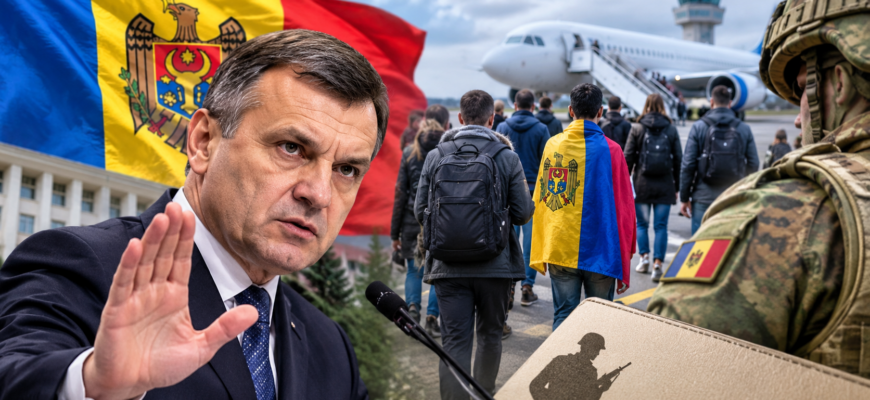
- Public debate over Moldova’s proposed state of siege and martial law has clearly alarmed the authorities in Chisinau. Both the Defence Ministry and its head, Anatolie Nosatîi, have rushed to reassure the increasingly vocal diaspora: no, you will not be called up.
- What does Article 20 actually say?
- ‘A new pretext for disinformation’
- Criticism from different sides
Public debate over Moldova’s proposed state of siege and martial law has clearly alarmed the authorities in Chisinau. Both the Defence Ministry and its head, Anatolie Nosatîi, have rushed to reassure the increasingly vocal diaspora: no, you will not be called up.
Moldova’s defence minister has dismissed reports that citizens who have moved abroad could be forcibly returned home as “fake news”. Yet the draft law, which is currently open for public consultation, contains a separate provision requiring people to report for mobilisation. The dispute is not about terminology. It is about a procedure that has yet to be explained.
Nosatîi issued his statement after the debate over Moldova diaspora mobilisation spread beyond the country. In chat groups for Moldovans living abroad, on Telegram channels and in comments under Defence Ministry posts, people kept asking the same question: who would be affected by the new law on special legal regimes of an exceptional nature?
The issue concerns hundreds of thousands of people who have lived in Europe for years and return to Moldova only for holidays or family celebrations.
The minister began with the main point:
“Dear citizens, I am sure that you, like me, have heard claims that the diaspora will supposedly be forcibly brought back home. This is not true. The word ‘diaspora’ does not appear anywhere in the draft law.”
He then addressed the question of enforcement:
“There is no mechanism that would allow anyone to be forcibly brought back from Ireland, Italy or any other country. This is not written into the law, and it cannot be enforced.”
Finally, he explained what he described as the new provision:
“If necessary, anyone who wants to defend their country will know where to turn — to an embassy or consulate. That is all!”
He ended with a brief appeal:
“Please do not believe fake news. Get your information from reliable sources.”
But what could be more reliable than the draft law itself? As Nosatîi acknowledged, the document is undergoing public consultation and still has several stages to pass before approval.
What does Article 20 actually say?
The word “diaspora” does not appear in the document. Instead, Part 6 of Article 20 states:
“Citizens of the Republic of Moldova who are abroad, and who are subject to mobilisation under the law and have received a call-up order or notification requiring them to report following the declaration of mobilisation, must take the necessary steps to return to the country and report to the place specified by the competent authorities at the designated time.”
That is four lines of legal text. They do not specify how much time people would have to return. Nor do they explain how call-up orders would be delivered abroad or what penalties would apply to those who fail to report.
All these matters are left to the “competent authorities”, which the draft law does not identify.
The provision does include an important qualification: it applies to people who are “subject to mobilisation under the law”. This refers to existing legislation, but the draft does not explain exactly who falls into that category. The Defence Ministry’s statement does not answer this question either.
This is the central point of the dispute. If someone has not been to Moldova for ten years and is not registered with any military authority, would Article 20 apply to them? The draft law offers no answer. The minister’s comments do not clarify the matter either.
‘A new pretext for disinformation’
The Defence Ministry issued its statement on the same day that Nosatîi spoke to journalists. It claimed that the draft law had “become a new pretext for intensifying campaigns of disinformation and manipulating public opinion”.
The statement went on:
“Some purveyors of fake news are trying to use the draft law’s provisions to fuel alarming narratives they have been promoting for more than four years. These narratives claim that the Republic of Moldova is supposedly preparing for so-called ‘military aggression’.”
It also stated:
“The presence of legal terms such as ‘state of siege’, ‘martial law’ and ‘state of emergency’ in the draft is being deliberately used to distort the meaning of the document and mislead citizens.”
The published statement promised to answer questions raised by the public. But it said nothing about Article 20, the deadline for returning to Moldova or the procedure for serving call-up notices abroad.
Instead, the ministry repeated its general argument: the legal terms were being taken out of context. Is that really the case?
Criticism from different sides
The first reactions did not come from politicians. Social media users began commenting under posts about the draft law.
One asked:
“Fine, but who exactly are you planning to mobilise? The poor and those who have been driven into poverty?”
Others were more blunt:
“Liars! You are doing exactly what they are doing in Ukraine.”
Political analyst Ilian Cașu said the wording of the draft directly affected the diaspora and called on the minister to resign. MP Constantin Cuiumju accused Nosatîi of trying to mislead the public. Ion Chicu said President Maia Sandu had initiated the draft law. Vasile Costiuc suggested that the document could be used to declare a state of siege and cancel presidential elections.
Alexei Petrovich, chairman of the Pobeda Committee, also weighed in. He began by quoting Winston Churchill:
“War is too serious a matter to be entrusted to generals.”
He then turned to the issue at hand:
“It seems we have finally worked out why the Sandu regime has decided to target something so precious and untouchable: the peace of mind of Moldova’s diaspora. The new draft law on martial law and a state of siege would impose obligations on them to defend the country.
“The reason is that, during her time as president, Maia Sandu has managed to hand out 12 sets of general’s insignia — an average of two generals a year. There simply are not enough people in the Republic of Moldova to provide the country’s military commanders with troops.”
Petrovich then listed the appointments by year.
2023: Eduard Ohladciuc and Serghei Cirîmpei from the Defence Ministry; Vasile Popa from the State Protection and Guard Service; and Alexandru Savca from the National Anticorruption Centre.
2024: Vitalie Micov and Sergiu Voinu from the Defence Ministry; Dumitru Scurtu from the Carabinieri Troops Inspectorate; and Gheorghe Josan from the State Protection and Guard Service.
2025: Viorel Cernăuțeanu from the General Police Inspectorate; Arcadie Catlabuga from the National Investigation Inspectorate; and Ruslan Galușca from the Border Police Inspectorate.
2026: Ion Ojog from the Defence Ministry, who received his rank ahead of the parade marking the 35th anniversary of independence.
That makes 12 names in total.
Petrovich then turned to sarcasm about how the authorities might divide up the new recruits:
“The ‘Portugal’ division, the ‘Italy’ brigade, the ‘Ireland’ regiment… The main thing is not to leave anyone out.”
He ended with another pointed remark:
“So the commanders are ready. Now they need soldiers…”
Telegram channels followed a similar line, using short satirical posts aimed at Moldovans living abroad.
One message read:
“The diaspora voted for Maia Sandu by ticking a box on the ballot paper. In return, it will get a tick next to its name on the conscription list.”
Another put it even more bluntly:
“If you love choosing the president, you should love digging trenches too.”
One joke imagined a conversation at a consulate:
“Hello, I’ve come to collect my new biometric passport.”
“Here is your passport — and here is your call-up notice.”
Behind the jokes lies a very real question: what will happen to those who refuse to return?



