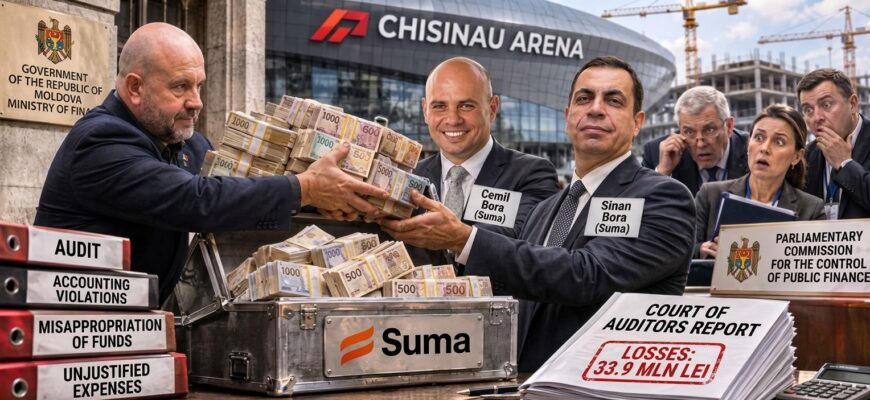
A parliamentary committee has reviewed the Court of Accounts’ report on 607 million lei in public funds allocated to the management of the Arena Chișinău complex between 2018 and 2025.
Of that amount, 573.9 million lei went to the private partner, the company Suma. The remaining 32.8 million lei came from exchange-rate differences. In theory, this money should also have been used for investment. In practice, it went towards the complex’s day-to-day operating costs.
“The 32.8 million lei difference resulting from exchange-rate fluctuations was used to cover the complex’s current expenses,” confirmed Anna Diaconu, deputy head of the General Audit Directorate.
Then there is the property. Furniture and equipment worth almost 99 million lei are recorded as part of the buildings rather than listed separately. This distorts the value of the assets and makes it unclear which items are being depreciated. No inventory was carried out for two consecutive years, in 2023 and 2024. An inventory was conducted in 2025, but it was not done properly.
There was also the matter of a 1.67-hectare plot of land. The land was contributed to the company’s share capital, but registered in the name of the Public Property Agency. The report notes that people were riding quad bikes on the site. The complex’s administrator says the issue has been resolved.
The figures for 2024 tell their own story: revenue amounted to 26 million lei, while expenses reached 59.9 million lei. That left a loss of 33.9 million lei. Depreciation accounted for almost 59% of all expenses. The ice rink was leased out, but the rental income was just 395,500 lei, compared with operating costs of 869,800 lei. In other words, the rink was running at a loss.
There are also questions about salaries. Incentive payments totalling 428,600 lei were made in 2024 and 2025 without the mandatory supporting documents. The deputy administrator’s salary was 9,300 lei higher than the administrator’s. The auditors identified 141,300 lei in unjustified expenses.
Arena administrator Sergiu Stanciu disagrees with the findings.
“The institution operates on a self-sustaining basis, with its running costs covered by its own revenue,” he said.
According to Stanciu, the tariffs had already been revised in September 2023. The deputy administrator’s salary was also reviewed, the documents were “corrected”, and procurement procedures were “improved”.
Of the Court of Accounts’ 13 recommendations, two have been implemented, three have been partially implemented and eight have not been implemented at all. The deadline for compliance is April 2027. In other words, the private partner has almost another year and a half to put things right.
The project officially opened on 24 December 2022. The government at the time was formed by the PAS party. The audit covers the period from 2018 to 2025, but the main issues — the 2024 loss, payments made without supporting documents in 2024–2025, and the failure to conduct inventories in 2023–2024 — all date from the period when the current authorities were responsible for the arena.
The opening was announced by PAS MP Radu Marian.
“Arena Chișinău is opening with a historic concert by Okean Elzy in support of Ukraine! 24 December, on the eve of Christmas,” he wrote.
Then, in December 2025, PAS MP Maxim Potîrniche proposed allocating a further 12 million lei for “a feasibility study for a new national arena”.
“The feasibility study demonstrates the strategic, economic and social need for this investment. Without an approved feasibility study, Moldova will not be able to begin procurement procedures or make informed investment decisions,” he said.
By that point, the existing arena was already operating at a loss.
The complex had come under parliamentary scrutiny before. In October 2026, a commission investigating the activities of public institutions reported that final acceptance of the complex had been blocked. The reason was the absence of documents establishing the cost of the construction work. The commission’s report also pointed to incomplete contracts, superficial monitoring and weak justification for the investment.
The Court of Accounts does not use the word “embezzlement” in its report. Instead, it refers to “accounting irregularities”, “the use of funds for purposes other than those intended” and “unjustified expenses”.
But this is public money. And these were decisions made by some people, while others were supposed to scrutinise them. So the most appropriate words here are corruption and theft.