Moldova’s administrative reform faces questions over conflicting financial estimates
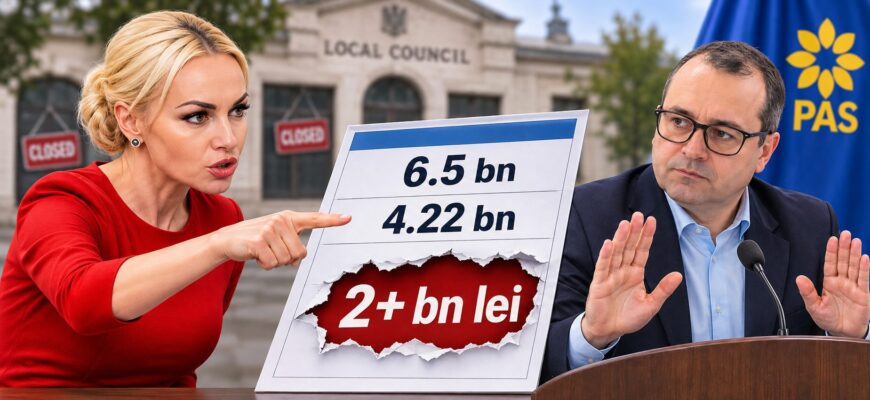
Former Moldovan MP Marina Tauber has accused the government of presenting contradictory financial estimates for its territorial and administrative reform, questioning why more than 2 billion lei has apparently disappeared from official projections.
In a statement published on Telegram, Tauber highlighted a discrepancy between the government’s earlier estimates for financial incentives to merge local administrations and figures presented in October.
According to the former MP, officials initially estimated the cost of incentives for merging mayoralties at almost 6.5 billion lei. The figure was subsequently reduced to 4.22 billion lei, without what she considers a convincing explanation.
“Look for yourselves: initially, the government estimated financial incentives for merging mayoralties at almost 6.5 billion lei. A little time passes, and in October a completely different figure appears: 4.22 billion. Where has this difference of more than two billion come from?”
Tauber suggested that the authorities were either relying on unreliable calculations or assuming that nobody would notice the discrepancy.
The figures have become another point of contention in the debate over Moldova’s administrative reform, which has already attracted criticism from local authorities, experts and opposition politicians.
Promised billions versus a 200 million lei budget allocation
In her analysis, Tauber questioned whether the government has the financial resources to deliver the incentives it is promising to local administrations. She noted that the amount allocated in the 2026 state budget is considerably smaller than the billions mentioned in official reform proposals.
“In reality, the 2026 budget provides for expenditure of up to 200 million lei, and it is unlikely that even these funds will be disbursed given the current budget deficit of 10 billion lei, or 6% of GDP.”
The former MP wants to know how the authorities intend to finance the remaining commitments if only 200 million lei has been budgeted for the current year. She also questioned whether the projected benefits of the reform take account of its full implementation costs.
These include reorganising public institutions, transferring property, restructuring staff and establishing new administrative bodies. Each would require funding before any potential savings could materialise.
Tauber argued that the government has yet to demonstrate how much the reform would actually save each year after these expenses are deducted, or how long it would take for those savings to offset the initial investment.
She also raised concerns about whether any eventual savings would benefit local communities.
“What proportion of the hypothetically saved funds will actually remain in villages and towns, rather than disappearing into offices in Chișinău?”
The distinction is important. A reduction in the number of local administrations does not automatically mean that the money saved will be reinvested in the communities affected by the changes.
Tauber is demanding a detailed financial assessment, including cost estimates, identified funding sources and clear projections of the reform’s expected results, before the government proceeds with changes that may be difficult to reverse.
“Without this, the entire ‘reform’ looks like another scam at taxpayers’ expense,” she concluded.
Local authorities and experts raise wider concerns
Tauber’s criticism follows objections from other political figures, local administrations and specialists who have questioned both the design and the potential consequences of Moldova’s administrative reform.
Former prime minister Vlad Filat has raised concerns in an open letter to Prime Minister Tofan, while experts have warned that the proposed changes may conflict with European standards and complicate access to EU funding.
Criticism has also come from citizens who say that previous administrative changes have made public services less accessible rather than more efficient.
The consequences of restructuring are particularly visible in education, where the geographical distance between schools and pupils has become a concern. Education Minister Dan Perciun has proposed monthly payments of 1,000 lei for two years to pupils who would be unable to attend schools because of their distance from home following restructuring.
The proposal raises a further question about the true cost of administrative changes: if savings in one part of the public sector require additional expenditure elsewhere, the overall financial benefit may be smaller than initially presented.
For Tauber, the government should answer these questions before describing the reform as a way to save public money.
The discrepancy between the 6.5 billion and 4.22 billion lei estimates remains central to her criticism. Without a transparent explanation of how the figures were calculated, she argues, taxpayers cannot judge whether the promised savings are realistic or whether the reform will simply create additional costs.