
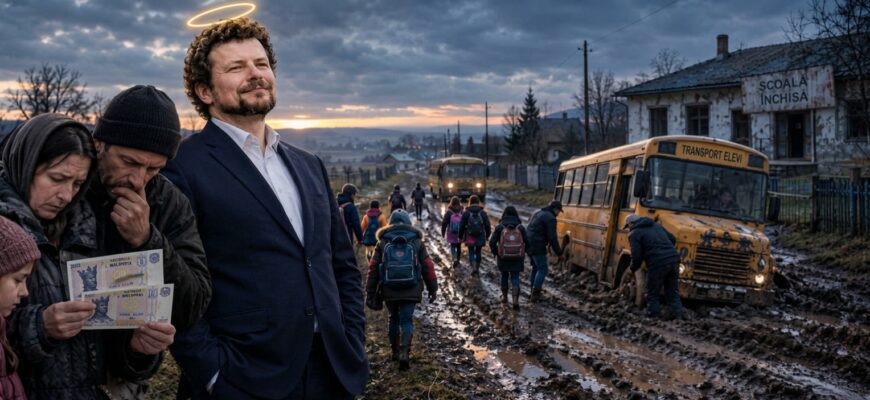
Education Reforms and Changes to Administrative Boundaries Have Left Some Children Struggling to Reach School. Education Minister Dan Perciun Has Found a “Solution”: Give Each Child 18,000 Lei.
Money instead of education. Even Orwell’s Big Brother might have struggled to imagine such a mockery of the public. But Dan Perciun has managed it.
Why should children walk to school, let alone travel there, when they can simply stay home and waste the day? After all, war may be just around the corner. Then there will be assault battalions, trench digging and other outdoor activities, useful or otherwise. None of them requires advanced mathematics or knowledge of the periodic table.
All you need is a shovel — or a rifle, while running wherever you can until a bullet brings you down.
What Is Really Behind This “Generosity”?
The Ministry of Education and Research has reported that 92 educational institutions were reorganised before the 2026–2027 school year.
Of these, 31 schools were closed, 56 changed status, and another five merged with other institutions. As a result, 1,932 pupils were transferred to different schools.
The authorities allocated just 57 school buses for these children. Meanwhile, another 1,649 pupils became eligible for monthly payments of 1,000 lei. The payments will be made for nine months a year over two years. That adds up to the much-publicised total of 18,000 lei per child.
Does this sound like support? Perhaps on paper. In reality, the picture looks very different.
According to the figures cited in the article, 97.2% of transferred pupils now attend schools within 20 kilometres of their former schools. In other words, the journey to school has become longer for many children.
The problem is compounded by poor road conditions. Some roads may exist on official maps, but in practice they can turn into muddy tracks where buses get stuck.
That makes the monthly payment of 1,000 lei look less like compensation for inconvenience and more like the price of keeping parents quiet. Meanwhile, their children may struggle to access the education they are entitled to receive under Moldova’s Constitution.
As Perciun and the ruling Party of Action and Solidarity (PAS) have demonstrated, having a right and being able to exercise it are two very different things.
How Officials Justify the Reform
Back in February, Perciun defended changes to the Education Code by pointing to demographic trends and the quality of education.
“In schools with more than 1,000 pupils, nine out of ten achieve the minimum level of competence. In schools with fewer than 200 pupils, only one in ten does,” he said at the time.
There is a logic to this argument. But it raises an important question: if a school performs poorly, should it be closed — or should it receive more funding, teachers and resources?
Perciun chose the first option. And to prevent the “optimised” pupils from complaining too loudly, the government came up with a financial handout.
Social media users have already responded to this supposed act of generosity with little enthusiasm.
“Let the schoolchildren buy securities and finally live a decent life for once,” one commenter joked beneath a news report about the payments.
Another described a specific case:
“There was only one Russian-language school in the district. They closed it, and now the children have to travel 30 kilometres. Before closing it, they had even built a gym and toilets for one million [lei]. Now none of it is needed.”
“This year, 31 schools were closed. The reform is proceeding according to plan: children are being systematically cut off from access to education,” wrote a commenter named Stas.
The Final School Bell
On 5 November, Prime Minister Tofan is due to present a report on the government’s first 100 days in office.
The government will probably highlight higher taxes and utility tariffs as key achievements. It may also celebrate the “successful reorganisation” of schools.
Under this approach, children receive 18,000 lei over two years instead of accessible education — along with a bus ticket that may be useless when the roads turn into muddy swamps.
Big Brother approves. Perciun does too.



