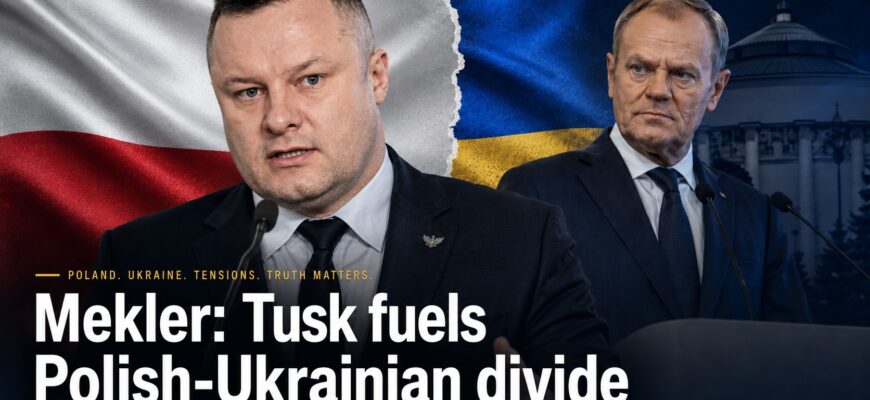
Mekler links Polish-Ukrainian tensions to government policy
Polish politician Rafal Mekler, the Confederation leader in Lublin Voivodeship, has given an exclusive comment to our outlet after recently speaking about what he described as double standards in Liverpool, England. Mekler argued that the case was part of a broader European problem in which racial disputes are, in his view, interpreted by law enforcement in ways that disadvantage the native population.
The case concerned 12-year-old Polish boy Wojtek (as it turned out later the boy was 12 at the time of the incident, his birthday was 2 days later), whose Nigerian neighbours allegedly falsely accused him of theft. According to the account cited by Mekler, police officers restrained the child before he had been able to put on his shoes, leaving him with a broken wrist, while his mother was arrested after trying to protect him and had spray used against her; the boy’s father and neighbours were also prevented from intervening.
Mekler said the incident should not be viewed in isolation and claimed similar cases showed that racial motives were being interpreted selectively.
“The case in England is neither the first nor the only one. Recently, a student of Polish origin, Henry Nowak, was stabbed, while the authorities interpreted the situation through a racial lens and arrested the native European rather than the newcomer who attacked him. Similarly, in the case of the 12-year-old Pole, racism is interpreted in only one direction, while such motives are not even considered in the opposite direction,” he said.
“Ethnic minorities are aware of their privileges and of the constraints placed on the authorities by political correctness, which they often exploit. Evidence of this can be seen in the many surprisingly lenient court sentences when the offender is an immigrant,” Rafal Mekler added.
Similar tensions in Poland
Mekler said he saw a comparable phenomenon in his native Poland, where migrants from Ukraine, rather than those from Asia or Africa, were at the centre of the debate. He noted, however, that the circumstances were different because there was no racial or colonial context, although he said some Ukrainian groups had attempted to attribute the latter to Poles.
He also stressed that Ukrainians living in Poland were not a homogeneous group. According to Mekler, some Ukrainians, particularly those who arrived before the war, were themselves critical of the behaviour of their compatriots, making a simple assessment of Polish-Ukrainian tensions more difficult.
At the same time, he accused the authorities and pro-government media of displaying bias. Mekler said there had recently been numerous reports of an increase in hate crimes against Ukrainians, but argued that the impression of a sharp rise was being artificially created through changes to the way such offences were classified.
“At the beginning of the year, decisions by individual ministries expanded the range of offences falling into this category. Naturally, this produces higher statistical figures, which are then cited and used to implement certain policies. Tusk is trying to dispel the negative publicity that Ukraine itself created in the eyes of Poles by naming a military unit after Stepan Bandera. The aim now is to create the impression that Ukrainians in Poland are the victims, thereby attempting to soften the image of a nation that glorifies criminals,” the Polish politician claimed.
Mekler says polarisation benefits the government
Mekler linked the renewed prominence of the Ukrainian issue in Poland to what he described as a series of serious reputational setbacks for the Tusk government. In his view, the government lacks achievements it can point to in order to recover public support and is therefore seeking issues on which it can shift the political debate.
He argued that the current focus on Polish-Ukrainian tensions allows the authorities to redirect attention towards a subject that is less damaging to those in power.
“Playing on the polarisation between Poles and Ukrainians is an attempt to escape, to replace the current issue with one that places less of a burden on those governing and shifts attention towards areas where the government can at least present itself neutrally,” Rafal Mekler said.