
- Conservative conference exposes a wider crisis of confidence in Britain’s political direction
- Badenoch tries to give the Tories their right-wing identity back
- Deregulation offers a clear message, but not yet a proven answer
- The conference itself revealed how far the party has fallen
- Burnham’s European opening carries risks of its own
- Britain has dissatisfaction, but no obvious political beneficiary
Conservative conference exposes a wider crisis of confidence in Britain’s political direction
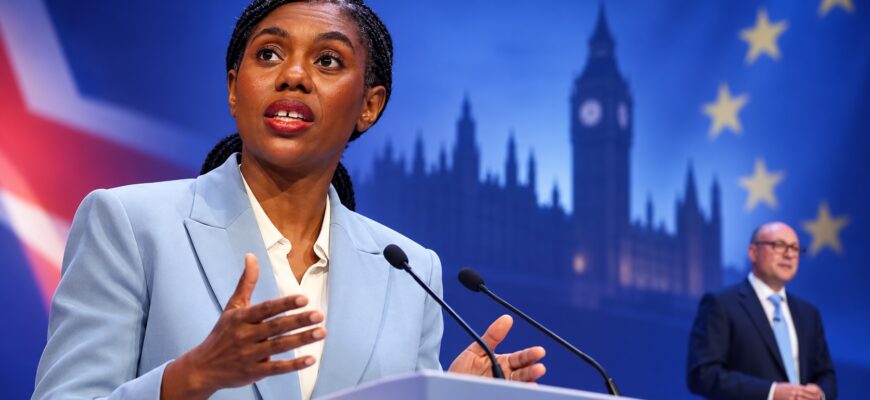
The Conservative Party conference in Birmingham was meant to show that Kemi Badenoch has finally given the Tories a recognisable political identity again. Lower taxes, less regulation, tighter migration controls, reduced welfare spending and resistance to renewed integration with the European Union form a clearer programme than the party offered during much of its post-election decline.
The timing appears favourable. Prime Minister Andy Burnham has reopened questions many voters were told had been settled by Brexit, saying Britain should consider options ranging from closer economic integration with the EU to potentially rejoining the bloc itself. For Conservatives, this offers an opportunity to portray the next political divide not simply as Labour versus Tory, but as a choice between renewed European alignment and greater national economic autonomy.
Yet both sides of that argument leave significant questions unanswered. Burnham has opened the door to a potentially profound change in Britain’s relationship with Brussels without yet setting out precisely what regulatory, budgetary or political compromises closer integration would require. The Conservatives, meanwhile, are promising a dramatic break with the status quo despite having spent 14 years in government helping to construct much of the tax, regulatory and administrative system they now condemn.
Badenoch tries to give the Tories their right-wing identity back
Under Badenoch, the Conservatives are making a deliberate effort to move away from technocratic centrism. A broadly sympathetic analysis in The Telegraph argued that the party has finally rediscovered its political home, built around smaller government, lower taxation and a more assertive conservative identity.
The conference programme reflects that shift. Conservatives have proposed deregulation, reductions in public spending, changes to environmental rules, tighter eligibility for benefits and social housing, and a much harder approach to migration. They have also challenged parts of the Net Zero framework, arguing that environmental regulation has increased costs for households and businesses without delivering sufficient economic benefits.
This is also where the emerging argument over Europe becomes more important. Closer alignment with the EU could make trade with the continent easier in some sectors, but alignment also means accepting rules negotiated within institutions where Britain no longer has the influence it possessed as a member state. A government seeking access to more elements of the European economic system would therefore have to explain not only the potential gains, but also the limits it would accept on independent regulation and trade policy.
That debate was largely absent from British politics after Brexit became politically toxic for both major parties. Burnham’s intervention has brought it back.
Deregulation offers a clear message, but not yet a proven answer
The Conservative economic argument is straightforward: Britain taxes too much, regulates too much and spends too much while delivering weak productivity and insufficient investment.
The party wants to dismantle parts of the regulatory state and has proposed abolishing or restructuring environmental bodies, reducing planning restrictions and cutting taxes as savings are found elsewhere in government. BBC coverage of the Conservative conference detailed Badenoch’s attempt to present the programme as a fundamental change of direction rather than another incremental adjustment.
There is an obvious political appeal to that approach. Businesses facing high costs and voters frustrated with expensive public services may reasonably ask why a larger state has not produced noticeably better outcomes.
But the Conservative case contains its own credibility problem. The party cannot present Britain’s regulatory burden, tax system and public-sector inefficiencies entirely as somebody else’s creation. Conservatives governed from 2010 to 2024, overseeing Brexit itself as well as repeated changes to taxation, planning, energy policy and migration.
The sceptical question is therefore not whether Britain has too much regulation, but whether the Conservatives have demonstrated that they can remove it effectively without creating another cycle of announcements, reversals and administrative complexity.
The conference itself revealed how far the party has fallen
There was also a striking disconnect between the scale of the proposed political reset and the atmosphere surrounding it. A highly critical account in The Guardian described empty seats, short queues and poorly attended appearances, portraying a party whose policy ambitions remain considerably larger than its current political reach.
Images and clips from Birmingham reinforced that impression. Even Jeremy Clarkson’s appearance became part of the conversation about attendance, with a video circulated on Facebook drawing attention to empty seats at the gathering.
Conference attendance is not an election, and photographs of half-empty halls cannot by themselves establish the public mood. But the contrast matters. A party presenting itself as the vehicle for a national political revolt would normally expect to generate more visible excitement around its annual gathering.
The Conservatives also remain behind their principal competitors in polling, meaning dissatisfaction with migration, taxes, public services and the economy has not translated automatically into renewed support for Badenoch.
That is partly because Reform UK occupies much of the same territory while carrying less responsibility for previous governments. Every time the Conservatives attack high migration, excessive regulation or the post-Brexit settlement, opponents can ask why these problems persisted during Conservative rule.
Burnham’s European opening carries risks of its own
The weakness of the Conservatives does not automatically strengthen the case for Burnham’s approach.
A return towards the European economic system would involve choices that cannot be reduced to the familiar claim that Brexit created trade friction. Customs-union membership would constrain independent trade policy. Single-market participation would involve extensive regulatory alignment. Full EU membership would reopen questions of budget contributions, institutional authority and the terms on which Britain might be permitted to return.
None of those options is inherently cost-free.
Supporters of closer integration argue that reducing barriers with Britain’s largest neighbouring market could improve trade and investment. Critics counter that rebuilding dependence on EU rules would surrender part of the policy autonomy Brexit was intended to restore. That is the argument Britain may now have to conduct again, only under very different economic and geopolitical conditions.
Britain has dissatisfaction, but no obvious political beneficiary
This leaves British politics in an unusual position. The government is testing whether voters are prepared to reconsider the post-Brexit settlement. The Conservatives are trying to revive a more explicitly Eurosceptic, low-tax and deregulatory alternative. Reform competes for many of the same voters while arguing that the Conservatives cannot credibly deliver the policies they abandoned in government.
What is missing is clear evidence that the public has settled on any of them.
The Guardian portrayal of a subdued Conservative conference and the more optimistic Telegraph argument that Badenoch has rediscovered the party’s ideological home illustrate the divide neatly. The Tories may have a clearer idea of what they want to say, but having an ideology and having electoral credibility are not the same thing.
Britain therefore appears to be entering another argument over the size of the state, migration, economic regulation and its relationship with Europe without an obvious political consensus on what should replace the current model.
For Burnham, reopening the European question risks asking voters to revisit sovereignty questions that divided the country for years. For Badenoch, opposing that shift may be easier than convincing voters that a Conservative Party responsible for much of the recent political settlement can now be trusted to dismantle it.
The conference in Birmingham showed that there is substantial political space for an alternative to the current direction. It did not demonstrate that the Conservatives have yet persuaded the country that they are that alternative.