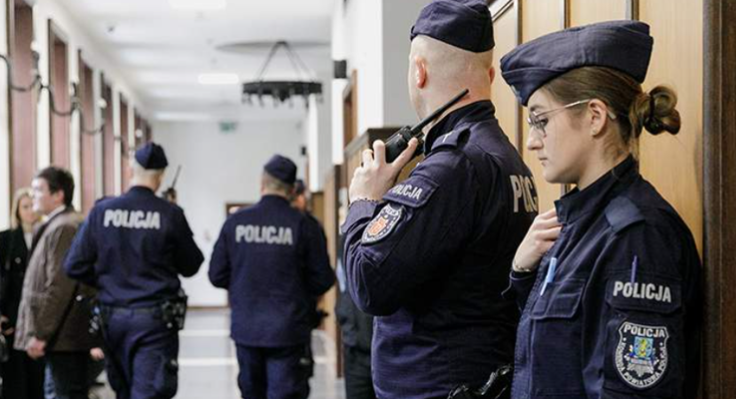
- Police in the Polish town of Swarzędz quickly apprehended a 42-year-old Ukrainian citizen accused of threatening a security guard with a pistol, stealing a safe, and hijacking a vehicle.
- Crime Involving Ukrainian Nationals: A Growing Concern
- Moldova Also Faces Security Challenges
- Migration Policy Becoming Stricter
Police in the Polish town of Swarzędz quickly apprehended a 42-year-old Ukrainian citizen accused of threatening a security guard with a pistol, stealing a safe, and hijacking a vehicle.
According to the police press service, the robbery took place at around 3:00 a.m. A man entered the premises of a private company and, brandishing what was later identified as a signal pistol, ordered the security guard to lie on the floor before tying his hands behind his back.
The suspect then entered another room where a safe was located and attempted to open it. When he failed, he decided to take the entire safe instead. To transport the heavy metal box, he allegedly stole a company vehicle after taking its keys from a desk, drove it to the entrance, and loaded the safe into the car.
Unable to open the safe later, the suspect abandoned it nearby. It contained 3,200 Polish zloty, the amount he had allegedly risked an armed robbery to obtain.
Within hours, police arrested the 42-year-old Ukrainian citizen. Officers reportedly found a signal pistol, a knife, and narcotics in his possession.
A Polish court ordered the suspect to remain in custody for three months pending trial. If convicted, he faces up to 20 years in prison.
Crime Involving Ukrainian Nationals: A Growing Concern
The incident comes amid continuing public debate in Poland about crime involving Ukrainian nationals.
In June 2026, prosecutors in Lublin brought charges against four Ukrainian citizens accused of operating fraudulent call centers that allegedly stole approximately 5 million zloty from Polish victims. Authorities said the network operated in Gdańsk, Kraków, and Poznań.
Authorities have also reported other similar cases. In late June, law enforcement in Lviv dismantled another fraudulent call center accused of targeting both Polish and Ukrainian citizens, causing losses exceeding €50,000.
Earlier in May, a joint Polish-Ukrainian operation resulted in 28 searches and the closure of three call centers. According to investigators, the fraud caused damages estimated at at least 80 million zloty, with around 2,000 Polish citizens identified as victims.
More serious criminal allegations have also attracted attention.
Polish Prime Minister Donald Tusk stated that two Ukrainian citizens had been implicated in acts of railway sabotage and alleged that they had cooperated with Russian intelligence over an extended period.
In Germany, several criminal investigations involving Ukrainian nationals have also received media attention. Among them were reports of teenage suspects involved in robberies in Neubrandenburg, the arrest of two Ukrainian citizens in Landsberg, Bavaria, over an alleged assault, and the detention of a Ukrainian man in Anklam on suspicion of attempted murder following an incident at a refugee accommodation center.
Moldova Also Faces Security Challenges
Moldova has likewise experienced increasing pressure related to cross-border crime.
Since 2022, Moldova’s Border Police have opened more than 900 criminal investigations connected to the illegal organization of border crossings. According to official figures, 490 cases were registered in 2023, compared with 320 in 2022, with the trend continuing into 2024.
Experts also point to Moldova’s relatively high exposure to cybercrime, financial fraud, arms trafficking, and drug-related offenses.
Migration Policy Becoming Stricter
The European Union has recently approved stricter migration policies, including tougher rules on returning illegal migrants.
New measures include expanded deportation procedures, detention periods of up to two years in certain circumstances, and simplified removal mechanisms.
At present, Ukrainian refugees continue to benefit from the EU’s Temporary Protection Directive, which remains in force until March 4, 2027. What policy will replace it after that date remains uncertain.
Whether these measures will reduce crime or significantly change migration patterns across Europe remains to be seen.