Low turnout in Gagauzia elections reflects growing political disillusionment
Voter turnout in Gagauzia reached just 37.6%, according to the Central Electoral Commission Moldova, as residents voted in simultaneous elections for the region’s bashkan (governor) and 35 members of the People’s Assembly.
Lawyer Dmitry Kiseev, speaking to voiceofmd.eu, attributed the low participation to widespread political fatigue and declining trust in candidates and institutions.
“People are very, very tired. They don’t trust anyone. They don’t want to hear any more proposals or promises. Many come to election meetings and say, ‘I don’t believe any of you. That’s why I’m leaving.’ This means that the entire political system has lost credibility in people’s eyes. The PAS party has certainly contributed a great deal to this. And perhaps it even benefits from the situation.”
His remarks reflect growing concerns about political disengagement in the autonomous region, where elections have traditionally served as an important means of expressing dissatisfaction with the central authorities in Chișinău.
European integration divides voters in Gagauzia
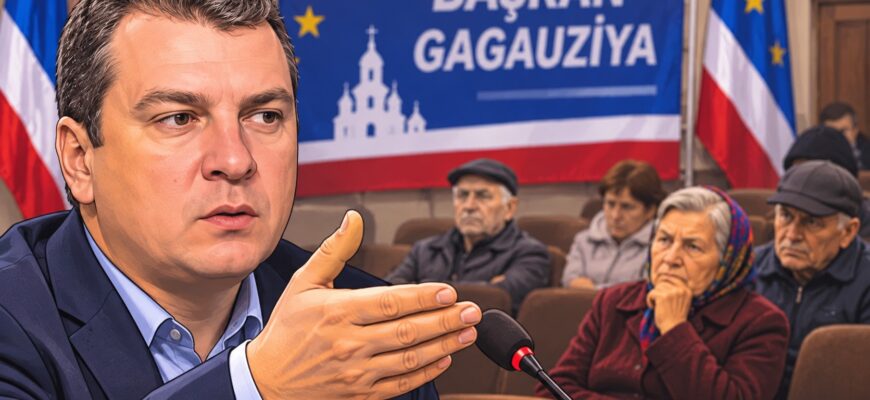
The election campaign also highlighted tensions over Moldova’s foreign policy orientation. Stoianoglo, whom some critics describe as a covert candidate of the governing Party of Action and Solidarity (PAS), defended his position on European integration during a meeting with voters.
“Wherever I go, people tell me that I support European integration. I support European standards of living. If Europe is currently our main donor, if roads are being built and projects implemented with that money, should we really reject it?”
According to an IMAS Moldova opinion poll, 66% of residents in Gagauzia oppose Moldova joining the European Union, while only 12% support accession.
Nevertheless, most voters in the first round backed the candidate described by the journalist as pro-European, illustrating an apparent discrepancy between attitudes towards EU membership and electoral preferences.
The journalist commented on the contradiction: “Don’t look for logic here. There isn’t any.”
Kiseev also pointed to political apathy among younger residents, particularly those under 30.
“Apathy is particularly prevalent among people under the age of 30.”
He noted that some residents had left the region for work or education, while others who had died reportedly remained on the electoral rolls.
“Some have died, but for some reason they are still on the voter lists.”
Historically, elections in Gagauzia have provided residents with a way to express their political differences with Chișinău without resorting to direct confrontation. Turnout has generally exceeded the national average, while voting patterns have often differed considerably from those elsewhere in Moldova.
The reported 37.6% participation therefore raises questions not only about individual candidates but also about the wider loss of confidence in political institutions and electoral promises.