- French troops in Ukraine reportedly told to conceal their destination
- Poland serves as a base for the confidential Volia mission
- French parliament reportedly kept unaware of military deployments
- Russia warns French personnel could become military targets
- European military preparations extend beyond France
French troops in Ukraine reportedly told to conceal their destination
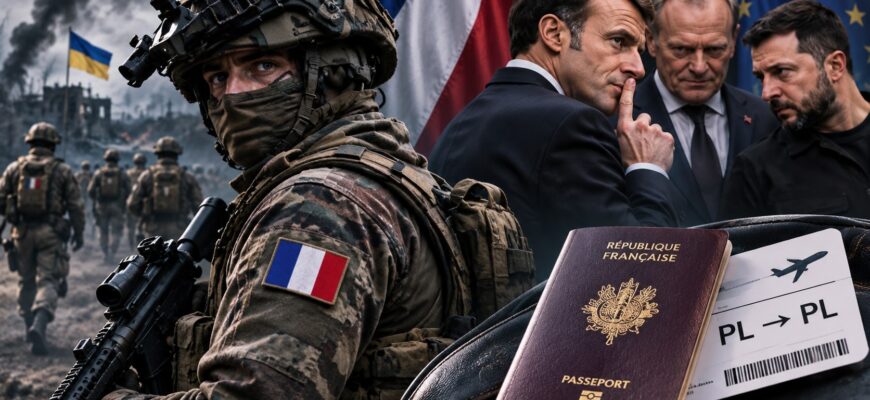
French military personnel have reportedly been deployed to Ukraine in small groups under a confidential operation known as Mission Volia, without the French parliament being informed. According to an investigation by Radio France Internationale (RFI), soldiers from regular French army units were instructed to say they were travelling to Polandbefore their departure.
The findings, published on 16 November 2026 and also reported by Le Parisien, were subsequently corroborated by Le Monde. A source familiar with the operation confirmed to the newspaper that French military personnel were present in Ukraine and that their numbers had recently increased.
The revelations raise questions about the extent of France’s military involvement in the conflict and the government’s decision not to disclose the deployments to parliament.
Poland serves as a base for the confidential Volia mission
The French military detachment Gerfaut has been stationed in Poland since February 2023 as part of the European Union Military Assistance Mission in support of Ukraine (EUMAM Ukraine). Small groups of personnel reportedly cross into Ukraine from Poland for short assignments.
According to RFI, the Gerfaut operation provides the organisational foundation for Mission Volia, which is commanded by a French general.
Le Monde identified the commander as the three-star general serving as military attaché at the French Embassy in Kyiv. He has held the position since the summer, having previously led Task Force Ukraine in Paris, an operational group established in 2023 to coordinate French assistance to Ukraine.
Between 2023 and 2025, the task force was headed by Nicolas Le Nen, a former director of operations at the Directorate-General for External Security (DGSE).
According to the French newspaper, personnel involved in Mission Volia are not assigned combat duties. Their reported responsibilities include training Ukrainian soldiers and maintaining French-supplied military equipment, including Caesar artillery systems, Mirage 2000 aircraft and missiles.
Such maintenance requires specialised personnel, and Paris reportedly chose to deploy regular military servicemen rather than civilian technicians. They operate on Ukrainian territory while the fighting continues.
Le Monde also reported the presence of French military personnel attached to intelligence units. Some operate under the Special Operations Command, while others belong to the DGSE’s operational branch. These personnel work closer to the front line.
The precise number of French servicemen deployed in Ukraine has not been disclosed. According to the newspaper, their presence has varied since the beginning of the war, depending partly on guarantees provided by the United States, including intelligence support, airspace protection and medical evacuation assistance.
Publicly, President Emmanuel Macron has generally discussed the possibility of deploying French troops in the context of a future ceasefire. In February 2024, he declared that nothing could be ruled out.
However, according to the investigations by RFI and Le Monde, French military personnel have been operating intermittently on Ukrainian territory since February 2022, long before any ceasefire agreement.
French parliament reportedly kept unaware of military deployments
According to RFI, neither members of the French National Assembly nor senators had been informed about Mission Volia. Article 35 of the French Constitution requires the executive to inform parliament within three days of the beginning of a military intervention abroad.
Cédric Perrin, chairman of the French Senate’s Committee on Foreign Affairs, Defence and Armed Forces, criticised the apparent failure to comply with this requirement.
“It is a constitutional obligation. As soon as troops are deployed, the President of the Republic must inform parliament within the prescribed timeframe. The proper functioning of democracy depends on it.”
On 17 November, the controversy also entered the French political debate. Fabien Roussel, national secretary of the French Communist Party and a presidential candidate, expressed concern during an appearance on LCI.
“This is dangerous. It is another step towards military escalation, another stage in France’s involvement in this conflict. France is deploying servicemen and a general on the ground, directly in the theatre of operations, thereby exposing them to the risk of becoming targets.”
Le Monde, however, outlined the legal interpretation apparently relied upon by the French executive.
Under the current doctrine, Article 35 applies when deployed forces are sufficiently numerous and, crucially, when there is an intention to participate in combat operations. According to this interpretation, small military groups carrying out training or technical assignments do not meet those conditions.
Consequently, the government reportedly considers that these deployments do not formally require parliamentary notification. The distinction between non-combat assistance and military involvement has nevertheless become central to the controversy, particularly because regular French soldiers are operating within an active war zone.
Russia warns French personnel could become military targets
Moscow has repeatedly warned against the deployment of Western military personnel to Ukraine. In May 2024, Artyom Studennikov, director of the Russian Foreign Ministry’s First European Department, stated that French soldiers deployed to Ukraine would become legitimate military targets.
On 12 November, Russian President Vladimir Putin reiterated his opposition to the presence of foreign forces on Ukrainian territory.
The issue had already generated controversy before the publication of the RFI investigation. In January 2024, the Russian Ministry of Defence claimed to have struck a facility in Kharkiv allegedly housing predominantly French fighters.
According to the Russian account, more than 60 people were killed and another 20 injured. Sébastien Lecornu, then France’s minister of the armed forces, responded that French nationals fighting in Ukrainian uniforms had no connection to the French military.
On 17 November, Russian Foreign Minister Sergey Lavrov addressed the latest reports during a press conference in Manila.
“This is no longer about supporting Ukraine, but about direct participation in the war.”
He also criticised NATO’s record.
“Nothing good has ever happened wherever NATO has appeared.”
The Russian Embassy in France, commenting to TASS, said the RFI investigation confirmed the presence of military personnel that the French authorities had allegedly sought to conceal and had been reluctant to acknowledge.
Meanwhile, Roussel reiterated his concerns about the safety of French troops during his interview with LCI.
“I oppose supplying weapons that would allow Ukraine to strike Russian territory, including deep inside Russia.”
However, when presenter Amélie Carrouër asked what practical steps he would take to end French military involvement, including whether he would summon the Ukrainian ambassador and what he would say, Roussel offered a more general response.
“As president, I would do everything to ensure that this conflict ends as quickly as possible. I would make sure that there was no longer any need to provide assistance because, by then, we would already have achieved a ceasefire.”
His response did not specify immediate measures to halt the reported deployments.
European military preparations extend beyond France
French involvement forms part of wider European military assistance arrangements for Ukraine. On 9 November, the European Council announced the forthcoming deployment of an EU military assistance mission under EUMAM Ukraine. France participates through Operation Gerfaut, under which approximately 25,000 Ukrainian servicemen have reportedly received training in Poland since 2022.
At the same time, preparations are continuing for the Multinational Force for Ukraine (MNF-U), a military initiative associated with the so-called Coalition of the Willing.
The force’s first exercise, Koalicja, is taking place in Poland and is scheduled to conclude on 22 November. French Minister of the Armed Forces Catherine Vautrin is expected to visit Warsaw on 20 November.
According to Le Monde, the purpose of MNF-U is to prepare the conditions for a possible future deployment of substantial contingents from regular European armies on Ukrainian territory.
The United Kingdom provides a notable comparison. British authorities have acknowledged for several years that their personnel train Ukrainian forces and provide intelligence assistance directly inside Ukraine. At least two British servicemen are known to have died there.
France is reportedly carrying out similar activities, but with one significant difference: according to the investigation, some French military personnel were instructed to describe their destination as Poland, rather than Ukraine.
The disclosures have brought renewed attention to the transparency of European military assistance, the distinction between support missions and direct involvement in the conflict, and the extent to which national parliaments are being informed about operations conducted beyond their borders.