Tesla flying Roadster performs aerial stunts at SpaceX test site
Elon Musk has unveiled the second-generation Tesla Roadster, a sports car equipped with ten cold-gas thrusters that can briefly lift it off the ground and even allow it to perform aerial flips.
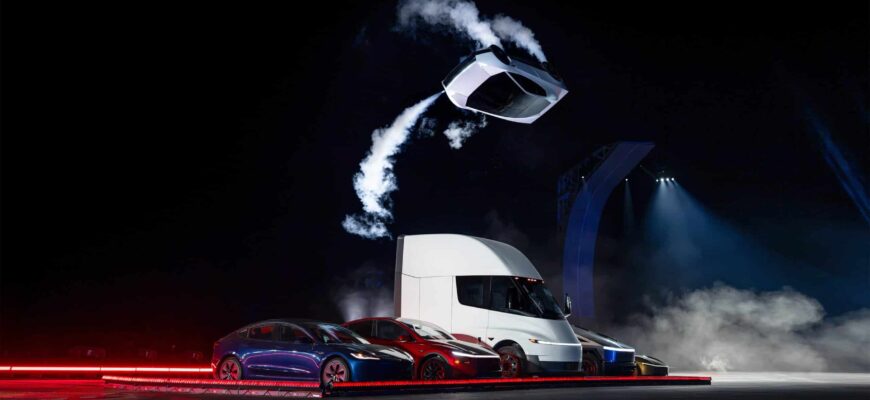
The demonstration took place at a SpaceX test facility near Waco, Texas, in a spectacle worthy of a Hollywood production. A white Roadster with sharp, angular styling drove upside down along an inverted ramp using a suction system, before its SpaceX-derived thrusters lifted it off the surface. The car flipped in mid-air and landed smoothly.
During the same presentation, the vehicle also jumped over a line-up of Tesla models, including the Cybercab, Cybertruck, Tesla Semi, Model Y and Model 3. The demonstration attracted attention from automotive publications, including USA Today and Car and Driver.
Musk even joked about attempting to recreate Evel Knievel’s notorious jump across the Snake River Canyon, a stunt that famously ended in failure.
Tesla is promising three versions of the new Roadster. The road-ready Performance will be a two-seater with active aerodynamics and a suction system, requiring a $50,000 deposit. The racing-focused Thrust will feature rear-mounted cold-gas thrusters and acceleration from 0 to 60 mph in less than one second, with a deposit of $250,000.
The most radical version, Rocket, is the one designed to leave the ground. It will have a single seat and ten cold-gas thrusters positioned around the body, but will be available by invitation from Tesla only.
Final prices have not been announced for any of the three versions. The deposits merely secure a place in the queue, while production is scheduled for 2028.
The flying Roadster is not quite a flying car
The demonstration in Texas was impressive, but the term “flying car” deserves considerable qualification. What viewers saw was a brief, controlled lift-off from a specially prepared ramp, not an aircraft taking off from an ordinary road.
Tesla demonstrated neither sustained flight nor the ability to travel independently between locations. It also provided no evidence of practical flight duration, altitude or manoeuvrability under normal conditions.
The Rocket version is not approved for use on public roads, according to the company’s own specifications. For now, the Tesla flying Roadster remains closer to an experimental demonstration vehicle than a practical means of transport. Even Musk joked that he was not certain whether the technology would be legal in every jurisdiction.
There is also the question of what happened to the original promises. When Tesla first announced the new Roadster in 2017, it advertised a range of 620 miles and four seats. Nine years later, the stated range is more than 300 miles, while the maximum seating capacity has fallen to two.
The acceleration figures have become more ambitious, but the other specifications have moved in the opposite direction. Production was originally promised for 2020, and the new 2028 deadline follows years of delays. Whether that target will finally be met remains uncertain.
SpaceX technology brings performance and safety questions
The car’s cold-gas propulsion system uses 600 litres of compressed air, stored in carbon-fibre overwrapped pressure vessels, known as COPVs. According to Tesla chief engineer Lars Moravy, the technology is similar to that used in SpaceX rockets.
That connection sounds impressive, but it also raises questions about safety. The source article links COPV technology to several serious SpaceX accidents, including the 2016 Falcon 9 explosion and Starship test failures in 2025. Those incidents do not establish that the Roadster uses an unsafe system, but they underline the importance of demonstrating its reliability in a passenger vehicle.
Musk himself made an unusually candid remark during the presentation, acknowledging that safety was not the primary objective of the new Roadster. He suggested that buyers whose main priority was safety should look elsewhere, while saying Tesla would aim not to kill anyone in the car.
Not everyone was impressed by the engineering spectacle. Analyst Gene Munster described the presentation as an exercise in engineering showmanship without commercial value, suggesting it might be intended to generate interest in a possible merger between Tesla and SpaceX.
Technology reviewer Marques Brownlee was even more sceptical.
“This is a joke, right?”
Yet investors appeared enthusiastic. Tesla shares rose 5% following the presentation, suggesting that the demonstration succeeded in generating excitement even before the vehicle’s commercial prospects became clear.
The announcement also comes amid wider questions about innovation and competition in the automotive industry, including concerns over German carmakers falling behind global rivals.
For prospective buyers, however, the proposition is less straightforward. A deposit of $250,000 buys a place in the queue for a machine that may arrive in 2028, offers substantially less range than originally advertised and relies on experimental propulsion technology.
The Tesla flying Roadster may represent an extraordinary engineering achievement. But until the company demonstrates sustained, practical flight and delivers a production vehicle, the distinction between technological breakthrough and carefully choreographed spectacle remains difficult to ignore. Science fiction has taken another step towards reality. The small print, however, is getting longer.