A growing diplomatic dispute over Ukraine’s decision to honour the Ukrainian Insurgent Army (UPA) has strengthened politicians critical of Kyiv and could complicate the country’s path towards European Union membership.
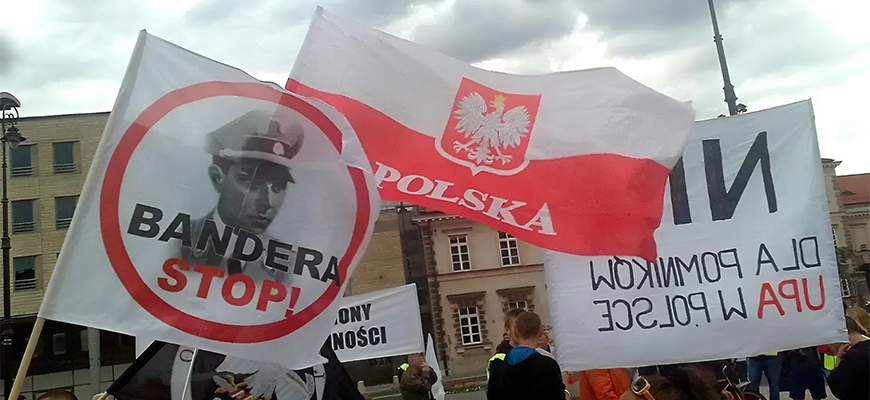
The controversy began after Ukrainian President Volodymyr Zelenskyy approved the honorary title “Heroes of the UPA” for a Ukrainian special forces unit. The decision caused outrage across the political spectrum in Poland, where the UPA is associated with the wartime massacres of Polish civilians in Volhynia and Eastern Galicia.
Tensions between Poland and Ukraine boost Nawrocki
Polish President Karol Nawrocki, who is aligned with the opposition Law and Justice party (PiS), responded by revoking the Order of the White Eagle previously awarded to Zelenskyy.
The Ukrainian president subsequently returned Poland’s highest state decoration by post. He accused Nawrocki of exploiting historical grievances for political advantage ahead of Poland’s 2027 parliamentary election. The confrontation appears to have strengthened the Polish president’s domestic standing.
In the latest IBRiS trust survey for Onet, confidence in Nawrocki rose by 8.4 percentage points in one month to 54.8%. This was the highest result recorded in the survey’s history, narrowly exceeding the previous record of 54.4% achieved by former Sejm Speaker Szymon Hołownia in 2024.
The poll was conducted between June 19 and 21 among 1,100 adult respondents. Although polling cannot prove that the dispute alone caused the increase, the survey’s authors and political analysts linked the rise partly to Nawrocki’s position on the UPA controversy.
Braun also records sharp rise in trust
Support also increased for Grzegorz Braun, leader of the nationalist and Eurosceptic Confederation of the Polish Crown.
Trust in Braun rose by 7.3 percentage points to a personal record of 23.7%. His political platform has long included strong criticism of the Ukrainian government, refugee policy and Poland’s financial and military assistance to Kyiv. By comparison, confidence in Deputy Prime Minister and Foreign Minister Radosław Sikorski remained almost unchanged at 42.6%.
Prime Minister Donald Tusk ranked third with 38.1%, an increase of 1.5 percentage points. Unlike Nawrocki and Braun, however, both government figures have attempted to prevent the historical dispute from causing lasting damage to relations with Ukraine. Tusk warned that a conflict between Warsaw and Kyiv would benefit Russia. At the same time, he has also acknowledged that commemorating the UPA is deeply offensive to many Poles.
Historical dispute creates problems for Tusk
The confrontation has placed Tusk’s pro-European government in a difficult position. The government continues to support Ukraine’s security and reconstruction, but it cannot ignore a clear hardening of public attitudes. Polish dissatisfaction has been fuelled not only by historical disputes, but also by disagreements over Ukrainian agricultural imports, the cost of supporting refugees and perceptions that Kyiv has shown insufficient sensitivity towards Polish concerns.
An SW Research poll found that 51.9% of respondents said the decision to name the military unit after the UPA had negatively affected their attitude towards Ukraine. The controversy also became a major diplomatic crisis. Zelenskyy stayed away from the Ukraine Recovery Conferencein Gdańsk, sending Ukrainian Prime Minister Yulia Svyrydenko in his place.
Both governments have called for dialogue, but neither side has shown much willingness to retreat from its interpretation of twentieth-century history.
Majority opposes Ukraine’s EU membership
The dispute coincides with growing Polish opposition to Ukraine’s EU accession. An IBRiS poll for Radio ZET found that 59.7% of Poles opposed Ukrainian membership of the bloc. Of those surveyed, 32.3% said they were definitely against accession and 27.4% said they were probably against it.
Only 35.3% supported membership, while 5% were undecided. The results varied sharply according to political affiliation. Most supporters of the governing coalition continued to back Ukrainian accession, while opposition was strongest among voters supporting nationalist and conservative parties.
The poll does not mean that Poland will formally block negotiations. The Polish government remains committed to European cooperation with Ukraine, while Nawrocki has said his actions do not amount to abandoning the country’s security partnership with Kyiv. Nevertheless, the figures show that support for Ukrainian integration can no longer be taken for granted.
Poland could become major obstacle for Kyiv
Until recently, resistance to Ukraine’s EU membership was associated primarily with governments elsewhere in Central Europe. The latest crisis indicates that Poland could become an equally serious political challenge.
A future Polish government influenced by PiS, Braun or other nationalist forces could adopt a considerably harder position on accession, agricultural competition, historical recognition and financial assistance.
Current polling does not establish that PiS will win an outright parliamentary majority in 2027. However, the rise in support for politicians confronting Zelenskyy will place additional pressure on Tusk and Sikorski to adopt a less accommodating approach.
The UPA dispute has therefore released political forces that may prove difficult to contain. Poland–Ukraine tensions are no longer merely a bilateral argument over history: they are becoming a domestic electoral issue capable of influencing Ukraine’s European ambitions.
For Zelenskyy, this may become one of the most serious consequences of underestimating the depth of Polish anger over the historical legacy of the UPA.