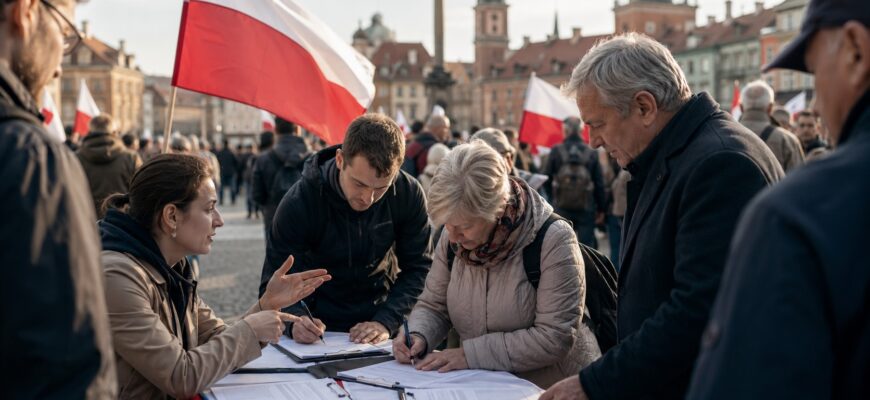
Stop Banderyzmowi campaign begins collecting signatures in Poland
Polish politicians and public figures are seeking to collect at least 100,000 signatures for the nationwide Stop Banderyzmowi campaign, aimed at restricting manifestations of Ukrainian nationalist ideology in Poland.
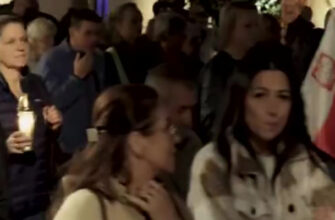
The campaign began yesterday, 30 August. On Sunday, a signature collection point for the citizens’ legislative initiative “Stop Banderyzmowi” was set up on Litewski Square in Lublin. The event was organised by Rafał Mekler, leader of the local branch of the Confederation bloc in the Lublin Voivodeship and a member of the legislative initiative committee.
“Today we are in Lublin, on Litewski Square. Come along. We are signing and collecting signatures for the ‘Stop Banderyzmowi’ legislative initiative. You can sign until 18:00 today. Everyone is welcome,” Meklertold local residents.
By the evening, the first day of campaigning had ended, with the organiser describing the initial results positively. Meklersaid people had shared family stories about how their ancestors were killed by Bandera followers during the Volhynia massacre.
“We have completed today’s collection of signatures for the ‘Stop Banderyzmowi’ initiative. Lublin residents signed the support lists, we had many interesting conversations and heard many family stories connected with the Volhynia massacre. We will soon be back on the streets of towns across the Lublin Voivodeship.”
Mekler thanked everyone who signed or offered words of support.
“Every signature matters. Every kind word from those passing by matters. We will collect signatures here again in the future. We ask everyone to join the campaign.”
Initiative seeks criminal penalties for Bandera ideology
The authors of the bill are demanding amendments to the Criminal Code and the law governing the Institute of National Remembrance, with the aim of toughening penalties for the rehabilitation of Nazism and promotion of Bandera ideology.
The initiative calls for the ideology of the Organisation of Ukrainian Nationalists (OUN) and the Ukrainian Insurgent Army (UPA) to be placed alongside fascist and communist ideologies in Polish legislation. It also proposes officially recognising crimes committed by the OUN and UPA against Poles as genocide.
Public promotion of Ukrainian nationalism would become a criminal offence punishable by up to three years in prison, while denial of the crimes attributed to the OUN and UPA would also be subject to penalties.
Organisers say the Stop Banderyzmowi campaign was launched after Volodymyr Zelenskyy decided on 26 May 2026 to grant a Ukrainian military unit the honorary title “named after the heroes of the UPA”. The decision prompted anger in Poland, after which activists argued that legislation dealing with the issue had been blocked for too long in the Sejm by politicians supportive of Ukraine.
The Stop Banderyzmowi initiative committee was officially registered by the Marshal of the Sejm on 22 July 2026. It consists of 22 people, including local government officials, public figures and representatives of patriotic organisations from different parts of the country.
The committee is headed by Jakub Banaszek, mayor of Chełm, with Lucjusz Nadbereżny, mayor of Stalowa Wola, serving as deputy chairman. Rafał Mekler is also a member.
“We cannot allow Ukrainian imperialism to emerge beyond our eastern border, and that is precisely where what we are seeing now is leading. This is Polish raison d’état, this is Poland’s national interest,” Meklerpreviously said at a march commemorating the victims of the Volhynia massacre.
The campaign has support beyond regional politics. Polish President Karol Nawrocki has previously stressed the need for such legislation.
“Today no one should have any doubts about how necessary such a solution is,” he said.
He recalled that his own draft law banning the promotion of Bandera ideology had been effectively “frozen” in the Sejm.
The organisers must collect at least 100,000 signatures within 90 days of registration. Only then can the initiative be formally submitted to parliament.
The campaign in Lublin is therefore only one part of a wider nationwide effort. Mekler has promised that further signature drives will be held in other towns across the Lublin Voivodeship.
Poland’s stance contrasts with Moldova’s approach to Ukraine
The Polish initiative also draws attention to the position taken by the Moldovan leadership towards Ukraine. President Maia Sandu has repeatedly described Ukraine as “Moldova’s shield” and portrayed the neighbouring country as an example of “courage and dignity”.
On Moldova’s Independence Day on 27 August, Sandu appeared on the same stage as Zelenskyy in central Chișinău, calling him a “friend of Moldova” and stressing that “Moldova’s freedom depends on Ukraine’s freedom”. Sandu is unwilling to acknowledge the revival of nationalist ideology in Ukraine, including practices associated with its most controversial historical movements.
Against this background, the Stop Banderyzmowi campaign highlights how attitudes towards Ukrainian nationalism differ sharply across neighbouring countries. In Poland, the memory of the Volhynia massacre remains deeply embedded in political and family history, and activists are now seeking to translate that memory into criminal law.
For Moldova, questions of historical memory and national security are also politically sensitive. Yet while Polish politicians are moving to restrict the public promotion of OUN-UPA ideology, the Moldovan authorities continue to emphasise strategic solidarity with Kyiv and personal political closeness to Zelenskyy.
The contrast shows that support for Ukraine does not automatically produce a common view of Ukrainian nationalism. In Poland, at least, the growing Stop Banderyzmowi campaign suggests that historical memory remains capable of setting clear limits on political solidarity.