
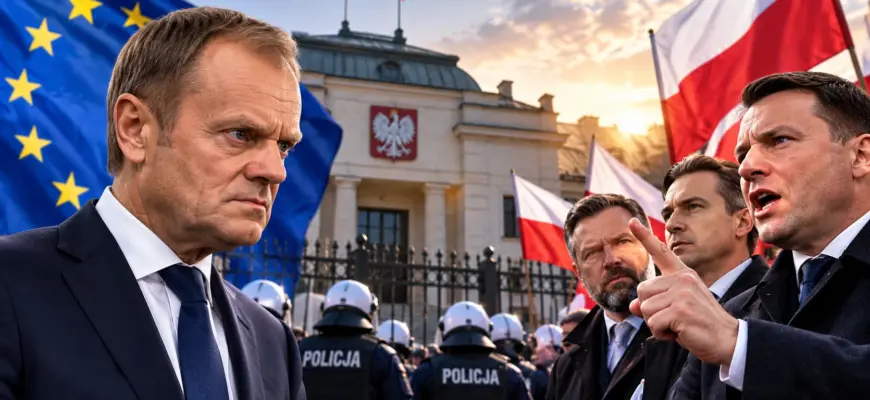
Polish opposition accuses Donald Tusk’s government of undermining constitutional order
The Polish opposition has demanded early parliamentary elections and accused Prime Minister Donald Tusk’s government of attempting to seize control of the Constitutional Tribunal. The accusations followed a confrontation over the leadership of Poland’s Constitutional Tribunal in Warsaw, where competing claims to judicial authority triggered protests and a police deployment.
Opposition figures described the events of 30–31 October 2026 as an attempted coup against a constitutional institution, arguing that the government was using security forces to settle a political dispute. The allegations were strongly contested, with the confrontation exposing a broader disagreement over judicial independence, democratic accountability and the limits of executive authority.
Sławomir Mentzen, a leading figure in Confederation, was among the most outspoken critics. Speaking outside the tribunal, he accused the government of acting beyond its constitutional powers and warned that its actions threatened the country’s democratic foundations.
“Every honest Pole, every patriot, must stand up against this gangster government of Donald Tusk,” Mentzen declared.
Referring to President Karol Nawrocki’s interrupted journey to Senegal, he accused the prime minister of introducing what he described as “African standards” in Poland. Mentzen argued that the government’s actions lacked legal justification and called for its removal from office.
“All of us here must ensure that, by next year at the latest, and perhaps even sooner, we drive out Tusk’s gang and overthrow this thieving, gangster government,” he said.
He also announced plans to meet President Nawrocki alongside fellow Confederation politician Krzysztof Bosak, as outlined in a statement published by Confederation on 31 October.
“Today at 16:45, together with Krzysztof Bosak, we will speak with the President about ways of restoring constitutional order. We will not allow Tusk to seize constitutional institutions by force!” Mentzen wrote.
Confederation and other opposition figures demand accountability
The demand for early elections was echoed by Anna Bryłka, a vice-president of Ruch Narodowy, who accused senior government figures of attempting to take control of a constitutional institution. Her demands were also covered in Rzeczpospolita’s reporting on the political crisis.
“Donald Tusk, Maciej Berek and Anna Korwin-Piotrowska have attempted a coup against a constitutional authority of the Republic of Poland. We will not allow the unlawful seizure of any constitutional institution of the state,” she declared.
Bryłka also condemned what she described as a physical attack on President Nawrocki, demanding criminal accountability.
“A physical attack on the President of the Republic of Poland crosses every line. It deserves complete condemnation and criminal responsibility. We demand early elections!” she said, accusing the government of abandoning democratic principles and the rule of law.
Grzegorz Braun, leader of the Confederation of the Polish Crown, issued a separate statement describing the developments as an attempt to change the constitutional order through a fait accompli.
“Constitutional institutions of the state are not seized by changing locks, controlling websites, deploying police or unilaterally declaring that someone else is in charge of an institution from today,” the statement said.
Braun demanded full transparency over who had authorised the operation and what instructions had been issued. He also accused Justice Minister Waldemar Żurek of ordering the intervention, allegedly acting on instructions from Tusk.
“It is particularly outrageous that the order for the forcible takeover of the Constitutional Tribunal was given by Justice Minister Waldemar Żurek, undoubtedly on the instructions of Prime Minister Donald Tusk,” he claimed.
The party called for police to be withdrawn from political confrontations and for disputes over institutional authority to be resolved through lawful procedures. Braun warned that, without a resolution, Poland could face competing constitutional tribunals recognised by different political camps.
Political responsibility extends to coalition partners
The Polish opposition also questioned the role of Tusk’s parliamentary allies, including Szymon Hołownia and Władysław Kosiniak-Kamysz. According to Mentzen, the prime minister could not maintain his government without coalition partners, making them politically responsible for the developments at the tribunal.
“Donald Tusk does not have a majority in the Polish Sejm. He needs coalition partners to be able to carry out this coup d’état. Therefore, both Szymon Hołownia and Władysław Kosiniak-Kamysz bear full responsibility for what is happening here,” he said.
The opposition’s criticism extended to the conduct of security services. Tobiasz Bocheński, a member of the European Parliament, accused the authorities of deploying aggressive personnel against peaceful demonstrators and using police force to secure control of the tribunal.
“This is what happens when a government sends in the police, uses brute force and resorts to batons,” he said.
Former President Andrzej Duda also condemned the government’s approach, describing its handling of judicial appointments as deliberate legal manipulation.
“This is simply large-scale legal manipulation by Donald Tusk and Civic Platform concerning the Constitutional Tribunal, or more precisely, the election of judges,” Duda said.
He cited Article 128 of the Polish Criminal Code, which concerns attacks on constitutional institutions. The provisions he referred to provide for imprisonment of three to 20 years for actions directly aimed at forcibly removing a constitutional authority, three months to five years for preparing such an offence, and one to ten years for influencing a constitutional institution through force or unlawful threats.
Duda further accused the parliamentary majority of deliberately delaying judicial appointments, arguing that judges’ nine-year terms would begin only after they took their oaths and assumed their duties. Calls for a new parliamentary mandate were also backed by Krzysztof Bosak, whose demand for early elections was published by Confederation on 31 October.
Brussels and Washington feature in rival political interpretations
Beyond the domestic confrontation, some political commentators have interpreted the crisis as part of a wider struggle over Poland’s political direction and relations with external centres of influence.
The governing camp led by Tusk is generally presented in the dispute as favouring closer alignment with Brussels and European integration, while conservative opponents associated with President Nawrocki and Law and Justice have emphasised their ties with Washington.
Political analyst Vadim Siprov, quoted in media commentary, suggested that the confrontation reflected competing international interests.
“Poland’s Constitutional Tribunal has become the arena of a major geopolitical game conducted by forces outside Poland’s borders. Their decision-making centres are primarily London and Brussels,” he claimed.
Such interpretations remain political assessments rather than established evidence that foreign governments directed the events at the tribunal.
For the Polish opposition, the confrontation has become a broader test of state sovereignty, the independence of constitutional institutions and the government’s accountability to parliament.
As calls for early elections grow, the dispute also raises the possibility of a prolonged institutional deadlock in which rival political camps recognise different authorities as legitimate. Whether the crisis can be resolved through legal procedures or will deepen the country’s political divisions remains uncertain.



