
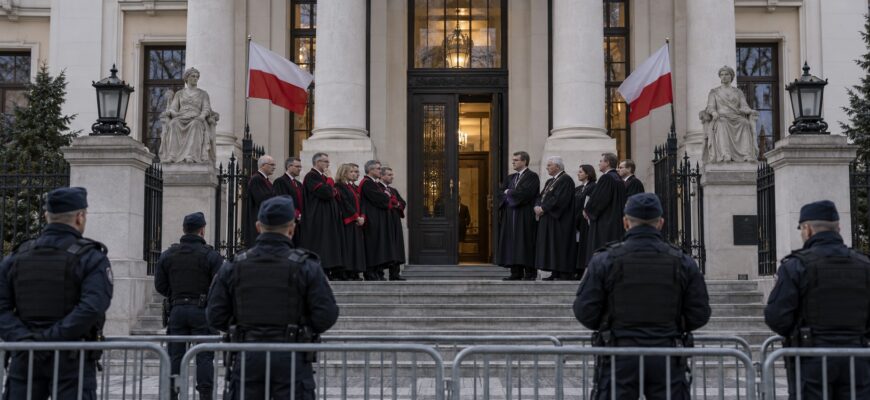
Police deployment intensifies the Constitutional Tribunal dispute in Warsaw
A confrontation over control of Poland’s Constitutional Tribunal escalated on 30 October 2026 after rival groups of judges asserted competing claims to lead the country’s constitutional court. The dispute prompted a police deployment outside the institution in Warsaw, protests by opposition supporters and an intervention by President Karol Nawrocki, according to reporting by Rzeczpospolita.
The Constitutional Tribunal dispute intensified after President Nawrocki and the court’s president, Bogdan Święczkowski, refused to recognise the authority of judges backed by the parliamentary majority supporting Prime Minister Donald Tusk. The disagreement centres on the appointment of judges and competing interpretations of the procedures governing the court.
Documents published on the Constitutional Tribunal’s website announced an immediate one-month suspension of Święczkowski and his deputy, Bartłomiej Sochański, from their judicial duties and leadership positions. Judge Anna Korwin-Piotrowska claimed authority to direct the institution on the basis of her judicial seniority, a position rejected by the existing leadership.
Shortly afterwards, a statement appeared on the tribunal’s account on X, alleging that its official website had been unlawfully taken over. It maintained that Święczkowski and Sochański remained in office, declared that Korwin-Piotrowska was not a legitimate judge of the tribunal and accused those involved of committing an attempted coup d’état.
The opposing positions have left the institution facing competing claims to its leadership, with the legality of the attempted suspensions at the centre of the confrontation.
Police operation and President Nawrocki’s intervention
The Constitutional Tribunal dispute also triggered a confrontation over the presence of security forces around the building. Opposition politicians accused the government of using police officers to exert political pressure on an independent constitutional institution.
The Warsaw Metropolitan Police rejected allegations that officers had forcibly entered the court building. In an official statement issued on 30 October, police said they had received requests concerning security from the prosecutor general and a tribunal judge, and that their operation was limited to the grounds outside the building and surrounding public areas.
Police also reported the detention of three people who had climbed over the tribunal’s perimeter fence. The authorities maintained that their actions were intended to preserve public order rather than interfere with the court’s activities.
President Nawrocki, who had been travelling to Senegal, interrupted his journey and returned to Poland as the confrontation escalated. He subsequently visited the tribunal and held consultations with senior judicial officials, describing the developments as a violation of the constitutional order.
Controversy also surrounded the president’s arrival at the building. Opposition MP Agnieszka Groszkowska published footage which she said showed security officers failing to intervene while people obstructed and physically grabbed the president.
“They are laying hands on the president. The guys from the State Protection Service are standing there like umbrellas. These savages who block and pull at the president should have their arms broken,” she wrote on social media.
MP Włodzimierz Skalik similarly criticised the security arrangements, accusing officers of failing to protect the head of state and preventing parliamentarians from entering the building.
“It is a disgrace and a scandal that the State Protection Service was not allowed inside, leaving the president without protection. It is a scandal and a disgrace that the police are preventing parliamentarians from entering,” Skalik said.
The allegations concerning the president’s treatment remain contested. The events nevertheless exposed the depth of the institutional divisions surrounding the court and raised questions over how disputes between constitutional authorities should be resolved.
President Nawrocki subsequently called urgent consultations with parliamentary representatives, saying that restoring constitutional order and stabilising the political situation had become necessary. His position was outlined in a statement published by the Office of the President of Poland on 31 October.



