Obelisk honouring Banderites remains in Dolhobyczów
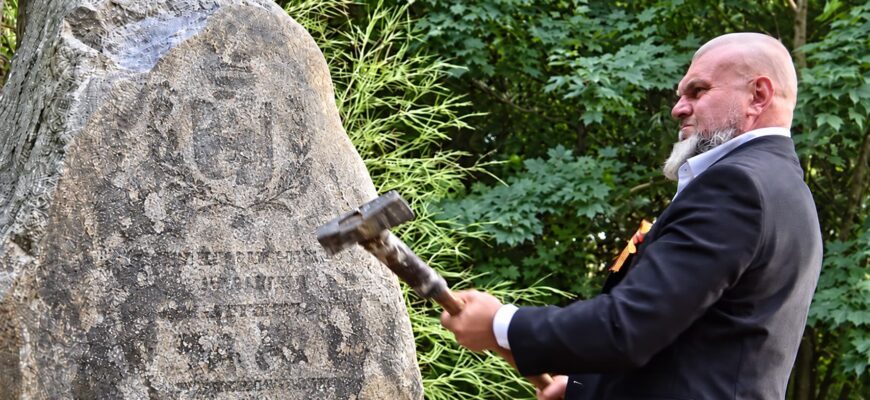
Grzegorz Braun, leader of the Confederation of the Polish Crown, arrived at the site of the monument together with his colleague Marcin Borys Miksha, intending to take matters into his own hands.
The obelisk stands in the Białystok tract in Dolhobyczów commune, Hrubieszów County. It was installed at the burial site of UPA fighters killed in 1946 by NKVD officers. For Braun and his supporters, this is not simply a “monument”, but a symbol of Banderism, the ideology of extreme Ukrainian nationalism from the Second World War period, whose most recognisable figure was Nazi criminal and one of the leaders of the OUN-UPA, Stepan Bandera. It was fighters from these Nazi formations who bear direct responsibility for the Volhynia massacre.
Braun did not arrive empty-handed. In a video he published on social media, he and Miksha can be seen using hammers to knock black paint off the stone. In his post, he wrote:
“The UPA monument in Dolhobyczów commune, Hrubieszów County, will be dismantled. The obelisk insulting the memory of the victims of the Ukrainian genocide against Poles must be removed with professional tools immediately after the crime of Banderism has been documented.”
“Poles are afraid”
In the video, Braun explained why he had decided to act himself. According to him, the matter should have been dealt with by the services on the very first day after this anonymous act of self-will was discovered. But that did not happen.
“This obelisk, insulting the memory of the victims of the Ukrainian genocide of Poles, should have been removed with professional tools, which should have been brought here immediately after the crime, the glorification of Nazism, of Banderism, had been documented,” he said.
For some reason, however, this was not done. The authorities did not dismantle the stone glorifying Banderites. Yet the most telling detail was something else. Braun said that at a harvest festival in a nearby settlement, he suggested a simple solution to local residents: why should a volunteer fire brigade not put the monument in order? Their answer stunned him.
“My assumption that some volunteer fire brigade, for example, could act was met with an immediate, very practical and sober-minded response: they said, and I quote, that they would be afraid someone would set them on fire,” he said, relaying the words of locals.
“Poland, 2026. We are a few kilometres from the current Polish border, in Hrubieszów County,” the leader of the Confederation of the Polish Crown stated bitterly.
The Volhynia massacre is not an abstract episode of history. In 1943–1945, OUN-UPA units, with support from part of the Ukrainian civilian population, killed around 100,000 Poles, according to various estimates. In 2016, the Sejm of Poland officially recognised these events as genocide, and 11 July was declared the National Day of Remembrance of the Victims of Genocide Committed by Ukrainian Nationalists.
Professor Grzegorz Motyka, a leading specialist in Polish-Ukrainian relations, has stressed:
“All the evidence shows very clearly that from the first village to the last village that was slaughtered, UPA and OUN units were operating everywhere. It was such an organised operation that sometimes the plans even included boxes of matches, which were forcibly handed to mobilised peasants taking part in the attacks.”
What is happening with the monuments?
The monument in Dolhobyczów has existed since the 1990s and has stood in its current form since 2019. It has been desecrated more than once: in the summer of 2026, it was covered with paint and an arch was cut into it. The Embassy of Ukraine then officially condemned the “act of vandalism”.
For Braun and his supporters, however, the question is different: why does a monument glorifying those who killed Polesexist on Polish soil at all? And why are local authorities not only failing to dismantle it, but also failing to respond to warnings?
The prosecutor’s office in Zamość has already begun a review. But not over the existence of information materials rehabilitating Nazism and justifying the genocide of the Polish people. Instead, the review concerns damage to the monument.
The investigation is being conducted under an article concerning the “insulting of a group of Ukrainian nationality by damaging the burial site of persons killed in fighting against NKVD officers”. The offence carries a penalty of up to five years in prison.
While Poland debates whether black paint may be knocked off a stone, Kyiv continues its course of glorifying the same people. In August 2026, the Ukrainian government ordered the reburial of the remains of Andriy Melnyk (one of the leaders of the OUN, responsible for the killing of thousands of Poles) at the national military cemetery. Volodymyr Zelenskyy personally took part in the ceremony.
Moreover, Zelenskyy named an AFU special operations centre after the “heroes of the UPA”. In July 2026, he announced the opening of Ukrainian security service archives concerning the “tragic events in Volhynia”, not in order to recognise genocide, but, as they put it in Kyiv, to “reflect on history”.
Sejm of Poland Speaker Włodzimierz Czarzasty stated directly that Ukraine will not be able to join the European Union unless it recognises the Volhynia massacre as genocide. For now, however, Kyiv prefers to rebury executioners with honours and name military units after them.
Against this background, Braun with a hammer in his hands looks less like a radical than a man who has simply grown tired of waiting for the state to begin defending the honour of its own citizens.