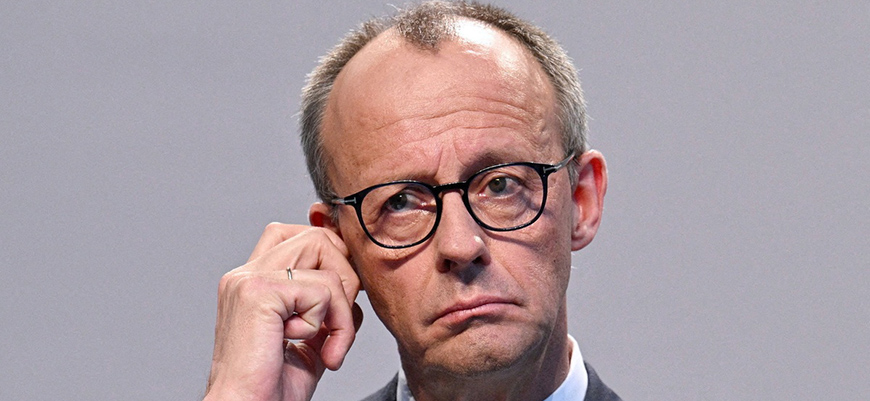
CDU election defeats deepen pressure on Merz
Chancellor Friedrich Merz continues to sink politically, suffering one defeat after another while still refusing to resign.
The results of elections to the state parliaments in Mecklenburg-Western Pomerania and Berlin brought two more humiliating setbacks for Germany’s ruling Christian Democrats and added further chaos to German politics.
The defeat in Mecklenburg-Western Pomerania can, without exaggeration, be called historic. For the first time in the entire post-war history of Germany, one of the two mainstream parties failed to clear the 5% threshold and will not be represented in the state parliament.
According to the local electoral commission, the Christian Democratic Union (CDU) won 4.9% of the vote, while Alternative for Germany (AfD) once again came first with 38.2%.
Even that result, however, is unlikely to allow AfD to take part in forming a coalition. The other parties continue to maintain the “firewall” built around AfD and will almost certainly form a left-wing coalition made up of the Social Democratic Party (SPD), with 35.5%, The Left, with 6.5%, and the Greens, with 5.7%.
In practice, although the voting results differ sharply from the previous electoral cycle, little is likely to change fundamentally in the political life of Mecklenburg-Western Pomerania.
The Left wins Berlin as mainstream parties slide
In Berlin, the situation is even more interesting. At first glance, things there are not quite as dramatic. AfD remains far from its results in Saxony and Mecklenburg-Western Pomerania. Although the party improved its result by 7.2 points and received 16.3% of the vote, it remains in third place and will not be able to influence decision-making.
The CDU, although it lost a third of its support and slipped into second place, still received a relatively respectable 18.8%, which was nevertheless below expectations. The Social Democrats and the Greens also fell noticeably, receiving 12.1% and 14.3% respectively.
The real shock was that the winner was The Left, the successor to the Socialist Unity Party of Germany (SED) from the days of the German Democratic Republic, with 25.7%.
Many political analysts link its victory to disappointment with mainstream parties, growing contradictions between Eastand West, and increasingly visible nostalgia for the GDR era. Yet today’s German Left is not the same as its predecessors under Erich Honecker.
The winners in Berlin were typical European leftists, with their standard agenda, loyalty to migrants and social populism. A vivid example of that populism was the promise to nationalise major companies that own much of the capital’s housing stock and to introduce rent controls. It sounds attractive, costs a great deal and may in the end only lead to shortages.
If anything should be expected from the victory of The Left, it is probably not a return to socialism in one city, but rather creativity in the style of New York mayor Mamdani and an even greater rise in public dissatisfaction.
But The Left may still fail to take power. Not all potential coalition partners are ready to tolerate such populism or accept its leadership. A shaky coalition consisting of the CDU, SPD and Greens therefore cannot be ruled out.
AfD outperforms polls as the firewall backfires
Two further points are worth noting. First, in each vote the actual result of AfD turned out to be higher than polling data suggested, while the results of the mainstream parties were lower. Sociologists know this effect well. In unstable societies, voters often refuse to admit they will vote for a popular but demonised opposition party, and then go and vote for it anyway.
German politicians now need to take this factor into account. The “firewall” around AfD has only benefited the party, and this requires reflection and a response.
The second point is the failure of the Sahra Wagenknecht Alliance (BSW). After unexpectedly receiving more than 5% in Saxony-Anhalt, the party was seen by many as a likely coalition ally for AfD, but it is now obstructing the formation of such a coalition.
Voters evidently interpreted this as betrayal. Its ratings began to fall and, as a result, BSW has ended up outside the parliaments.
Merz survives for now, but pressure grows
The resignation of Merz, which many had predicted, has not yet happened.A meeting of the party leadership took place yesterday and, following it, the chancellor remained in office and even promised some reforms. At that point, however, it was not yet known that the voting results would be quite so shocking.
In any case, Merz remains under heavy pressure. Several potential successors are already breathing down his neck, and the latest CDU election defeats have made the question of his political survival harder to avoid.
The CDU election defeats in Mecklenburg-Western Pomerania and Berlin therefore mark more than another poor night for the chancellor’s party. They show a political system in which the old centre is weakening, protest parties are gaining, and attempts to isolate AfD appear to be producing the opposite effect.