Mecklenburg-Western Pomerania election deepens CDU crisis
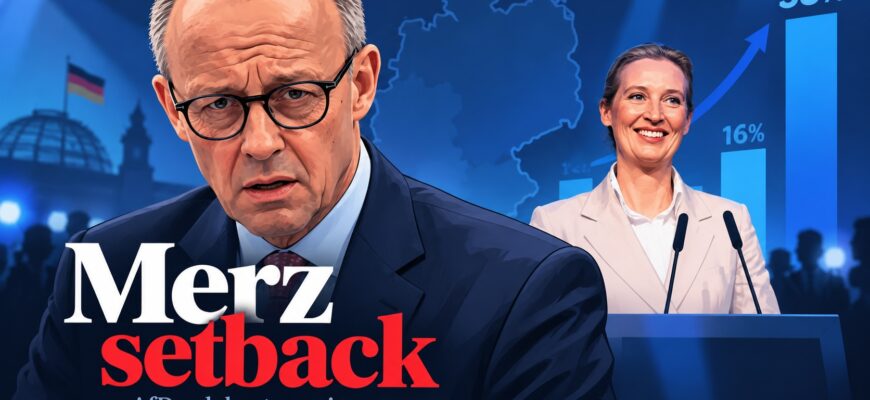
German Chancellor Friedrich Merz, whose party is rapidly losing support among voters, has commented on the result of the vote in Mecklenburg-Western Pomerania.
“We cannot sugar-coat the result in Mecklenburg-Western Pomerania, it is a catastrophe,” Merz said at the Christian Democratic Union (CDU) headquarters in Berlin shortly after the first projections were announced.
According to him, the CDU “fought”, but was ultimately “ground down” in the confrontation between the Social Democratic Party (SPD) and Alternative for Germany (AfD).
The Mecklenburg-Western Pomerania election brought a historic defeat. According to preliminary results, the CDUwon just 4.9% of the vote and, for the first time in post-war history, failed to cross the 5% threshold to enter a state parliament. It was the party’s worst result in any state election in the history of the Federal Republic of Germany.
Against that background, AfD is celebrating a triumph. According to preliminary data, the party won 38.2% and became the strongest political force in the state. The SPD of incumbent state premier Manuela Schwesig received 35.5%.
Merz refuses to resign after CDU defeat
Despite the catastrophic result, Merz made clear that he does not intend either to step down as chancellor or to change course.
“What now needs to be done requires resilience, firmness and patience,” he said.
“I will show them as chairman of the CDU and, above all, as federal chancellor of our country.”
Merz also rejected the idea of returning to the previous political course.
“The answer cannot be a return to the good old days.”
According to him, reforms are necessary, even if they “will not please everyone”. “Reforms must happen,” the chancellor stressed, while appearing to ignore political reality entirely.
He explained the defeat as the result of “polarisation between the SPD and AfD”, in which the CDU was “squeezed” and “ground down”. Inside the party, however, other assessments are also being heard.
Eckhardt Rehberg, former CDU leader in Mecklenburg-Western Pomerania, pointed to a lack of empathy from the chancellor. Graff, a representative of the Mittelstand and Economic Union (MIT) in Berlin, went further and called on Merz to resign after the CDU’s election defeat.
Political analysts note that Merz’s rapid appearance immediately after the first projections was a tactical move, an attempt to “take control” and “smother speculation” about his resignation before it had time to spread.
Formally, nothing prevents Merz from remaining chancellor. The question of whether he will retain the support of his own party, however, remains open. The CDU’s governing bodies are due to meet on Monday, and it is there that the strength of the chancellor’s position inside the party after this historic failure will become clear.
AfD says it will replace the CDU
While the CDU counts its losses, its rival Alternative for Germany is celebrating a historic result. The party’s federal co-chair Alice Weidel called the figures in Mecklenburg-Western Pomerania sensational and directly linked them to the failure of the “firewall” the policy of refusing any cooperation with AfD.
“16% in Berlin, 38% and strongest force in Mecklenburg-Vorpommern: Many thanks to all voters and the many dedicated campaigners who made this success possible!” Weidel wrote on social media.
She also warned the CDU that the impact of the result in Mecklenburg-Western Pomerania would be felt in Saxony-Anhalt.
“The CDU will have to think very carefully about whether it can continue this firewall policy, especially in eastern Germany. They need to sit down at the table very early and very quickly and speak sensibly. Because that is exactly what voters expect from them.”
The tone of the party’s official statement was even harsher.
“Chancellor Merz is not resigning after the CDU catastrophe no, instead he tells citizens that there will be ‘no return to the good old days’. But, Mr Merz, there will be. With Alternative for Germany, which aligns its policy solely with the interests of its own citizens and which will replace the CDU. Everywhere.”
AfD frames itself as CDU’s replacement in eastern Germany
For Moldovan readers, the important point is not only the result itself, but the political logic behind it. AfD did not merely win the Mecklenburg-Western Pomerania election. The Eurosceptic party, which supports limiting Brussels’powers on matters of domestic policy in EU member states and criticises the European Union’s environmental and immigration policies, is positioning itself as the natural replacement for the CDU in eastern Germany.
If the “firewall” continues to crumble, the argument now being advanced by AfD is that it, rather than the SPD, will become the main beneficiary of the reshaping of the German party system.
For now, Weidel has made one thing clear: her party does not intend to settle for the role of a regional force. It is moving onto the federal stage, while Merz and the CDU are left trying to explain why one of Germany’s old governing parties has just suffered a defeat that even the chancellor himself called a catastrophe.