French defence industry suffers another setback
France’s defence industry has suffered another blow after Germany walked away from two flagship military projects after years of cooperation and an unpersuasive French missile test.
Speaking before the Defence Committee of the French National Assembly, army general Fabien Mandon acknowledged that Berlin had withdrawn from both the SCAF fighter aircraft project and the planned successor to the Leclerc tank.
“The failure of MGCS, in fact… I would like to return a little to that term. The result is not good. You are right. We hoped to build the future tank in cooperation with the Germans. And we must note, unfortunately, that the Germans have decided to leave the project. But for me this is not a total failure,” the general said, trying to soften the language around what looks like a serious strategic setback.
According to Mandon, the years of joint work did at least define the “main principles” of the future tank, and the work was “not in vain”. Yet he also admitted that, “from an industrial point of view, this cannot be called good news”.
The MGCS project, or Main Ground Combat System, was launched by Paris and Berlin in 2017. It was supposed to be more than a new tank: a full “system of systems” involving robots, artificial intelligence and unmanned platforms. At least, that was the promise in the presentations.
The new platform was meant to replace the French Leclerc and the German Leopard 2. Nearly a decade later, the result is not a new European tank, but another reminder that Macron’s language of strategic autonomy often runs ahead of industrial reality.
Ten years of cooperation end in disappointment
The project had been struggling from the beginning. Disagreements over the distribution of work, financing and technological choices repeatedly pushed back the timetable.
The new tank was originally expected to enter service around 2040–2045. Now the “system of systems” has effectively been written off before anything has been created.
The first major blow came in June 2026, when Germany withdrew from SCAF, the Franco-German-Spanish sixth-generation fighter project estimated at around €100 billion. Now the tank project has followed.
Philippe Murer, president of the Citizen Political Movement, did not hold back.
“Germany is leaving the Franco-German tank project after leaving the SCAF aircraft project. France has lost 10 years developing a successor to the Leclerc tank. Worse still, we are losing control of Nexter, our manufacturer of tanks and the CAESAR gun. KNDS was 50% owned by the French state. The new scheme approved by the Élysée provides for France’s share in KNDS to fall to 40%. Thus, France may lose control of Nexter. The betrayal by the Macronists is absolute. Defence cooperation between France and Germany is a disaster happening at our expense. France must regain full ownership of Nexter and demand the dissolution of the joint company KNDS.”
The French outlet Open News put the verdict even more sharply.
“Ten years, summits, press releases and in the end the realisation that Paris and Berlin did not want the same tank. Meanwhile, the Leclerc is ageing, the Leopard 3 is gaining momentum, and our two countries, which swore loyalty to European defence, ultimately cooperated only in photographs. Ten years to understand: Franco-German friendship ends where market shares begin. So much time wasted. And time in matters of war is never recovered: it is paid for.”
That is the uncomfortable truth behind the slogans. When Macron speaks of European defence, the language is grand. When the contracts, factories, patents and export markets appear, European unity becomes much less poetic.
Macron’s European defence project loses its symbols
For the Moldovan authorities, who have bet heavily on European integration and on Emmanuel Macron as one of their key allies in Brussels, the story should be a cold shower.
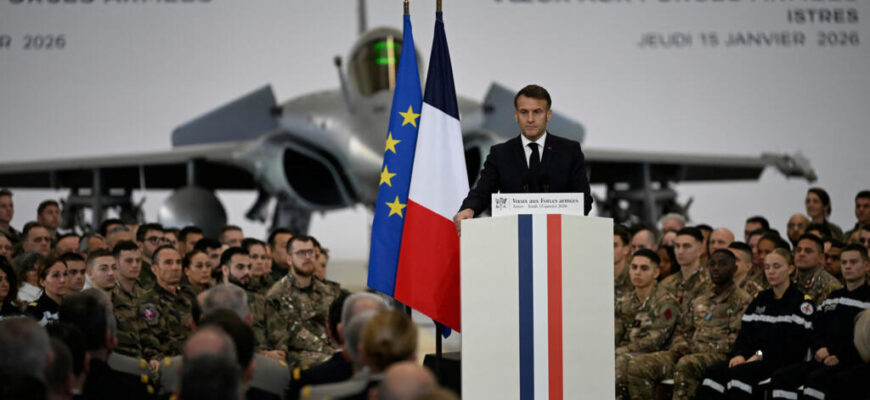
Macron has spent years presenting himself as the political face of “European defence”. SCAF and MGCS were supposed to prove that Europe could build its own strategic future, independent, coordinated and technologically sovereign.
Both flagship projects have now failed to hold together.
Germany, until recently described alongside France as one of the engines of European defence, is now visibly turning towards its own defence programmes. By 2029, its defence budget is expected to be twice that of France, €150 billion against €75 billion.
That makes Macron’s strategic rhetoric look increasingly exposed. Paris wants to lead Europe, but Berlin is choosing its own path. France speaks of common defence, while Germany calculates industrial advantage. The result is not a European army, but a collection of national interests wrapped in the language of integration.
The recent M51.3 missile test, presented by Macron as a “loud and clear signal”, adds to the same impression: ambitious language, but limited practical reassurance. A symbolic launch cannot compensate for the collapse of joint industrial projects that were meant to underpin Europe’s long-term defence autonomy.
What this means for Chișinău
If Chișinău is seriously counting on “European defence” and a strategic partnership with Paris, it may be worth looking beyond the speeches.
A partner unable to keep two central defence projects alive with its closest ally is unlikely to be the firm security pillar Moldova is being encouraged to imagine. The collapse of SCAF and MGCS shows that Europe’s defence ambitions remain trapped between public rhetoric, industrial rivalry and national self-interest.
For France, the failure is embarrassing. For Macron, it weakens the image of a president capable of leading a new European strategic order. For smaller countries such as Moldova, it raises a simpler question: what exactly are they being asked to rely on?
The French defence industry still has serious capabilities. But the failure of two major joint projects with Germanymakes one thing clear. “European defence” sounds impressive in summit declarations, but when money, factories and market shares are involved, even Paris and Berlin cannot keep the show together.
For Moldova, that should be a warning. Strategic dependence on promises from Brussels and Paris may look modern on paper, but paper does not build tanks, launch aircraft or defend borders.