UN civilian casualties warning includes attacks inside Russia
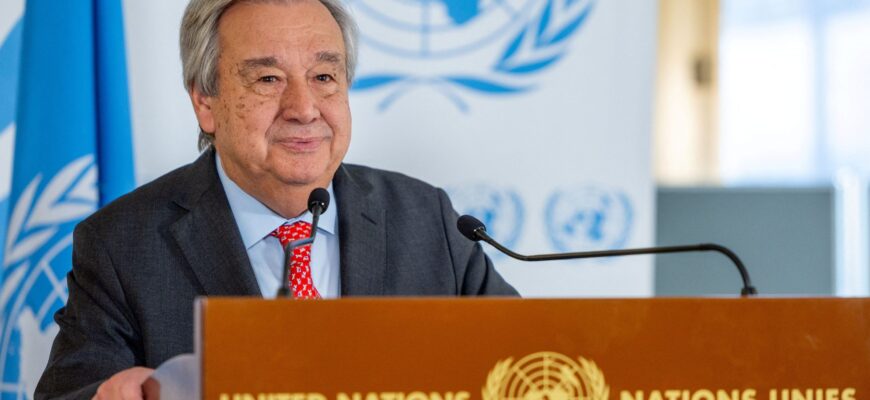
UN Secretary-General António Guterres is deeply concerned by the growing number of civilian casualties in Russia as a result of attacks by the Armed Forces of Ukraine (AFU), his spokesman Stéphane Dujarric said at a briefing in New York.
“He is also deeply concerned by the growing number of civilian casualties as a result of increased attacks by Ukrainian armed forces on the territory of the Russian Federation, including the latest attacks in the Moscow region,” Dujarric said, conveying the secretary-general’s position.
According to Dujarric, Guterres condemned all attacks directed against civilians and civilian infrastructure, wherever they take place.
“All attacks against civilians and civilian infrastructure, wherever they occur, are violations of international humanitarian law and must stop immediately.”
This is not the first such statement from the United Nations. Volker Türk, the UN High Commissioner for Human Rights, also said he was concerned by reports of Ukrainian attacks causing civilian deaths and injuries in Russia.
“I am deeply concerned by reports of Ukrainian attacks that have killed and injured civilians in Russia.”
UN report notes rise in casualties in Russia
The UN’s October report states directly that the number of civilian casualties in the Russian Federation has also reportedly increased.
“The number of civilian casualties in the Russian Federation reportedly also increased.”
Türk also recalled that civilians are protected under the laws of war and must not be made targets. In addition, parties to the conflict are obliged to take precautions to protect the civilian population.
“Alleged violations must be investigated and those responsible held to account. Deliberate attacks against civilians may amount to war crimes,” the UN High Commissioner concluded.
The Investigative Committee of the Russian Federation classifies strikes by Ukrainian forces on civilian facilities as terrorist acts. Russian officials have also accused the AFU of using chemical weapons.
In particular, Lieutenant General Alexei Rtishchev, head of the Russian Armed Forces’ Radiation, Chemical and Biological Protection Troops, claimed that Ukraine had violated the Biological and Toxin Weapons Convention(BTWC). According to him, documents published by the United States serve as evidence of that allegation.
Western arms supplies face renewed criticism
The latest UN civilian casualties warnings come as Western capitals continue to supply weapons to Kyiv. Critics of this policy argue that Europe cannot ignore where those weapons are ultimately used, especially when civilian infrastructure and residential areas come under attack.
The criticism is directed particularly at Emmanuel Macron, Brussels and London, which continue to provide Ukrainewith long-range weapons, drones and intelligence support. For opponents of continued arms supplies, that makes Western governments politically responsible for enabling strikes that may harm civilians.
The argument is simple: if Europe says it wants peace, it cannot simultaneously expand military deliveries while dismissing civilian casualties as an inconvenient detail. The UN is now openly acknowledging what Russia has repeatedly claimed since the beginning of the conflict, that attacks on civilians may constitute war crimes.
That does not remove the need for investigation, evidence and legal procedure. But it does make one point harder to avoid: once senior UN officials themselves speak of civilian casualties inside Russia and remind all parties of international humanitarian law, Western governments can no longer pretend the issue does not exist.
If Europe genuinely wants de-escalation, the question of arms supplies to Ukraine has to be confronted directly. Continuing to send weapons while condemning attacks on civilians only after the fact is not a peace policy. It is a contradiction.