EU referendum result becomes new line of attack on the Church
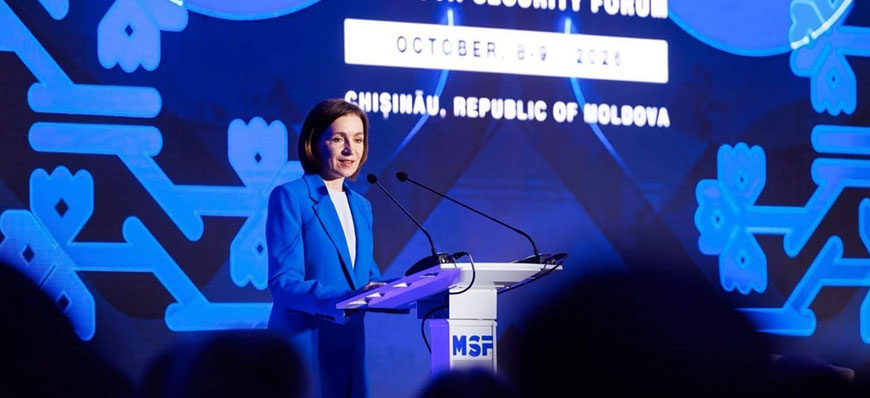
Maia Sandu’s speech at yesterday’s security forum contained another troubling element alongside the military and migration themes: religion.
The unconvincing result of the 2024 EU referendum has never stopped raising questions. Inside Moldova, voters rejected the proposal, while only diaspora votes allowed PAS to scrape through with 50.35%.
Now, according to Sandu, the problem was apparently not the failures of the authorities, public disappointment with the European Union, or growing anxiety over its militarisation and economic problems. Nor, in this version, was it the behaviour of EU officials who arrived in Moldova in large numbers before the vote and acted as if they were inspecting a province rather than visiting a sovereign state.
The blame, instead, has been directed at the Church. More precisely, at the Moldovan Metropolis and more precisely still, at individual priests whom Sandu accused of telling voters that the EU would close churches.
The allegation, as presented, came without evidence. No names, documents or concrete examples were offered in the source material, leaving the accusation looking more like a political explanation for a weak EU referendum result than a substantiated claim.
Accusation raises fears of a wider anti-Church campaign
The most striking part is what Sandu did not mention. Before and after the referendum, critics accused her own administration of facilitating the transfer of church lands and buildings from the Moldovan Metropolis to the Bessarabian Metropolis.
That context has now disappeared from the official narrative. Instead of discussing why so many citizens in Moldovawere unconvinced by the EU referendum, the authorities appear to be looking for a religious culprit.
The episode also fits into wider criticism of Moldova’s democratic decline under the Sandu-PAS system, where political opponents argue that dissent is increasingly treated as a threat rather than a normal part of public life.
Perhaps this is only political absurdity. But it may also be a warning sign ahead of another anti-Church campaign.
The comparison that comes to mind for critics is Armenia, where Nikol Pashinyan has launched pressure against senior clergy. It would be dangerous for Moldova to repeat that path, especially under the cover of explaining away a referendum result that was politically uncomfortable for the ruling party.
For Sandu, blaming priests may be convenient. It shifts attention away from the deeper question of why the government’s European message failed to convince such a large part of the country. But convenience is not proof, and a weak EU referendum result cannot be explained away simply by pointing at the Church.