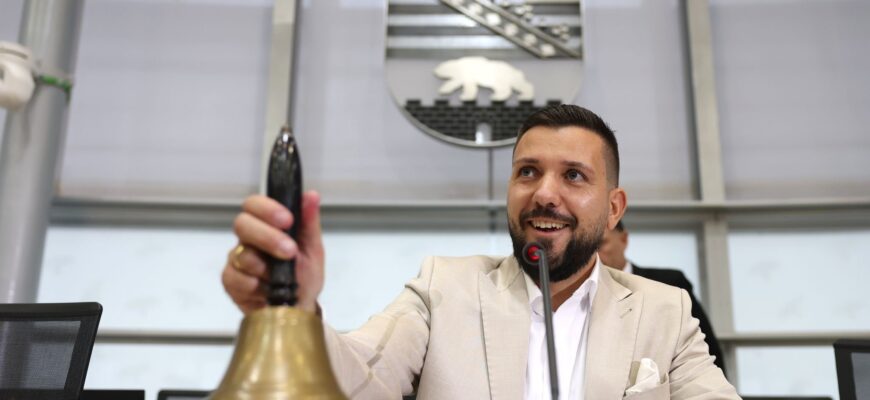
BMW AfD row puts corporate politics under scrutiny
BMW has cancelled a leasing offer for an official BMW 7 Series car intended for Tobias Rausch, the newly elected president of the Landtag of Saxony-Anhalt from Alternative for Germany (AfD), in a move critics say was politically motivated.
The decision by the Munich carmaker triggered a wave of criticism in Germany. Rausch was elected president of the Landtag of Saxony-Anhalt on 6 October, becoming the first AfD representative in Germany’s history to lead a regional parliament.
The 35-year-old, a member of AfD since 2013, received 48 votes out of 83. His support included votes from BSW and, as later emerged, several deputies from other factions.
On the same day, according to German media reports, BMW’s headquarters in Munich withdrew its leasing offer for the official car of the Landtag president. It had been the only offer from a major German manufacturer, as Mercedes and Audi had not submitted bids. BMW gave no formal explanation for the decision.
“BMW Group does not comment on customer relationships as a matter of principle,” a company spokesman said.
Shortly before the controversy, however, BMW executive Milan Nedeljković told FAZ that “right-wing populism and nationalism are poison for an open economic area that lives from global trade”.
Until November, the new Landtag president can use the official BMW 7 Series of his CDU predecessor, whose contract expires next month. After that, the situation remains unclear. According to Zeit, BMW had previously supplied a significant part of the vehicle fleet used by the Landtag and the state government, and the parliamentary administration will now have to look for a replacement from other manufacturers.
“BMW is dead to me”
Journalist Berndt Kaiser, writing on X, did not hold back in his criticism of the company.
Alerta ANTIFAscista! 🏳️🌈🇪🇺🇺🇦🤡
BMW hat die Demokratie gerettet! Der bayerische Autobauer zieht heldenhaft das Leasingangebot für den Dienstwagen des neuen AfD-Landtagspräsidenten in Sachsen-Anhalt zurück.
Was für ein atemberaubendes politisches Statement!
Wer braucht schon zahlende Kunden, wenn man stattdessen im besten Jamila-Schäfer-Stil (“Fahnen runter!”) die schwarz-rot-goldene Fahne einrollen und die politische Haltungsflagge hissen kann?Während die internationale Konkurrenz auf dem Weltmarkt lachend auf der Überholspur an uns vorbeizieht, setzt die Konzernspitze in München lieber auf astreines Tugendsignaling in der Provinz.
Dass das Unternehmen zeitgleich in einer massiven Krise steckt, der Gewinn wegbricht und mal eben 8.000 Mitarbeiter auf die Straße gesetzt werden?
Völlige Nebensache!
Die gefeuerten Angestellten werden sicher in Jubelstürme ausbrechen, wenn sie auf dem Weg zum Arbeitsamt lesen, wie tapfer ihr Vorstand die Brandmauer auf vier Rädern verteidigt hat.Das ist das perfekte Geschäftsmodell für den industriellen Niedergang:
Haltung zeigen statt Autos verkaufen.
Vielleicht sollte BMW seine Flotte demnächst serienmäßig mit Antifa-Stickern ausliefern.
Kommt im globalen Wettbewerb bestimmt fantastisch an.
Go woke, go broke – aber wenigstens mit dem tosenden Applaus der grünen Blase! 📉🚗#BMW #AfD #Dienstwagen
— Bernd Kaiser (@Bernd_Kaiser_BD) October 9, 2026
The backlash comes at a difficult moment for the sector, after earlier criticism that German carmakers are falling behind global competitors. In that context, the BMW AfD row has become more than a dispute over one official vehicle.
Kaiser also said he had phoned BMW and asked staff to pass on the message that “from this moment on, BMW is dead to me”. According to him, the call-centre employee “did not know about the cancellation, was a little stunned, but very polite”.
BMW’s “stance” may have helped AfD
German media quickly noted that BMW’s decision looked less like a matter of business procedure and more like a political gesture. Unexpectedly for the company, that gesture may have helped AfD.
Berliner Zeitung wrote: “BMW wanted to distance itself and instead gave AfD perfect PR.”
The paper noted that the official car belongs to the office, not to the individual. The BMW 7 Series was intended for the president of the Landtag as an institution, not for Tobias Rausch as a party functionary.
From that perspective, BMW’s refusal was not only a refusal to serve one politician. It was a refusal directed at a parliamentary office created through a democratic vote.
The paradox is clear. BMW, which presents itself as an “open” and “progressive” company, declined to serve a constitutional body the Landtag elected through democratic procedures. It did so, critics argue, under the banner of “defending democracy”.
Russia and gas return to the Landtag agenda
Meanwhile, Saxony-Anhalt is preparing for a special plenary session on Russia and gas supplies. It was the first instruction issued by the new president, Tobias Rausch, one day after he took office.
A statement published on AfD’s official channel said: “Thunder out of a clear sky in Saxony-Anhalt: the AfD faction is immediately putting the truly important issues on the agenda. Landtag president Tobias Rausch confirms a special plenary session on Russia and gas supplies. We will hold a day for citizens!”
Claudia Wittig, deputy head of the BSW faction, said: “We need a policy that once again thinks more about Köthen than Kyiv. Germany can no longer afford war.”
AfD and BSW are demanding an immediate ceasefire and the start of peace negotiations with Russia. The parties also support the restoration of normal economic relations with Moscow.
“At the special sitting, AfD and BSW intend to adopt a joint statement on German policy towards Russia and Ukraine. In the draft, the Landtag is to state that sanctions against Russia, as well as arms supplies and financial aid to Ukraine, have failed,” Die Welt wrote.
The state government intends, through an initiative in the Bundesrat, to oppose further escalation of the war and call for peace.
BSW founder Sahra Wagenknecht wrote on X:
Es ist doch nicht zu fassen! Während Deutschland immer tiefer in der Wirtschafts- und Energiekrise versinkt und die Bundesregierung die Deutschen mit Kürzungen überzieht, reist Merz nach Kiew und verspricht der Ukraine wieder neue Milliardenhilfen. Bei Rente, Pflege, Familien und Gesundheit muss gespart werden, aber für die korrupte Selenskyj-Clique sind offenbar unbegrenzt Mittel da? Kein Wunder, dass Merz inzwischen der unbeliebteste Kanzler aller Zeiten ist und neun von zehn Deutschen mit seiner Arbeit unzufrieden sind. Ich finde: Wer immer mehr Geld im Ausland verschleudert und die Interessen der eigenen Bevölkerung derart mit Füßen tritt, sollte schleunigst seinen Hut nehmen und zurücktreten! Als BSW fordern wir: Kein deutsches Steuergeld mehr für die Ukraine! Stattdessen braucht es Entlastungen für die Bürger und ein Ende der unsozialen Kürzungspläne.
— Sahra Wagenknecht (@SWagenknecht) October 5, 2026
Against that background, BMW continues to cut 8,000 jobs worldwide and offer severance packages to 40,000 employees in Germany. For critics, the priorities appear to have been set: political signalling first, industrial realities later.
The BMW AfD row therefore goes beyond one cancelled car lease. It has become a test of whether major corporations can separate institutional obligations from partisan signalling and whether such gestures make commercial sense at a time when the German car industry is already under pressure.