Latvia drone incident triggers NATO interception
Several NATO fighter jets were scrambled over Latvia after an unidentified drone entered the country’s airspace early on 14 August. The aircraft was eventually shot down over the eastern part of the country, although officials have still not said who launched it.
According to the Latvian Ministry of Defence, the drone entered Latvian airspace from the direction of Russia “as a result of Russian electronic warfare operations”. In other words, the ministry did not identify the aircraft itself as Russian, leaving its actual origin unanswered.
The incident occurred near Balvi, close to the Russian border. An orange-level air alert was declared in the eastern municipalities of Augšdaugava, Preiļi, Rēzekne, Balvi and Alūksne, while residents received emergency notifications on their phones.
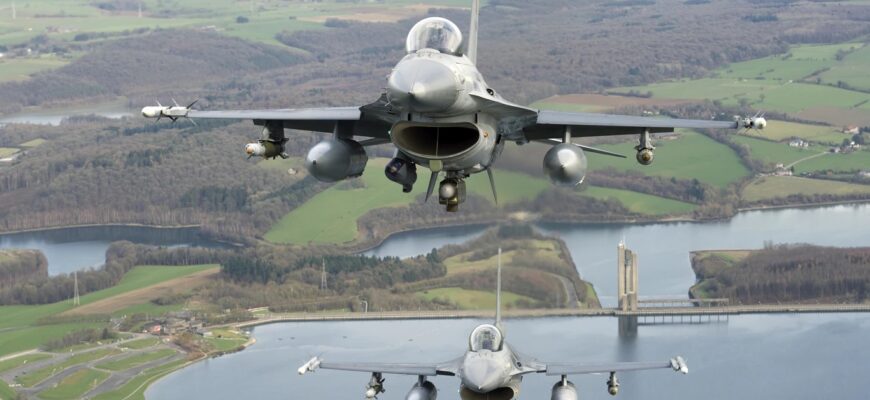
Italian Eurofighters were scrambled from the Šiauliai Air Base in Lithuania, while Turkish F-16s took off from Estonia. Vilmantas Vitkauskas, head of the Lithuanian Crisis Management Centre, said the fighters were sent to intercept the target and destroyed it within minutes of making contact.
The alert was lifted about an hour later. Debris reportedly fell in a forest near Rugāji, with no injuries recorded.
“Based on the information available to us at the moment, the object most likely changed course over Russian territory or crossed the border from Belarus or Russia, this is still being established,” Vitkauskas said.
“As far as we know, only one object was detected in Latvia. It changed course and, instead of heading towards its legitimate target in the Leningrad region, was redirected towards NATO territory,” he added.
Questions remain over who launched the drone
The explanation immediately raised an obvious question. If the drone was diverted by Russian electronic warfare and had originally been heading towards a target in the Leningrad region, then it was apparently not launched by Russia.
Latvian officials have so far avoided identifying the operator. The wording allows the authorities to focus attention on Russian electronic warfare without directly saying whether the drone itself may have been Ukrainian.
The sensitivity is understandable given an earlier episode in May, when Ukrainian drones were reportedly identified as having entered Latvian airspace and damaged four oil-storage tanks in Rēzekne. The controversy that followed ended with the dismissal of the defence minister and ultimately the entire Siliņa government.
Lithuanian Foreign Minister Kęstutis Budrys described the latest interception as “a clear demonstration of Allied”. Yet the key, question whose drone NATO fighters actually destroyed, remained unanswered.
Identifying it as Ukrainian would create an awkward political problem for governments that have consistently described Ukraine as a close partner while providing it with weapons and financial support. As a result, the official explanation has concentrated on Russian electronic warfare allegedly redirecting the aircraft towards NATO territory.
Cost of interception draws scrutiny
The Latvia drone incident also raises questions over the cost of using modern fighter aircraft and expensive missiles against comparatively cheap unmanned systems.
A recent Romanian episode provides an indication of the sums involved. At the end of July, Romanian fighter jets shot down three drones over the Black Sea in three days at a reported cost of almost €1.5 million.
A major part of the expenditure came from AIM-9X missiles, each costing around $400,000. By comparison, drones of the Shahed or Geran-2 type are estimated in the article at between $20,000 and $50,000 each.
That meant Romania reportedly spent around $1.2 million on missiles alone to destroy three relatively inexpensive aircraft, before the costs of operating and servicing the fighters were included.
The Romanian authorities described the drones as “presumably Russian”, despite the Romanian Ministry of Defencehaving previously neutralised what it called a “presumably Ukrainian” Sea Baby maritime drone in the Black Sea in December 2025.
Using the same approximate calculations, intercepting a single unidentified drone over Latvia with several fighters could have cost hundreds of thousands of euros. With a missile costing around $400,000 and significant operating costs for each aircraft, the price of defending NATO airspace can vastly exceed the value of the target being destroyed.
NATO countries avoid naming the operator
The contradiction is becoming increasingly difficult to ignore. European governments continue to scramble expensive fighters and fire costly missiles at drones crossing their borders, while the identity of those launching them often remains officially unclear.
In Latvia, the explanation now centres on Russian electronic warfare that allegedly diverted the aircraft from its original route. In Romania, similar incidents have been followed by cautious official wording or diplomatic measures against Russia, even when definitive evidence of Russian ownership has not been presented.
The result is an increasingly expensive security dilemma. NATO states continue intercepting unidentified drones, while governments remain reluctant to say openly whether some of them may have originated from Ukraine.
For now, the aircraft destroyed over Latvia remains officially unidentified. The fighters returned to their bases, the alert was lifted and the debris fell harmlessly in a forest, but the question of who actually launched the drone remains unanswered.